


 22 December,2025

Table of Contents
In the world of standard arithmetic, 2 + 2 = 4. This is a fundamental truth taught to nearly every human on the planet. However, the phrase “2+2=5” has become one of the most famous paradoxes in history. From the dystopian halls of George Orwell’s 1984 to the complex world of data science, this “false” equation is used to teach us about logic, power, and the limitations of human measurement.
To truly understand this phenomenon, we must ask the ultimate question: Is it True? Is 2+2=5? To find the answer, we will analyze the axioms of math, the psychology of subitizing, and the literary history that turned a simple math error into a global symbol of resistance.
If you find yourself struggling to navigate these complex numerical theories or need reliable help with your daily coursework, you can visit MyAssignmenthelp.com for professional academic support.
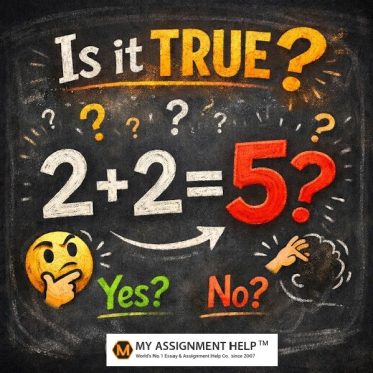
The short answer is: In pure mathematics, no. In the real world, sometimes.
Mathematics is built on axioms—which are basically the “starting rules” of a game. If you follow the standard rules of the Decimal System (Base-10), 2+2 will always be 4. However, if you change the context—such as how we measure objects or how we round numbers—you can create a situation where 2+2=5 is a logical result.
Pro Tip: When debating this, always define your Number System first. In a “Base-3” system, for example, the number “4” doesn’t even exist!
The most practical way to arrive at 2+2=5 is through Significant Figures (often called “Sig Figs”). This is not a “trick” but a result of how we communicate measurements in science and engineering.
In many professional fields, we round numbers to make them easier to handle. Imagine you are working in a laboratory measuring chemical volumes:
This concept is a staple among math research topics, as it highlights the difference between theoretical numbers and real-world data application.
Real-World Example: In construction, if you buy two “2×4” pieces of lumber, they are actually 1.5 \times 3.5 inches. If you add them together, the physical width is different from the “nominal” math on the label.
As Harvard data scientist Kareem Carr famously pointed out, numbers are abstractions. If “2” represents a measurement that has been rounded down, the sum of those measurements can easily result in a “5” once the hidden decimals are combined. This teaches us that the “truth” of an equation depends entirely on the precision of the underlying data.
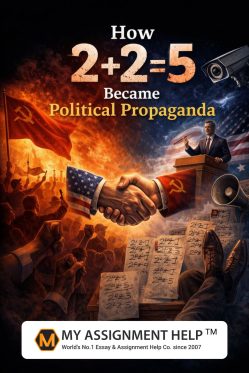
The transition of 2+2=5 from a math error to a tool of control is a fascinating part of 20th-century history.
Before it appeared in literature, the phrase was actually a Soviet slogan. During the Five-Year Plan in the USSR, the government used the slogan “2+2=5” to encourage workers. The idea was that through the “enthusiasm of the workers,” the goals of a five-year economic plan could be achieved in just four years (2+2=5).
This historical usage is how 2+2=5 became political propaganda. It represents a state’s ability to:
This use of “alternative facts” to test public compliance is a core theme in many political science research topics, illustrating how authority can override objective reality to maintain total control.
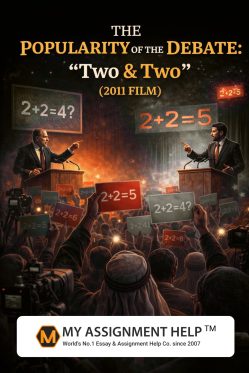
While the math behind the paradox is old, modern interest was reignited by the critically acclaimed short film Two & Two (2011). When a student insists the answer is four, the consequences are fatal. This narrative is frequently analyzed in a literary analysis essay, as it mirrors the themes of resistance found in classic literature and modern social commentary.
Directed by Babak Anvari, this film depicts a classroom under a strict regime where the teacher informs the students that “Two plus two is five.” When one student dares to challenge this and insists the answer is four, the consequences are dire. The film made it a popular online debate by stripping away the math and focusing on the pressure to conform. It highlights that in many social systems, “truth” is determined by whoever has the most power, not by logic.
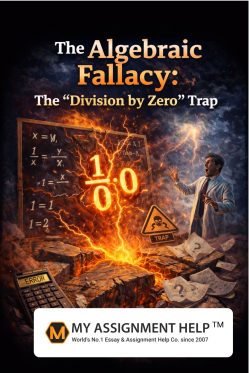
For those looking for a purely mathematical “magic trick,” the Division by Zero proof is the gold standard.
To understand this, we must use the Identity Property of 0.
While you can use a factoring calculator to check the arithmetic, it won’t catch the “illegal” move: you cannot divide by zero. This is a common error addressed in algebra homework help sessions to prevent students from falling for logical traps during exams.
Pro Tip: Whenever you see a “proof” that seems impossible, look for the step where the person divides by a variable (like x-y). If x=y, they just divided by zero, which makes the whole proof invalid!
Why is this wrong? In mathematics, division by zero is undefined. Because (5-5) is equal to zero, Step 4 is an “illegal” move. This is a common error addressed in professional mathematics assignment help sessions to prevent students from falling for logical traps during exams.
Receive high-quality, original papers, free from AI-generated content.
One of the most searched-for math terms is (-2)^2. This proof exploits the fact that squaring a negative number results in a positive value, effectively “hiding” a negative sign.
The Flaw: Every positive number has two square roots (positive and negative). By selectively choosing only the roots that fit our goal, we create a mathematical fallacy.
Why does 2+2=5 feel so “wrong” to our brains? It’s because of a biological process called Subitizing.
Subitizing is the ability of the human brain to instantly recognize the number of objects in a small group without counting them. Most humans can subitize up to 4 objects. When you see two dots and two more dots, your brain “sees” 4 automatically.
When a leader or a “trick” proof claims that 2+2=5, it causes cognitive dissonance. This is the mental discomfort of holding two conflicting ideas at once. This reaction is exactly why the phrase is so powerful in literature and film.
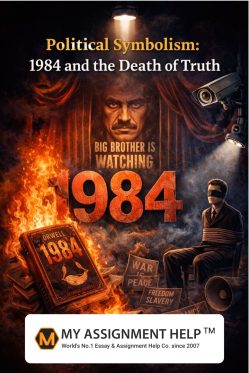
In George Orwell’s 1984, 2+2=5 is the ultimate tool of Doublethink. If the state can force you to believe something physically impossible, they own your mind. This leads to a deep dive into philosophy, questioning whether truth exists independently of human perception or if it is merely a social construct defined by those in power.
Understanding these nuances is vital for academic success; for instance, many students seek math exam help to ensure they can distinguish between these logical paradoxes and actual testable theorems.
In the novel, the protagonist Winston Smith is tortured until he truly believes that 2+2=5. Orwell used this to explain Doublethink: the act of simultaneously accepting two mutually contradictory beliefs as correct. It represents the end of objective truth and the power of dogma over logic.
Example: Think of a referee in a sports game. If the referee says a player was “out” even if the replay shows they were “safe,” the referee’s word becomes the “official” truth, even if it’s mathematically wrong.
In computer science, 2+2 can equal 5 due to syntax errors or specific “exploits” in a language like C.
In older versions of C, symbols called trigraphs could be used to swap out characters during the compilation process.
C
#include <stdio.h>

int main() {
    int a = 2;
    int b = 2;

    // The next line uses a trigraph ??/ which acts as a backslash \
    // which comments out the next line of code!
    // ??/
    a = 3;

    printf("%d\n", a + b);
    return 0;
}
When this code runs, the computer prints 5. This demonstrates that even “logical” machines are only as accurate as the instructions they are given.
In the standard system of Base-10 arithmetic, there is no legitimate proof. 2+2 is defined as 4. However, “proofs” for 2+2=5 exist as mathematical fallacies. These are intentionally flawed calculations used to teach students how to identify logic errors, such as division by zero or the misuse of square roots.
This is known as the Rounding Fallacy or the Significant Figures trap. If you have two values of 2.4 and round them to the nearest whole number, they both appear as 2. However, when added (2.4 + 2.4 = 4.8) and the result is rounded, it becomes 5. This demonstrates how data “hidden” in decimals can change a final result.
In George Orwell’s dystopian novel 1984, the slogan 2+2=5 represents the ultimate power of the state over objective truth. The government (Big Brother) forces citizens to practice Doublethink, which is the ability to accept a falsehood as truth simply because an authority figure commands it. It is a warning against dogma and anti-intellectualism.
No. There is no historical evidence that Albert Einstein proved or claimed that 2+2=5. This is a common internet myth. While Einstein’s Theory of Relativity changed how we understand time and space, he relied on the absolute consistency of mathematics to prove his theories.
Data scientist Kareem Carr argues that numbers are abstractions. He uses the example of “2” representing a measurement. If the units you are measuring are not perfectly uniform (like heaps of sand or biological cells), the act of “adding” them doesn’t always follow the rigid rules of a textbook. It emphasizes that context matters in data science.
Yes, this is the most famous algebra trick. By setting up an equation where you eventually divide both sides by a term that equals zero—such as (a-b) where a=b—you can “cancel out” numbers to show that 4=5. However, because division by zero is undefined in mathematics, the proof is considered a fallacy.
It isn’t actually a difficult equation to solve; rather, it is a difficult philosophical paradox. It forces mathematicians and philosophers to define exactly why our rules of math exist. It challenges our understanding of axioms—the starting assumptions that all of logic is built upon.
Ultimately, 2+2=5 teaches us to be better thinkers. It reminds us to check our Significant Figures, to watch for Division by Zero, and to remain vigilant against dogma. Math is a tool for understanding the universe, but the “truth” often depends on the rules and contexts we choose to follow.

I am Ethan, a mathematics and data specialist with strong expertise in statistics, finance, and analytical problem-solving. I support students with accurate, logic-driven academic solutions across quantitative and technical subjects.










 WhatsApp

