


 13 January,2026

Table of Contents
If you’re part of Gen Z, you’ve probably used AI today without even noticing it. From movie recommendations to resume screening and chat assistants, AI is already part of daily life. By 2026, AI skills won’t just be a bonus; they’ll be a basic requirement.
One of the primary concerns is that AI will replace human jobs or human input will be eliminated. However, the reality is that the reverse is becoming a reality: AI is transforming workplaces instead of removing them.
For Gen Z, this is a moment of opportunity. Those who understand AI and learn how to work alongside it will find themselves better positioned than ever before. This blog focuses on the impact of AI skills and how students can develop these skills without harming their academics, and even be empowered with the latest technologies that would help them fetch better career opportunities in 2026
AI skills are the ability to understand, use, and work with artificial intelligence tools in daily tasks. These skills help students learn faster, solve problems better, and stay ready for future jobs. As AI becomes common in every industry, having these skills gives students a strong career advantage.
How AI skills help students:
Read More: Rethinking Drinking: Understanding the Student Reality
On a deep level, AI competencies can be divided into three major areas:
This involves awareness of:
Although one need not have an in-depth technical expertise, a good understanding of these fundamentals enables a person to make a sound decision.
This is the most common form of AI skill today. It includes:
These skills are highly applicable and can be used instantly because most of the modern tools already have AI functionalities.
This is where AI skills become truly valuable. It means:
This skill sets high-performing professionals apart from average users. Students, whether studying online or offline, need strong AI skills for better career opportunities. However, managing multiple courses can feel overwhelming with limited time. In such cases, some students consider options such as pay someone to take my online class for me through reliable online class help services to stay on track while balancing academic and personal responsibilities.
Students must understand that future job opportunities will heavily depend on AI skills. To stay competitive, they should start early and build relevant AI abilities alongside their studies. If managing AI learning with regular coursework feels overwhelming, students can rely on trusted online assignment help platforms to handle tasks like assignments, quizzes, and exam preparation, giving them more time to focus on developing in-demand AI skills.
It is still under the false indications that AI knowledge involves intensive programming or mathematics. These capabilities will be worthwhile in niche positions, but most employers who will focus on the 2026 job market will look for practical competency in AI as opposed to theoretical prowess.
This will require them to ask candidates to understand the role of AI in decision-making, to understand how AI tools can be used to enhance productivity, and to question AI outputs as the need arises. The employer requires individuals who are capable of critical thinking, not automation.
In that way, the future of AI skills in the field of employment in 2026 will be based on awareness, flexibility, and usage. An applicant of Generation Z who realises the role AI is playing in the business processes instantly will be seen as contemporary, ready, and able to keep up with the technological changes.
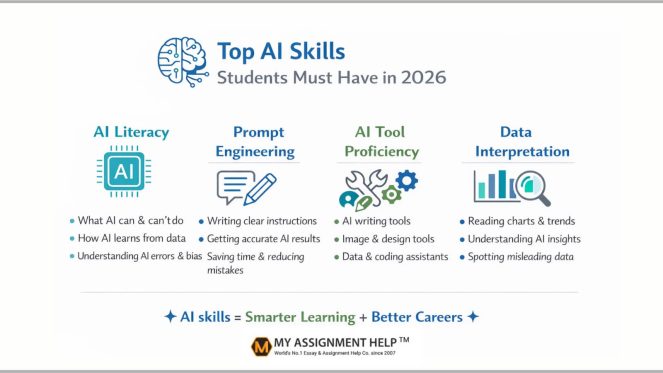
The working environment is changing faster than ever, leading us to a new era of technology. It has become an inseparable part of almost all professional sectors and industries. For students going to the workforce, being proficient in the use of AI and capable of utilising AI tools will make the difference between failure and success.
Here’s a detailed, student-friendly list of the top AI skills you should focus on by 2026, and why each one matters.
This is the foundational skill every student needs. It’s not about coding yet; it’s about grasping the basics of AI.
Key points include:
Having a proper understanding of artificial intelligence will help students to effortlessly deal with upcoming challenges and stay ahead of the competition.
This capability is the ability to write specific prompts to AI platforms (ChatGPT, Midjourney, Jasper, Bard, and others) in order to obtain the required results.
Effective prompts:
Example: Instead of saying “Write a paragraph,” a good prompt would be:
“Write a 200-word paragraph explaining AI literacy for high school students, in a casual tone.”
This is one of the most in-demand skills already. People who write great prompts complete tasks faster, get better outputs, and make AI tools far more useful.
Knowing how to use AI tools effectively, not just hearing about them.
Tools that are suggested to be studied by the students:
Every field, from design to journalism, finance to human resources, is using AI tools. Students who can operate these tools will be ready to hit the ground running.
Learning how to interpret data, read trends, and understand what information means, not just where it comes from.
Skills within this area:
These skills strengthen critical thinking and help you approach subjects like chemistry and physics more efficiently. Having strong analytical and problem-solving abilities ensures that you do not feel lost when situations become challenging or unpredictable. And if you ever need external support with your online courses, you can simply reach out to trusted online platforms and ask, Can you take my chemistry class for me, instead of feeling overwhelmed or stuck.
The world is getting increasingly competitive, more so among fresh graduates. Educational qualifications, certificates, degrees, and test scores seem to look similar on paper. The relevance of their skills is what is currently making a difference among candidates.
AI skills generate a physical distinction. A Gen Z applicant will be significantly more desirable to an employer when they can interact with AI tools, process AI outputs, and implement technology to address actual problems. Recruiters consider them as low-risk recruiters who can adjust and work faster.
What is more important, AI competencies transform the perception of thinking and communication of Generation Z. They get to practice how to take challenges logically, use data-driven arguments and explain them with confidence. This change is reflected in interviews and evaluations, giving them an obvious competitive advantage.
As AI continues to evolve, certain skills will become especially valuable. These future AI skills Gen Z must learn are not about predicting technology perfectly, but about developing the right mindset.
Key competencies include:
Learning AI skills is not really about technology. It is about how you think. It means working smarter, learning continuously, and making better decisions. AI is not a threat. It is a helpful partner.
Students who understand this will grow faster in their careers by 2026. Those who avoid AI may struggle. Smart learners will move ahead.
For Gen Z, the message is clear. AI skills are no longer optional. They connect education with real jobs. They turn potential into performance.
You do not need to compete with machines. You only need to learn how to work with them and build a stronger career together.
Yes. By 2030, using AI will be necessary and not optional. The majority of industries will require employees to learn how to operate AI-driven tools in their everyday life.
Absolutely. Degrees and certificates may be similar, but AI talents separate the applicants. Gen Z that are comfortable using AI tools, interpreting data, and solving actual challenges using AI are perceived to be more occupational, flexible, and future-oriented, which puts them at a great advantage compared to others.

I am an experienced class-help specialist supporting students across all subjects. I assist with online classes, coursework, and exam preparation, delivering structured academic guidance, reliable subject coverage, and consistent support to help students succeed confidently.










 WhatsApp

