


 19 March,2026

Table of Contents
E-Learning or digital learning is one of the growing fields in today’s educational landscape. This particular field has the potential to solve most of the words education related problems as it supports flexibility and accessibility from remote locations. Students from every corner of the world can use this learning mode to gain the desired expertise in their preferred field of study. This is one of the prime reasons behind the popularity of E learning. With the changing learning preferences and habits, students nowadays are more inclined towards getting education from digitalised sources. But it doesn’t mean it replaces the idea of traditional or offline learning. Both the learning models are designed to serve their specific purpose and help students get an education as per their preferences.
If you are a student confused about which mode of learning to choose after high school, this blog by MyAssignmentHelp will help you understand the key differences between e-learning and traditional learning, along with their advantages and limitations. By the end, you will be able to make an informed decision based on your learning style, goals, and lifestyle.
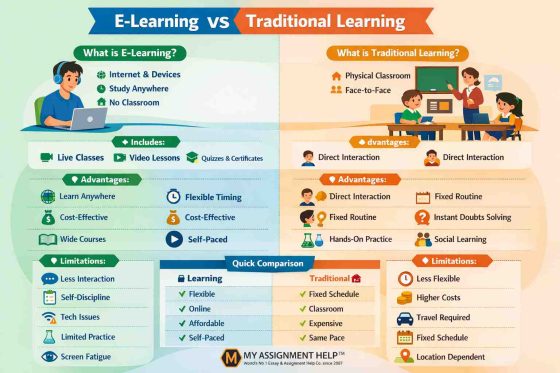
E-Learning is a way of learning that uses computers and the internet to teach people. I this mode of learning, students do not have to go to a classroom. They can learn from home or anywhere else with a computer and the internet.
E-learning includes different formats such as:
Many schools, universities and companies use E-Learning for teaching and training purposes. It helps students and employees learn and upskill through opportunities with experts from all around the world without having to relocate.
Example: A student in the UK can take a class from Harvard University by enrolling in its online course. He can also get academic help with the same course when overwhelmed and wondering, how can I pay someone to do my online class for me? This digitalised mode of learning not only smooths his academic journey but also promote healthy learning environment
E-Learning is getting immense popularity amongst learners due to its ease of accessibility, affordability, and effectiveness. Here are some benefits of E-Learning:
Flexibility is one of the biggest USPs of online learning as it allows students to learn from every corner of the world at any instance of time. This is particularly highly beneficial for working employees and for those who want to continue their education, but can’t pursue full-time offline degrees.
Online learning only requires an internet connection and a compatible device. With these things you can continue learning from any corner of the world without any geographical boundaries.
E-learning reduces expenses like travelling and accommodation. This makes it an affordable alternative to full-time learning. Some educational portals also offer free courses, making learning accessible to all.
With E learning, students can access thousands of AI courses along with technology, business, healthcare, for their desired career options.
Digital learning allows students to study at their own pace. They can take a break, replay lessons and go over lessons, which enhances learning and may help to retain better.
AI and analytics are implemented on numerous platforms to suggest courses and track the progress, which makes the process of learning individualised.
Despite all the benefits, E-learning is also associated with some challenges.
Students might feel alone since there is not much direct interaction with teachers and peers.
Lack of a well-organised setting may encourage procrastination among students or demotivate them.
Learning may be interrupted due to poor internet connectivity, failure of devices or software glitches.
The use of subjects that require practical work, like medicine or engineering, might be ineffective over the internet.
Spending many hours in front of the screens may lead to eye-related problems, headaches, and a lack of concentration.
Traditional learning is the conventional one which takes place in a physical classroom setting. In this mode of learning, students go to schools, colleges or universities and interact directly with teachers and colleagues
The approach has a systematic approach which incorporates:
It has been the most common form of education for centuries and is still widely used across the world.
Example: Students attending school daily, sitting in classrooms, and learning from a teacher in person.
Traditional learning still holds significant value and comes with some major benefits:
Students can engage teachers physically, which enhances comprehension and relationships.
A scheduled timetable makes the students regular and study-oriented.
The students are able to pose questions directly to the instructor and get an explanation directly.
In traditional learning, real-world experience is provided through laboratories, workshops and hands-on.
Classroom interaction enables students to acquire communication skills, teamwork and friendships.
The organised setup helps students follow a proper learning path without distractions.
While effective, traditional learning also has some drawbacks:
Students need to follow set standards of learning schedules, which might not apply to all.
Communication at work and prolonged hourly classes may be exhausting and lower productivity.
Expenses like transportation, accommodation, books, and campus fees can be high.
Students are restricted to the courses offered by their institution.
Teachers usually follow a standard pace, which may be too fast for some students and too slow for others.
Students must be physically present to attend classes, which can be difficult for those who have to travel long distances on a regular basis.
Although both learning modes serve similar purposes, they differ in several ways, as outlined below.
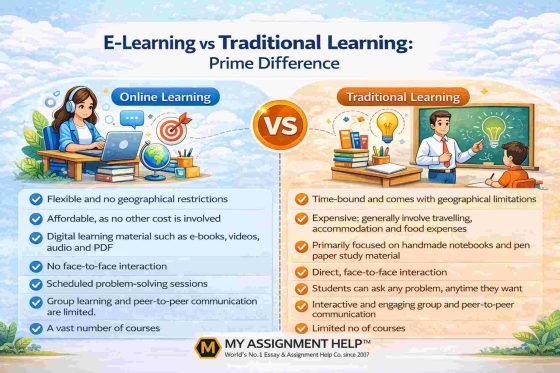
Deciding which form of learning is best for students is not as simple as it seems. It does not have a universal solution, as the most appropriate kind of education is based on the needs of a student, his or her goals and learning style.
Online education is effective when the students:
Example: A working professional pursuing an online certification can study at their own pace without leaving their job.
Traditional education is recommended when
Conventional learning suits well with students who:
Desire to develop social and interpersonal skills.
Example: A medical or engineering student often needs physical labs and real-time guidance, making traditional education more effective.
Choosing any learning mode depends on one’s own preferences. However, blended learning, which is a combination of online and traditional, is the best approach for most students. It provides the convenience of web-based learning as well as the benefits of real-life classroom learning.
E-learning is no longer an alternative to classroom learning; it has become the keystone of the modern-day education system. By 2026 and beyond, digital education will be smarter, much more personalised, and closer to everyday life.
E-learning will not replace conventional education completely, but it will become a leading mode of digital literacy.
By the year 2026, AI will be your personal tutor, it will track your progress and areas of weakness, and suggest lessons and quizzes specific to you.
Future impact:
The process of learning will become more realistic and interactive through the latest technologies. Some of the major advancements will be seen through visual learning options such as AR-based medical education and virtual field trips.
Technologies like VR (Virtual Reality) and AR (Augmented Reality) create immersive classrooms, improving engagement and practical understanding
Example:
By 2030, it is expected that learners will be studying using mobile devices.
Positive Impact: Even in the rural and remote regions, education will be available.
Example: Online education is already expanding to rural students via digital efforts in India.
Learning becomes more interactive with gamification, which is based on quizzes, badges, rewards, leaderboards, competitions, and interactive simulations.
The future of learning will be centred on skills-based certifications, industry-specific courses, and new areas of emerging technologies, including AI skills, data science, and digital skills.
Colleges are already increasing AI and technology-oriented courses in all fields in order to equip students with a good skill set in the future.
Nevertheless, e-learning has its own weaknesses: it lacks human interaction, there are problems with self-discipline, Digital divide (internet access gaps), and quality and credibility issues. Approximately 18 -24% of students are still concerned about engagement and quality in remote learning.
The future will not be a totally online one, but it will be a blended learning one. It will be an integration of both online and classroom. Adaptable learning models will come up. Universities that go online, however, do not completely go offline but maintain some face time to enhance interaction.
E-Learning, online learning, or digital learning, they are all the same term serving the same purpose. The purpose of making education accessible to all through digital devices from every corner of the world. Post Covid, this trend of learning gained immense popularity among students and working professionals and started a debate on Online Education vs Traditional Education.
Online learning holds the same significance and potential as traditional learning options. So students can choose any of the options as per their preferences and get the desired learning opportunity.
Moving forward, e-learning is also going to improve, with the help of AI, immersive technologies, and skill-based learning. It will not completely displace traditional education, but it will remain an influential and important part of the modern education system.
It is the combination of online and offline learning, where students have options to learn in any of their preferred learning mode when ever they want.
If you are looking for ease of learning and flexibility, then choosing the online mode of learning would be the best option for you.
Yes, online learning is as good as offline and holds the same significance for future prospects and opportunities.
Yes, both the learning modules are the same and offer a digitalised form of learning opportunity where students can learn using their smart devices.
Hybrid learning is growing because of the advantages it carries from both online and offline learning modules. Students get better exposure and learning opportunities while experiencing the flexibility of online learning, along with the structure and discipline of traditional classroom education.
Yes, it is a completely safe and effective learning option that ensures the same academic excellence while breaking geographical barriers.
Yes, both online degrees are as good as offline. All you need to get it from reliable and trusted sources.

I am an experienced class-help specialist supporting students across all subjects. I assist with online classes, coursework, and exam preparation, delivering structured academic guidance, reliable subject coverage, and consistent support to help students succeed confidently.










 WhatsApp

