


 29 June,2026

Table of Contents
I have been there myself more times than I care to admit. It is 10:00 PM on a Sunday night. Your desk lamp is the only light on in your entire room, casting long shadows across your workspace.
Your final term paper is due at 8:00 AM tomorrow morning, and your Google Doc or Microsoft Word screen is completely blank. Your heart is beating fast, you feel a heavy knot of anxiety in your stomach, and you are running out of time on your assignment.
When you look at that blinking cursor, a wave of panic sets in. You might feel incredibly tempted to open up a generative AI tool, type in a quick prompt, and copy-paste whatever generic text it spits out.
Do not do it.
In 2026, high school senior teachers and college professors across the United States use advanced institutional detection systems such as Turnitin’s latest authorship algorithms, GPTZero integrations, and Canvas/Brightspace validation engines that spot synthetic AI fluff in seconds.
Even worse, generic public AI models love to invent historical facts, hallucinate academic citations out of thin air, and write in repetitive, predictable loops that instantly ruin your final grade. If your paper looks like machine-generated filler, it will not pass a human evaluation rubric.
I am going to show you exactly how I finish a 2,000-word essay overnight while keeping my writing 100% human, highly structured, deeply analytical, and worthy of an A grade. This is my personal fast-track essay writing process for pure survival when you need last-minute essay help. Let us dive right into the strategy.
Before you start typing blindly on your keyboard, you need a realistic, mathematical view of how long this process actually takes.
In the US higher education system, a standard 2,000-word research paper or college essay writing spans roughly 4 pages single-spaced or 8 pages double-spaced when using standard 12-point Times New Roman font with 1-inch margins.
To stay on track throughout the night without burning out by 2:00 AM, I use a specific metrics framework based on average student typing speeds and active cognitive processing. Let us break down what I call my 20 minute word count velocity:
This means that your raw writing time for a 2,000-word assignment tips the scale at roughly 80 to 100 minutes of pure typing. The rest of your night will be spent on research shortcuts, rapid outlining, structural layout, and final proofreading.
When you learn how to write 2000 words in 12 hours or less, your secret weapon is not typing faster. Your real secret weapon is dividing your night into strict milestones so your brain does not freeze up under cognitive fatigue.
Knowing how to write an assignment when you’re tired means knowing when to stop for a moment.
Hour 0.0 – 1.0: Topic Dissection, Thesis Formulation, & Outline Setup
Hour 1.0 – 2.5: Fast-Track Academic Research & Source Gathering
Hour 2.5 – 6.5: Deep Work Drafting Block (Target: 500 words / hour)
Hour 6.5 – 7.5: Editing, Polish, and Academic Style Check (APA/MLA)
Hour 7.5 – 8.0: Final Formatting, Citations, and Plagiarism Pass
By sticking to this structured tracker, you remove the guesswork from your night. You do not have to worry about the massive 2,000-word mountain; you only have to worry about hitting your mini-milestone for the hour.
Time management is key, and our expert tips on how to write a 2000 word essay effectively will help you beat the clock.
To understand the effectiveness of the system and processes behind a strict deadline rubric, you need to know exactly what your professor is grading. Your teacher wants critical thought, clear text, unique style, and reliable verification.
When you use automated shortcuts, your content loses its competitive edge. The table below breaks down the key structural differences between authentic, rapid human writing and low-value AI writing assistance:
| Evaluation Criteria | High-Velocity Human Writing | Synthetic AI Fluff |
|---|---|---|
| Sentence Structure | Varied lengths, human rhythms, spontaneous transitions, conversational but professional tone. | Uniform lengths, highly predictable patterns, robotic transitions (e.g., “Furthermore,” “In conclusion”). |
| Fact Verification | Direct quotes from peer-reviewed sources mapped directly to your arguments. | Vague generalizations, repetitive sentences, and high risk of fake or hallucinated references. |
| Topical Insight | Specific data, historical examples, and deep critical analysis of arguments. | Surface-level summaries that repeat the prompt without adding original thought. |
| Academic Integrity | Clears modern AI detectors and matches your unique student voice. | Flags instantly on campus tools, risking automatic failure or disciplinary action. |
If you want to use the best essay writing tools or essay writing software effectively, utilize them strictly for organizing your ideas, checking your grammar, or formatting your final bibliography page.
Do not let them write the actual text for you. Your unique human voice is what carries your grade, satisfies the grading rubric, and keeps your paper clear of automated academic integrity flags.
The fastest way to write an essay is to build a rock-solid, efficient essay structure for quick writing before you touch a single body paragraph. If you try to write without a layout, you will get stuck staring at your screen, your mind will wander, and writer’s block will win.
I always use this dependable, fast essay outline template to split my 2,000 words into manageable, bite-sized sections:
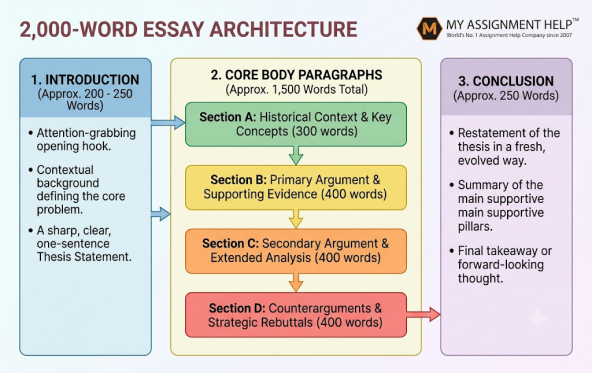
Using this structural architecture ensures you are never writing an open-ended paper. Instead, you are simply filling in small, focused compartments that total up to your target length. If each body section is broken down into two paragraphs of 150–200 words each, the entire writing project becomes a series of simple steps.
When I execute an essay writing process fast track, I follow a strict, non-negotiable phase-by-phase system. This ensures I finish my assignment quickly without panicking or wasting precious midnight hours on low-value details.
Pick your topic and commit to it immediately. Do not change your mind halfway through the night. Write out your thesis statement right away on your digital scratch sheet. Your thesis statement is the anchor of your entire paper; every sentence you write next must support it. If your thesis is weak or wishy-washy, your body paragraphs will wander. Make a clear, arguable claim that answers the prompt directly. Fill out your outline placeholders so you know exactly what each paragraph needs to accomplish before you write it.
This is where you write 2000 words fast. Turn off your phone, close your social media tabs, log out of messaging apps, and put your headphones on. Use a technique I call “Draft Isolation.” Write without stopping to edit your typos, grammar, or spelling.
If you cannot find the perfect word while typing a sentence, do not break your concentration. Simply write [INSERT WORD] or [LOOK UP STAT] and keep moving forward. You can fix minor mistakes later during the editing phase, but right now, your exclusive goal is momentum. Keep your fingers moving across the keys.
Go back through your raw draft to fill in any blanks, fix awkward sentences, and polish your transitions. Ensure that every single paragraph begins with a clear topic sentence and ends with a smooth link to the next concept. Check your overall layout against your teacher’s prompt requirements to guarantee you have not accidentally left out a required question or argument.
When you are writing an essay under deadline, you do not have time to read entire library books or lengthy journal papers. You need highly effective research shortcuts for essays to find premium sources in minutes. Here is my personal step-by-step strategy for quick research essay writing:
When you are running out of time on an assignment, panic causes mental blocks. If you find yourself staring blankly at your document, use these psychological procrastination essay writing solutions to reset your focus and lower your stress levels:
To help you work faster and smarter, I have gathered my favorite last minute essay writing tips and quick essay writing strategies into an actionable checklist:
If you are dealing with a much larger project—such as trying to complete a dissertation in 24 hours or a massive capstone term paper—the stakes are much higher. While you cannot write a whole dissertation overnight, you can use these strategies to submit a major milestone or final draft under a tight deadline:
Get expert support, track results and non AI content
You can write an essay much faster by separating your research phase from your active writing phase, using a structured outline template, and writing your draft continuously without stopping to edit errors until your text is fully complete. This approach preserves your natural human cadence, prevents writer’s block, and avoids generating synthetic fluff patterns that flag automated institutional filters.
The most efficient framework is a classic multi-tiered structure consisting of a brief introduction containing a clear thesis statement, distinct body paragraphs focused on evidence and counterarguments, and a concise conclusion that wraps up your key points. Splitting a 2,000-word requirement into small, distinct paragraph blocks makes the process highly predictable and easy to manage under a deadline.
To beat writer’s block instantly on a tight deadline, apply the 5-minute writing rule to break your initial anxiety, practice the Pomodoro technique to maintain focus, and skip your introduction entirely so you can build your core body paragraphs first. This strategy builds momentum and lets your ideas flow naturally onto the page without friction.

I am an English literature specialist with experience in critical analysis and academic writing. I support students with well-researched essays and literature-based academic assignments.










 WhatsApp

