


 15 December,2025

Table of Contents
Stress among students is one of the most debated issues in the education field today. How students think and feel is an impact of test pressure, online classes, part-time jobs, social comparison, and endless digital notifications.
What many people are not aware of is that stress is not just emotional. It’s a biochemical process that alters the way the brain and body work.
This blog offers a deep, science-based dive into why students feel stressed, how that stress affects their memory and performance, and what evidence-based behaviors can help them bounce back.
The aim is to describe the chemistry of student stress in clear, simple terms without sacrificing scientific accuracy. No drama. No fear. Just facts students can use.
Stress about chemistry class is the cascade of chemicals the body releases when it feels pressure. These signals include hormones and neurotransmitters that affect energy, focus, emotion, and learning.
The primary chemicals that are involved are:
Under normal circumstances, these substances help students concentrate and stay awake. When the stress turns into never-ending exams, long online classes, and constant assignments. They transition to a non-equilibrium. That imbalance is what creates the physical and mental strain that students complain about.
Stress in education is nothing new and has been around for decades, but the environment today is not the same. A few things are pressuring students more than in the past:
Students bounce between LMS portals, online assessments, video lectures, and group chats. This coming-and-going exhausts the mind.
Many students balance:
Everything is hard to manage without stress.
Entrance exams, high scores, and a strict grading scale just increase the cortisol level.
The students are worried whether their degree will give them a stable job.
Online learning adds another level of stress. Students even try to find answers to questions such as Pay someone to take my online class for me. It just shows how they feel overwhelmed.
Student grades, internships, and lifestyle updates are constantly being compared online. These elements now trigger the stress response to a much greater extent than the older systems of education ever did.
Knowing what the chemistry of stress looks like allows students to understand what is happening inside their bodies. Here’s how each one of those chemicals behaves under the stress of school:
1. Cortisol: The Main Academic Stress Signal
When pressure is felt by the brain, cortisol is secreted by the adrenal glands. Students have this during:
A little cortisol is good when you need to focus. But an excessive amount causes:
If students are always feeling behind, their cortisol levels increase and stay high. It’s early-stage chronic stress.
2. Adrenaline: The Deadline Boost
The adrenaline rises when students have to respond quickly to quizzes, deadlines, and last-minute notifications. It is getting stronger:
However, repeated spikes can cause:
Students may feel as though they ‘work better under pressure,’ but it is a trade-off.
3. Dopamine: The Motivation Chemical
Dopamine makes students enjoy making progress. It increases when they:
However, chronic stress reduces dopamine, which results in:
This is one explanation for why students spend hours scrolling instead of studying. They were trying to stimulate dopamine.
4. Serotonin: The Mood Stabilizer
Serotonin is also known to promote mood stability. When the strain of intellectual work did not abate:
Low serotonin and high cortisol levels can trigger a stress loop.
5. Noradrenaline: The Attention Chemical
Concentration and speed of response are enhanced by noradrenaline. But under the pressure of high tension, it is disorganized, with the following results:
It’s a deterrent to productivity, long hours of student studying notwithstanding.
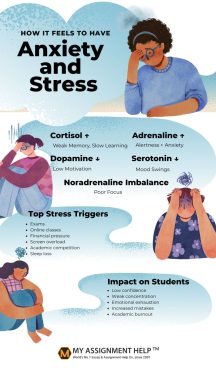
There is virtually no aspect of a student’s academic life that is not touched by stress.
Suspended levels of high cortisol prevent the hippocampus from encoding new information, which is why students:
The prefrontal cortex buckles under stress. Students may:
Stress interferes with the brain’s ability to assimilate new information. Once simple topics now seem perplexing.
When their performance suffers, students blame themselves, rather than knowing they’re experiencing a chemical imbalance.
Many students lie in bed at night ruminating on exams or assignments that are due. In addition, insufficient sleep causes even more cortisol.
Burnout is a response that affects the whole body, including:
Burnout doesn’t occur all of a sudden. It is the endpoint of chronic stress. Chemistry homework is an overload.
Online classes altered the way students study. While flexible, they also produce a distinct set of stress triggers:
1 Burning your eyes on a screen for hours is tiring.
2 Notifications break your flow when studying.
3. The deadlines seem so abrupt
4. Anxiety over technical glitches.
5 Students feel isolated .
6. Challenging subjects seem even more bewildering without live assistance.
Hence, students on occasion were observed to browse educational forums like MyAssignmentHelp for clarification or for getting an outline to follow. It indicates that students are seeking assistance with managing their workloads, rather than easy shortcuts.
Online learning stress chemistry is the same as real-life stress chemistry, just faster.
Continuous performance is demanded in many subjects. So many tests in such a short period of time are a strain on the nervous system.
Non-stop study drains the brain of neurotransmitters.
Noise, distractions, and clutter are all linked to higher levels of stress hormones.
Education-for-ownership students endure long-term cortisol elevation.
The pressure to perform can take precedence over mental health.
If students are given the vaguest hint at what’s expected of them, their adrenaline is already rising.
Seeing other people succeed online creates unseen pressure to do better.
These strategies are supported by cognitive science , and they help the chemicals within your brain to stabilize.
1. Break Tasks Into Smaller Segments
Finishing mini-tasks stimulates your dopamine and makes you feel less overwhelmed. Example: Instead of “finish the chapter,” break it into:
2. Follow the 45–15 Study Cycle
Work hard for 45 minutes, take a rest for 15. It stabilizes cortisol and keeps you from burning out.
3. Build a Sleep Routine
Sleeping 7–9 hours restores:
Students retain more when they sleep well.
4. Add Omega-3 and Magnesium-Rich Foods
These nutrients promote stress recovery and the balancing of brain chemistry.
Some helpful options:
5. Exercise 20–30 Minutes a Day
Exercise cuts down on cortisol production and ramps up the hormones dopamine and serotonin. Even simple movement , walking, stretching, and light cardio can help.
6. Reduce Digital Overload
Schedule screen-free blocks during the day. It soothes the nervous system.
7. Get Academic Help When Needed
Students have greater success when they ask for help early. This may include:
(Insert your site’s branded and class-page interlinks here.)
8. Use Relaxation Tools That Actually Work
Studies have demonstrated that the following habits promote biochemical homeostasis:
9. Create Predictable Routines
The brain better handles the predictable. Students feel more at ease when schedules do not change.
10. Limit Caffeine Intake Late in the Day
Caffeine is a stimulant that causes the release of adrenaline. Excessive amounts may disrupt sleep and contribute to stress.
Education systems may assist students by:
1. Delivering clear instructions
2. Refraining from unnecessary last-minute communications
3. Establishing workable deadlines
4. Offering guidance, not pressure
5. Allowing for optional assistance sessions
6. Alleviating exam stress
A healthy climate inspires students to learn and teachers to teach.
Students may choose to seek assistance whether if they have encountered:
Assistance is not a stumbling block. It is a bolstering agent for the academy.
Expert tutors help you tackle tough topics, manage workload, and stay focused—stress-free.
The stress response is not the same for all students. The biochemistry of stress varies with personality, environment, and study habits. Knowing this allows teachers and parents to more effectively help students, rather than blame them for having trouble.
These are the students who drive themselves unrelentingly. They are stuck in “performance mode,” with high levels of cortisol for weeks on end. They tend to manifest their strain in:
Their stress chemistry makes them burn out more quickly because they never really get off the adrenaline.
Such students have a low dopamine response, so they have trouble focusing. When stress strikes, dopamine drops further, leading to:
1. Learning sessions are harder to initiate
2. Jobs are more burdensome than usual.
3. Minor distractions break the concentration
4. Motivation ends abruptly.
Stress exaggerates problems with attention, not because students are lazy but because their brains are overtaxed.
In the absence of emotional and academic support, students often harbor untreated stress. They are subject to:
Chemically, their stress levels remain high for much longer because there is no one to divide the burden with.
Tech is good and bad. Students use screens to study, revise, and take exams. But that dependency leads to chemical imbalances that few people discuss.
Screens lower melatonin, which impairs sleep quality. Poor sleep → More cortisol → More stress → Weaker memory. This cycling is why many students are exhausted despite a full night of sleep.
Each ping causes a small dopamine spike. But too many spikes cause the brain to become numb to rewards, so students:
This is not a matter of self-control – it’s a dopamine imbalance.
Timed tests, camera monitoring, and surprise quizzes increase adrenaline. During online exams, the brain acts as if it’s under threat.
This triggers:
Again, biology – not a weakness.
Students often ignore food, but it has a direct impact on the chemical makeup of the brain.
These lead to sharp rises and falls in blood sugar, which increases cortisol and decreases concentration.
Balanced nutrition keeps cortisol under control and the brain emotionally balanced.
Exercise is among the most accessible means of managing stress hormones — but students are likely to forego it in favor of homework.
Even small habits, like a 10-minute walk or stretching between classes. Can recalibrate your stress chemistry for several hours.
Students do not experience stress in isolation. Stress chemicals ebb and flow with adults, who are a big influence.
Students are transitioning to the long-term elevation of cortisol. This results in:
Now, the amygdala relaxes and the chemicals of stress subside. Students are safer and smarter.
Anticipation lessens the adrenaline spike because the brain is prepared for what lies ahead.
Helpful approaches:
Both contribute to chemical stability, which brains need to operate at its best.
Occasionally, stress is so overwhelming that it’s impossible to handle alone. Students exhibit symptoms such as:
1. Chronic headaches
2. Severe procrastination
3. There are simple instructions she cannot follow.
4. Emotional numbness in later life
5. No motivation, not even for things they used to enjoy
6. Pre-test panic
7. You feel mentally “stuck.”
Stress chemistry is now already disrupted at this stage. Educational help services like ‘MyAssignmentHelp’ enable students to get a better understanding of the concepts and lessen the cognitive load.
Learners who are having difficulties with online assessments, a heavy workload, or multiple due dates might also seek assistance with:
These tools reduce cognitive load and enable students to heal from chronic stress.
Enduring stress while in school doesn’t just hurt grades; it hurts how students think about long-term goals.
Students also become more reactive to minor problems because the stress pathways are still activated.
The brain adjusts to disorder, and as a result, tranquility and focus feel unnatural.
Stress hormones impair the executive functions, which means students are unable to think outside the confines of short-term difficulties.
Constant pushing without rest teaches students that failure is the default state of affairs. Awareness of stress at an early age keeps these long-term patterns from becoming established.
If chronic stress persists over months or years, students are at risk of:
Realizing that stress chemistry is not meant to cause panic,but to allow for earlier student action.
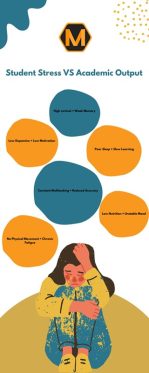
When these factors accumulate, performance suffers even if the students have studied for hours.
Expert support to handle classes and complex topics with ease.
Stress students experience affects everything they do in learning—memory, feelings, concentration, confidence, and incentives. Knowing the science behind it makes stress feel less mysterious and more manageable. When students develop good habits, manage their time well, and get help. When necessary, they guard their brain chemistry and enhance productivity.
Stress is real, but it can be controlled. Using the appropriate tools and the right support, students can develop healthier study habits and achieve greater success in their academic work.

I am an experienced class-help specialist supporting students across all subjects. I assist with online classes, coursework, and exam preparation, delivering structured academic guidance, reliable subject coverage, and consistent support to help students succeed confidently.










 WhatsApp

