


 17 February,2026

Table of Contents
Nowadays, students are often searching for smarter ways to understand and recall information. Traditional reading and listening do not work for everyone. Some students can understand concepts better when they are able to see them rather than just hearing or reading them. That’s where visual learning comes in.
Visual learning is not only about looking at pictures. It’s a structural, powerful approach that takes complex information and transforms it into diagrams, charts, videos and mind maps. If used correctly, it can help improve academic performance to a great extent.
This guide by MyAssignmentHelp will cover:
So, if you are a student and having difficulty learning, switching to this particular form of learning can help you grasp the information more accurately and effectively.
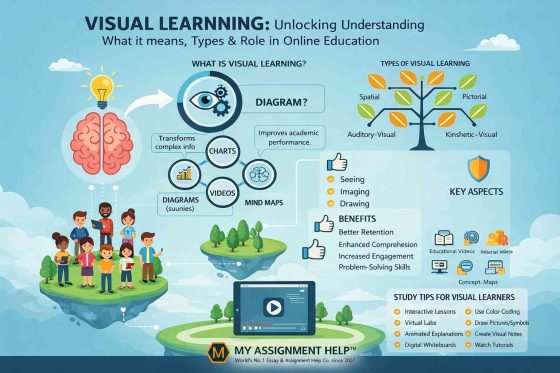
Understanding visual learning is all about using your brain’s memorisation capabilities at the higher extent. Think about the way in which your brain deals with information. Visual learning is a unique learning style where students learn and retain information through images and videos. When the information is presented in a visual format, your mind works differently and helps you store the same info for a longer period of time.
In short, visualising things is easier than learning written inputs
Instead of long paragraphs or lectures, visual learners prefer:
Examples:
Research shows that visual information is thousands of times faster than written words, and this is the reason why visual learning is so effective. The concept of visual learning can easily be seen in online courses where teachers try to teach students complex concepts and ideas with the help of visual learning methods and it works well. This is one of the main reasons behind the popularity of online courses.
The concept is so goated that even online class help services use the same methods to help students overcome the complicated topics and subjective queries when they reach them, asking, can you take my online class for me? The visual learning technique is all about making the learning process simpler and easier to understand for every age group, and promoting healthy learning practices.
There are different types of visual learning methods students can use. Each type serves a specific purpose and works well in different academic situations.
It is one of the most common types of visual learning which includes:
Diagrams make complicated topics easy to understand. For instance:
Diagrams help to understand the relationship between the various ideas clearly. Instead of reading about connections, you see the connection of ideas and how they work.
This is the type of visual learning which is especially useful with data and statistics
Examples:
Charts are useful to help students identify patterns and trends in a short time. Instead of checking numbers one by one, you see changes and comparisons at a glance.
Useful in:
Video‑Based Learning
Video-based learning is quite a popular form of visual learning. In online education, it plays a major role by making complex ideas and theories easier and understandable.
Educational videos often include:
Videos combine sound with image, making it engaging and informative. Students can stop, rewind, and replay difficult areas. This is one of the most powerful visual types of learning in the digital age.
Color‑Coded Learning
Colors help the brain to cope with information quickly and effectively
For example:
Color coding can help students to find important information quickly when they are revising or making notes.
This type focuses on how information is arranged on a page.
Visual learners prefer:
Messy notes can confuse visual learners. Clean formatting makes content easier to understand. Creating clear and well-formatted notes helps students grasp important information quickly and effectively. Since visual learning is widely accepted among Gen Z, there is no denying that it has become a key part of Gen Z learning habits and supports better understanding.
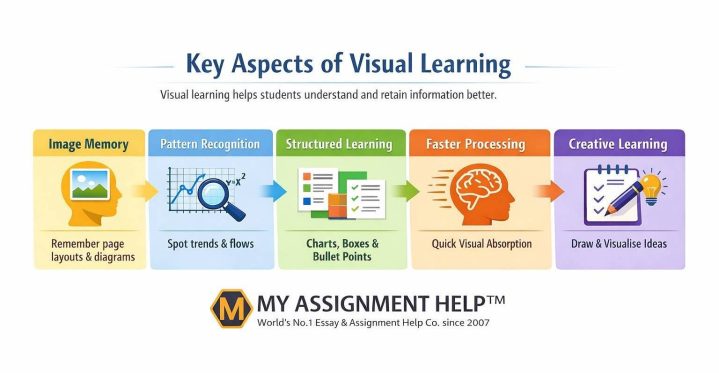
Understanding the key aspect of visual learning assists students in making use of it for better data and information processing.
Visual learners memorise information in the form of images in their minds. When revising, they often “see” the layout of the page or diagram in their memory. This works well when students need to recall something during exams or storytelling.
Visual learners are capable of spotting patterns in data, equations or processes easily. For example:
Visual learning focuses on presenting information in a structured manner. Instead of random text, content is segregated into:
This makes complex subjects and topics easier to understand
The brain processes images quickly compared to text. This enables visual learners to:
Visual learning promotes creativity. Students often:
These activities strengthen long-term memory. Students pursuing their academic journey through online courses leverage this method of learning to make things simpler and quicker to understand. For instance, subjects like machine learning or deep learning are quite different in nature, but most of the time students get confused with both and consider them as one unit.
However, they are known for serving completely different characteristics. Machine Learning vs Deep Learning can easily be understood with the help of visual learning and effectively mastered with the right use of visual learning.
Visual learning is quite beneficial for students and comes with proven advantages across subjects.
Diagrams and charts form good images in the mind and are easier to remember than plain text.
A well-designed diagram can better explain a concept than a long paragraph.
Visual elements keep students interested, and chunks of text can reduce concentration.
Graphs and charts aid students in understanding numerical data in a short period of time.
Clear Visuals reduce anxiety and build confidence.
Visual learning works well with subjects like:
It is versatile and flexible.
Online education involves the use of screens and engaging visual methods to teach students. The use of visual learning can easily be seen in online AI courses and classes.
Here’s how it contributes to E- learning
Most online classes use:
This makes learning engaging and effective.
Videos can be replayed by students, and visual demonstrations can be viewed multiple times for better clarity.
Online platforms offer:
These factor supports the idea of visual learning and make students well engaged throughout the course work
Visual learners can:
This flexibility makes online learning effective and highly popular among students.
Students can create:
Technology plays a powerful role in strengthening visual learning, especially in online education. It transforms traditional text-based content into engaging visual experiences that improve understanding and retention.
Applying visual learning in practical scenarios helps students understand things with more clarity and accuracy.
Instead of memorising the water cycle concept, students can draw:
It is easier to recall when you visualise the cycle by drawing pictures.
Rather than reading chronologically through the wars, students can make a timeline with:
This improves clarity and vision.
In place of solving equations blindly with no results, students can:
This makes grasping of concpets easily and effectively.
Instead of reading theory, student can create:
This makes theory practical and well understandable.
Some practical study tips for improving academic performance through visual learning are listed below:
After reading a chapter, summarise key points in a simple diagram.
Mind maps link ideas and give clarity. Begin with the main topic and branch out.
Avoid overusing colours. Keep consistent and organised when highlighting.
Previewing a topic in a visual way makes reading easier from a textbook.
Turn lengthy chapters into one-pager summaries.
Close the book and draw diagrams from memory to enhance recall.
A cluttered desk is a distraction for visual learners. Keep notes neat and organised
Mind map apps, digital whiteboards, and presentation tools enhance visual learning.
Break up long topics into visual blocks to make learning easier.
Before exams, revise using charts and summaries with visual aids rather than entire textbooks.
Although it is a good approach for learning visually, students should refrain from:
You may be a visual learner if:
If these sound familiar to you, then visual learning can be a great way to boost your academic performance.
Visual Learning is not limited to just adding pictures to notes. It is the method which is structured and improves the memory. Students who are able to apply this strategically can boost their understanding and reduce the stress of learning in their academics. Visual learning is not only a trend. It is a smart strategy that can help you to be successful in school, college and online education.
Visual learning is a learning style that allows students to learn and retain information more effectively with the use of pictures, diagrams, charts, videos, and other visual tools rather than with the traditional methods of reading a book or listening to a lecture.
Online learning has been screen-intensive, slide-based, video-based, and tool-based. Visual elements, such as animations, infographics, and well-structured presentations, can help make complex ideas easier to grasp and keep learners engaged and focused.
The types of keys include diagram-based learning, chart and graphs learning, video based learning, colour-coded learning and spatial learning. Each method assists students in visual processing and organisation.
The brain processes images faster than words. When students see diagrams or summaries in pictures, they create mental pictures in their minds that will be easier to remember when they take exams and revise later.
Yes. Visual learning is applicable across disciplines – science, math, history, geography, business and technical courses. Charts, timelines, and diagrams help to make both theoretical and practical topics clear.
Videos are a combination of visuals and verbal explanations. Animations, demonstrations, and real-life examples make difficult topics easier to understand, and students can pause or replay for additional clarity.
Clear visuals help to make complicated information simpler and less overwhelming. Structured notes and diagrams add clarity, confidence and speed up revision, taking the stress away.

I am an experienced class-help specialist supporting students across all subjects. I assist with online classes, coursework, and exam preparation, delivering structured academic guidance, reliable subject coverage, and consistent support to help students succeed confidently.










 WhatsApp

