


 02 January,2026

Table of Contents
Writing a top tier MBA assignment is about more than just knowing facts. It is about how you organize your thoughts. Examiners at top US business schools look for a clear path from a problem to a solution. If your paper is hard to follow, your best ideas will stay hidden. Using a proven framework helps you present your work like a business leader rather than just a student.
“In MBA analyzing, structure matters as much as content. A clear framework helps examiners see strong thinking faster.”
— Dr. Alan Pierce, MBA Examiner & Strategy Lecturer
The biggest challenge for most MBA students is information overload. You likely have a lot of research and data. Without a clear structure, this data becomes a “wall of text” that is hard to read.
Frameworks act as a mental map. They break messy business problems into small, easy parts. In the corporate world, time is money. These tools teach you to move from a problem to a solution in a logical way. To improve your grade, you must stop “telling a story” and start “making a case.” Many students find that an MBA assignment writing service is the best way to learn these structures and turn raw notes into a polished, A grade paper.
The five frameworks below are widely used in top-tier US business schools to help you master how to write assignment papers that stand out.
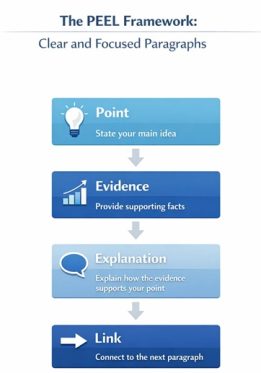
The PEEL framework is one of the most useful tools in academic writing. It works best for body paragraphs in essays and reports. US MBA examiners look for analysis, not long descriptions.
“Most low-scoring MBA papers fail because they describe events instead of explaining impact.”
— Former MBA examiner, USA Business School
They want to know why something matters, not just what happened.
PEEL helps you stay focused. It stops long paragraphs, repeated facts, and unclear points.
Point: Start with one clear idea. This tells the reader what the paragraph is about.
Evidence: A specific data point or quote (e.g., “According to a 2024 Harvard Business Review report).
Explanation: Explain what the evidence means and how it supports your point.
Link: Connect the idea back to the main argument or move smoothly to the next point.
Topic: Digital Change in Retail
Point: Using AI-based stock systems helps retail stores lower daily costs.
Evidence: A 2023 McKinsey report shows that AI in supply chains can cut costs by up to 15%.
Explanation: These systems predict demand earlier. This reduces over-ordering and frees cash that would otherwise sit unused.
Link: This extra cash supports wider digital upgrades discussed later in the assignment.
Pro Tip: Using a professional assignment writing service can help you refine your PEEL structure to ensure every paragraph adds direct value to your thesis.
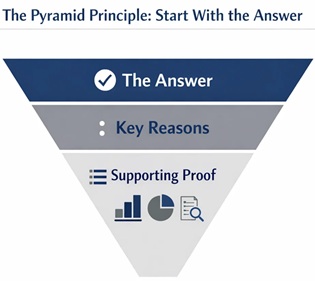
The Pyramid Principle was created by Barbara Minto at McKinsey and is used in MBA and consulting work. It is widely used in consulting and executive writing. This method works best for strategy reports and executive summaries.
MBA examiners often read many papers in a short time. Starting with your main answer, respect their time.
“Executives expect conclusions first. MBA students who write this way show real leadership thinking.”
— Barbara Minto Strategy Consultant at McKinsey
The Answer: Start with your final recommendation.
Logical Grouping: Support your answer with three distinct pillars (e.g., Financial, Operational, Strategic).
Supporting Data: Use APA 7th Edition citations to back up your claims with evidence
Topic: Market Entry for an Electric Vehicle Company
The Answer: Company X should enter Southeast Asia through a joint venture in Vietnam by Q4 2025.
Reason 1 – Regulations: Government support for green energy lowers entry risk.
Reason 2 – Competition: Few mid-priced EV brands operate in the region.
Reason 3 – Operations: Local partners reduce setup and factory costs.
Supporting Proof: A full PESTEL review and financial forecasts show break-even within three years.
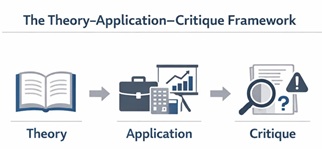
This framework works best for theory-heavy MBA assignments. High-scoring students do more than explain theories. They show how theories work in real life and where they fall short.
Examiners give higher marks to students who question ideas instead of repeating them.
“Critical thinking is shown when students test a theory, not when they simply explain it.”
— Professor of Management Studies
Theory: Explain the model or theory in simple terms.
Application: Apply it to a US-based case study (e.g., Netflix, Amazon, or Tesla).
Critique: Discuss the limitations. For instance, in a finance assignment help context, you might explain why a traditional DCF model struggles with highly volatile tech startups.
Topic: Netflix’s Competitive Strength
Theory: The VRIO model says a resource must be valuable, rare, hard to copy, and well managed.
Application: Netflix’s recommendation system keeps users engaged and is difficult for rivals to copy.
Critique: VRIO does not change over time. In fast-moving markets, rivals can catch up quickly. Netflix also needs the ability to adapt, not just protect existing strengths.
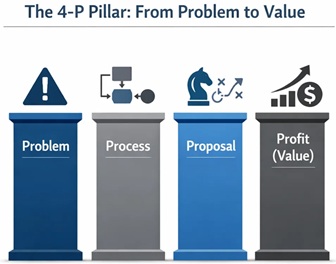
The 4-P Pillar framework works well for finance, operations, and turnaround cases. It follows the same steps managers use to solve business problems.
“This is the same problem-solving flow used in boardroom decision-making.”
— Operations Manager, Manufacturing Sector
This framework helps you explain problems clearly and focus on results.
Problem: Describe the issue using clear facts or numbers.
Process: Explain how you studied or diagnosed the problem.
Proposal: Present your recommended solution.
Profit (Value): Show the expected benefit or financial result.
Topic: Supply Chain Delays
Problem: Delivery times increased from 30 to 50 days, causing lost contracts.
Process: Process mapping showed delays during quality checks.
Proposal: Replace manual checks with automated inspection tools.
Profit: Delivery times fall by 15 days, saving about $200,000 each year.
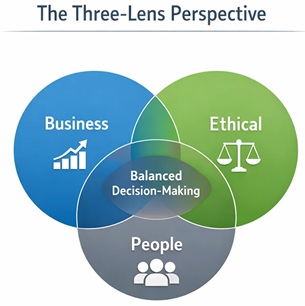
The Three-Lens framework works best for leadership, ethics, and people-focused assignments. Modern MBA programs expect students to think about profit, people, and long-term impact.
“Business decisions without ethical review rarely score well in MBA leadership modules today.”
— MBA Ethics Instructor
This framework shows balance and long-term thinking.
Business Lens: Impact on cost, growth, and market position.
People Lens: Impact on employees, culture, and teamwork.
Ethical Lens: Impact on society, fairness, and sustainability.
Topic: Permanent Remote Work
Business Lens: Reduces office costs and widens the talent pool.
People Lens: May weaken team culture without clear rules.
Ethical Lens: Cuts travel emissions but may disadvantage junior staff without home offices.
| Pillar | Academic Equivalent | Practical Application |
|---|---|---|
| Experience | Case Study Integration | Mentioning industry-specific hurdles (e.g., “In the fintech sector…”). |
| Expertise | Theoretical Synthesis | Comparing two competing theories (e.g., Kotter vs. ADKAR). |
| Authoritativeness | Strategic Tone | Leading with the conclusion and using high-impact citations. |
| Trustworthiness | Critical Reflection | Discussing the limitations and ethical risks of your proposal. |
After each paragraph, ask: Why does this matter to the examiner?
If the paragraph only gives facts, it needs explanation. Every point should help the reader understand a decision or result.
High-scoring MBA assignments often include:
Always explain what each visual shows in the text.
Strong assignments compare ideas instead of listing them.
Basic: Kotter explains change in eight steps.
Stronger: Kotter gives structure, but later models focus more on employee response. A combined approach works best.
When showing financial formulas, keep them simple and explain each part. Clear presentation builds trust and improves marks.
Final Thoughts
These frameworks are learning tools.
“Using structured examples to learn is ethical when students apply the thinking in their own words.”
— Academic Integrity Advisor
Use them to improve your own thinking, not to replace your work.
These five frameworks help you organize ideas, explain problems clearly, and support decisions with evidence. They show examiners that you understand business thinking and can communicate it well.
Strong structure turns good knowledge into high marks. When your ideas are easy to follow, your expertise becomes clear.
These frameworks are learning tools.
“Using structured examples to learn is ethical when students apply the thinking in their own words.”
— Academic Integrity Advisor
Use them to improve your own thinking, not to replace your work.
These five frameworks help you organize ideas, explain problems clearly, and support decisions with evidence. They show examiners that you understand business thinking and can communicate it well.
Strong structure turns good knowledge into high marks. When your ideas are easy to follow, your expertise becomes clear.
Ans: Examiners look for “executive logic.” A clear structure shows you can organize complex data into a simple, persuasive argument. It helps your expertise stand out.
“From an examiner’s view, structure is the fastest way to spot high-level thinking.”
— MBA Assessment Lead
Ans: The Pyramid Principle is best for the “big picture,” like an Executive Summary. PEEL is better for body paragraphs where you need to explain specific points in detail.
Ans: The PEEL framework ensures that every paragraph has a purpose. By following Point, Evidence, Explanation, and Link, you avoid “storytelling” or simply listing facts. It forces you to explain why your evidence matters, which is key to getting a higher mark.
Ans: You should use the Three-Lens Perspective when your assignment covers leadership, ethics, or corporate strategy. It helps you look at a problem from three sides: the financial impact (Business), the impact on people (Human), and the long-term fairness (Ethical). This shows you are thinking about the whole company, not just profit.

Hi, I am Mark, a Literature writer by profession. Fueled by a lifelong passion for Literature, story, and creative expression, I went on to get a PhD in creative writing. Over all these years, my passion has helped me manage a publication of my write ups in prominent websites and e-magazines. I have also been working part-time as a writing expert for myassignmenthelp.com for 5+ years now. It’s fun to guide students on academic write ups and bag those top grades like a pro. Apart from my professional life, I am a big-time foodie and travel enthusiast in my personal life. So, when I am not working, I am probably travelling places to try regional delicacies and sharing my experiences with people through my blog.










 WhatsApp

