


 06 January,2026

Table of Contents
A nursing case study is more than just a paper. It is a way to show you can think like a nurse. Since the 2026 NCLEX-RN update, students must prove they have “Clinical Judgment.” This means you don’t just follow orders; you notice small changes in a patient and take the right action.
This guide explains the modern way to write a case study. We use the NCSBN Clinical Judgment Model to make sure your work meets US standards. If you feel stuck, you can always find expert nursing case study help to guide your writing.
In the modern clinical environment, a nursing case study has evolved. It is no longer just a history of a patient’s illness; it is a demonstration of clinical judgment. In line with the 2026 NCLEX-RN standards, your study must show how you “Recognize Cues” (Assessment) and “Prioritize Hypotheses” (Analysis) to ensure patient safety. While a medical case study focuses on the pathology and pharmacological cure of a disease, a nursing case study focuses on the human response to that condition.
According to the American Nurses Association (ANA), nursing is the protection and optimization of health. Therefore, your case study must document the Nursing Process in real-time. You are not just recording vital signs; you are analyzing how a diagnosis—like heart failure or chronic pain—impacts a patient’s mobility, mental health, and social stability.
If your professor asks you to analyze a patient simulation profile, reviewing a structured clinical reasoning cycle case study will show you exactly how to structure your clinical observations and evidence-based arguments.
To transform a standard patient file into a highly rigorous academic presentation, it helps to examine trending child health nursing case presentation topics that emphasize evidence-based practice and advanced diagnostic triage.
For students, this assignment is the primary way to build Clinical Judgment. This is the ability to observe a patient, recognize “cues,” and take the right action to prevent complications. It is a bridge between classroom theory and the fast-paced reality of the hospital floor.
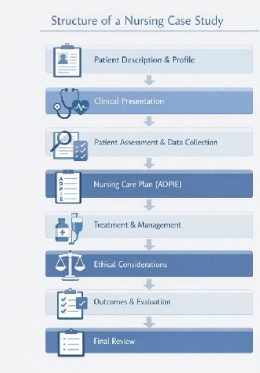
The nursing case study format is simple and systematic. Each part works together to create a full picture of the patient’s journey from admission to recovery. By following this standard academic structure, you ensure that your clinical reasoning is clear to instructors and peers. Professional case study writing services have experts in all subjects, like different experts for even problems related to how solve cubic equation.
1. Patient Description & Profile The report begins with key facts about the patient to establish context. Age and gender are listed first, followed by a brief medical and social history. You should include:
2. Clinical Presentation In this stage, the reason for seeking care is introduced in detail. You record the patient’s symptoms in a clear, chronological sequence. Observable signs—such as vital signs, skin color, or respiratory effort—are described separately so the situation is easy for a reader to visualize.
3. Patient Assessment & Data Collection A strong study requires a deep dive into clinical data. You collect information through physical examination, diagnostic tests, and lab results (e.g., CBC, ABGs, or Electrolytes). From these notes, you form clinical conclusions and determine which issues require immediate attention.
4. The Clinical Core: Mapping ADPIE to the NCJMM
The heart of your report is the Nursing Care Outline. To meet 2026 academic standards, you must translate the traditional ADPIE process into the NCSBN Clinical Judgment Measurement Model (NCJMM). This section is where goals and plans are established to ensure patient safety.
5. Treatment and Management Actual care is described here. The text outlines medications (including dosages and routes), clinical treatments, and multidisciplinary cooperation with doctors or therapists. Every measure is presented as a separate step to demonstrate organization and clinical intention.
6. Ethical Considerations Professional nursing involves more than just physical care. Issues of informed consent, patient privacy (HIPAA), and professional boundaries are reviewed. You should discuss how you maintained the patient’s dignity and autonomy throughout their stay.
7. Outcomes and Evaluation Results close the report. Compare the patient’s final status against the goals you set in the Care Outline. Improvements and remaining concerns are addressed separately. A deep reflection on how well goals were met—and what could be improved in the future—strengthens your final analysis.
8. Writing Process and Final Review The final stage involves organization, reference checking (APA 7th edition), and a professional accuracy review. This confirms that your study is not only medically sound but also meets the academic standards required for a top Grade.
| Section | Content Requirements & Student Checklist |
|---|---|
| I. Patient Profile |
The “Who”: Document age, gender, and occupation. Include the Chief Complaint. Ensure all data is anonymized. |
| II. Clinical Presentation |
The “What”: Describe symptoms chronologically. Separate subjective and objective findings. |
| III. Pathophysiology |
The “Why”: Explain the disease process and connect symptoms to the condition. |
| IV. Nursing Care Plan |
|
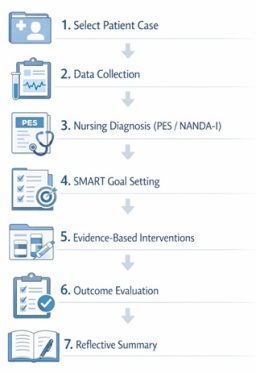
Don’t just pick the simplest patient on the floor. Choose a case that offers “learning value.” A patient with multiple comorbidities (e.g., Heart Failure + Diabetes) allows you to demonstrate complex care planning. If you need inspiration for broader medical research, check out these nursing research proposal topics to find a focus area that interests you.
In this stage, you record symptoms chronologically. However, a top-tier paper doesn’t just list data. It highlights relevant cues. For example, if a patient has a high heart rate (tachycardia), you should link this cue to a potential hypothesis, such as dehydration or pain.
This is where many students lose marks. You must use the PES Format:
This is the core of your report. Using the NCSBN Clinical Judgment Model, you must decide which nursing diagnosis is the highest priority. Is the patient’s airway at risk, or is their pain the primary concern? This is where you prove your ability to keep a patient safe under the 2026 NCLEX-RN Test Plan. Your care plan must have Specific, Measurable, Achievable, Relevant, and Time-bound goals. A crucial part of this is knowing how to write a nursing care plan that addresses both immediate and long-term patient needs.
Explain the rationale behind your actions. If you are administering a specific medication, explain its mechanism of action regarding the patient’s pathophysiology.
Did the intervention work? Reflect on the patient’s progress. If goals weren’t met, explain why and how the care plan should be adjusted.
End with what the case taught you. For a deeper understanding of the overall process, you can refer to our general guide on writing a case study.
The following examples provide a blueprint for documenting complex patient scenarios. Each case includes a “Pathophysiology Deep-Dive” and “Critical Thinking Questions” to help you master the clinical reasoning process.
Focus: Oxygenation and Infection Control
Question: “Why do I need to sit up so high in bed? It’s hard for me to sleep this way.”
Clinical Rationale: The nurse must explain that the High-Fowler’s position uses gravity to lower the diaphragm, allowing for maximum lung expansion. Sitting upright prevents “atelectasis” (alveoli collapse) and makes it easier for the patient to clear the fluid (exudate) filling their lungs.
Question: “The doctor says I have a ‘ventilation-perfusion mismatch.’ What does that mean for my recovery?”
Clinical Rationale: This requires the nurse to explain that while air is entering the lungs (ventilation), the fluid from the pneumonia is preventing it from reaching the blood vessels (perfusion).
Focus: Patient Adherence and Physiological Balance
Question: “I feel fine today. Why do I have to prick my finger and check my sugar even when I don’t have symptoms?”
Clinical Rationale: The nurse should explain the concept of asymptomatic hyperglycemia. High blood sugar can damage small blood vessels in the eyes, kidneys, and nerves long before the patient “feels” sick. Consistent monitoring is the only way to prevent long-term complications.
Question: “Why can’t I just take a pill instead of these insulin shots? My neighbor only takes pills.”
Clinical Rationale: This is an opportunity to discuss pancreatic exhaustion. In advanced Type 2 Diabetes, the pancreas may no longer produce enough insulin, making oral medications (which stimulate insulin production) ineffective.
Focus: Perform daily morning weights.
Question: “Why are you weighing me every single morning? I haven’t even had breakfast yet.”
Clinical Rationale: Daily weights are the most sensitive indicator of fluid status. A gain of 2 lbs in 24 hours is a “critical cue” that suggests worsening heart failure, requiring an immediate change in the care plan (Generating a new Solution).
Question: “My legs are so swollen. Why am I on a ‘fluid restriction’ when I feel so thirsty?”
Clinical Rationale: The nurse must explain that the thirst is a result of the body’s hormonal response (RAAS system), but adding more fluid will only worsen the edema and increase the workload on the failing heart.
Focus: Pain Management and Complication Prevention
Question: “I’m in a lot of pain, but I’m afraid I’ll get addicted if I keep asking for the morphine pump.”
Clinical Rationale: The nurse must address the difference between physical dependence and addiction. Unmanaged pain prevents the patient from deep breathing and walking, which significantly increases the risk of post-op pneumonia and blood clots (DVT).
Question: “Why do I have to wear these tight squeezing stockings (TED hose) on my legs?”
Clinical Rationale: Explain that surgery and immobility slow down blood flow. The compression promotes venous return to the heart, preventing blood from pooling and forming dangerous clots.
This guide was created by academic nursing writers.
It was reviewed by registered nurses with experience in patient care, clinical documentation, and nursing education.
A nursing case study is both a technical report and a reflective task. While accuracy is paramount, do not forget the human element—your empathy and professional judgment guide every decision made at the bedside. When written thoughtfully, a case study becomes a powerful demonstration of your professional growth and your readiness for real-world clinical practice.
References & Evidence-Based Sources
American Nurses Association (2015). Code of Ethics for Nurses with Interpretive Statements. Silver Spring, MD.
Herdman, T. H., & Kamitsuru, S. (Eds.). (2021). NANDA International Nursing Diagnoses: Definitions & Classification, 2021–2023. Thieme.
National Council of State Boards of Nursing (NCSBN). (2023). Clinical Judgment Measurement Model. Retrieved from https://www.ncsbn.org.
Potter, P. A., Perry, A. G., Stockert, P. A., & Hall, A. M. (2021). Fundamentals of Nursing (10th ed.). Elsevier.
A: A medical case study focuses primarily on the diagnosis and treatment of the disease. A nursing case study focuses on the human response to that disease, following the nursing process (ADPIE) to provide holistic care.
A: Select a patient whose condition is complex enough to allow for multiple nursing diagnoses. If you need inspiration, check our list of nursing research proposal topics to see current trends in clinical study.
A: While clinical experience is preferred, many students use “simulated” patients. The key is to make the clinical data (vitals, labs) consistent with the pathophysiology of the condition.
A: Personal communications (like interviews) are usually cited in the text but not included in the reference list. Example: (J. Doe, personal communication, October 15, 2023). Always refer back to the general guide on how to write a case study for specific formatting rules.
A: You must de-identify the patient. Change their name (use initials or pseudonyms), change their date of birth to just their age, and remove the name of the specific hospital or clinic.
A: This is actually great for a case study! It allows you to demonstrate “Critical Evaluation.” Explain why the interventions didn’t work and what changes you would recommend for the next care cycle.
A: You can find standardized clinical reasoning templates directly from our free samples section to ensure you don’t miss any required academic sections.

I am a nursing and healthcare academic expert with experience in medical research and evidence-based writing. I ensure accuracy, uphold ethical standards, and maintain subject credibility in all healthcare and nursing-related academic content.










 WhatsApp

