


 18 June,2026

Table of Contents
If you are stepping onto the floor for your first clinical rotation in nursing school, the sheer volume of documentation required can feel completely overwhelming. Trust me, I have been exactly where you are sitting right now.
When I had to draft my very first nursing care plan assignment under a tight academic deadline, I stayed awake until 3:00 A.M., wondering how a single student was supposed to memorise every diagnostic label, intervention rationale, and shorthand medical abbreviation.
But here is the secret I learned through years of clinical practice and nursing assignment help education: writing an exceptional care plan doesn’t have to be a stressful guessing game.
If you treat it as a predictable recipe built on systematic critical thinking, it becomes an incredibly manageable roadmap designed to keep your patients safe.
Whether you are navigating advanced high school health science tracks or grinding through your first semester of college clinicals. Our medical assignment help online resources break down the ideal nursing care plan format, unpack essential clinical terminology, and provide practical, real-world examples so you can ace your grading rubrics and dominate your exams.
When we look at the core of clinical education, we have to ask a fundamental question: what is care plan documentation designed to achieve? In simple terms, it is a comprehensive guide tailored to an individual patient’s unique biological and psychosocial needs.
If you are wondering what a care plan in nursing school is, it serves as the ultimate written proof that you can think like a nurse. It demonstrates your ability to gather raw clinical data, prioritize complex problems, and make safe, evidence-based decisions under pressure.
![A horizontal flowchart from a light blue background shows "[Continuity of Care]" leading to "Safe Shift Handovers," "Legal Medical Records," and "Interdisciplinary Team Alignment." The top right has the "MY ASSIGNMENT HELP" logo.](https://cdn3.myassignmenthelp.com/blog/wp-content/uploads/2026/06/19080518/image-18-592x373.png)
According to the American Nurses Association (ANA), this structured process defines the professional standards of daily practice. It is much more than just a passing grade on a nursing student care plan paper; utilizing professional nursing essay help acts as a legal and operational safeguard.
In a hospital or clinic, what is a plan of care for a patient is an open communication line across the entire healthcare management assignment help network.
It ensures that when shift changes occur, the incoming nurses can review your documentation and immediately identify the patient’s current trajectory, maintaining absolute continuity of care.
To successfully build this roadmap, you must live and breathe by the classic five-letter acronym: ADPIE. This stands for the nursing process, which serves as our universal framework for critical thinking and maps closely to the standard clinical reasoning cycle. Think of it as a continuous loop that constantly updates as the patient’s condition changes.
Before you begin writing nursing care plan entries, you have to master the standard language of clinical shorthand.
If your documentation contains informal grammar or non-standard abbreviations, it will compromise patient safety, potentially leaving a practitioner exposed to the medical negligence file audits, it will compromise patient safety and lead to lost points on your assignments.
| Clinical Shorthand | What It Stands For | Exact Functional Role in Documentation |
|---|---|---|
| RPN | Registered Practical Nurse | The RPN’s meaning relates to licensed nursing professionals who collaborate within the care team to execute structured interventions under clinical rubrics. |
| R/T | Related To | Used to connect the patient’s nursing problem directly to its underlying cause or aetiology. |
| AEB | As Evidenced By | Introduces the specific, verifiable signs and symptoms (your assessment data) that prove the diagnosis is accurate. |
When you learn what r/t means, nursing notation signifies, you realize it is the link that prevents your diagnoses from looking like random guesses. Similarly, mastering aeb meaning nursing application gives you the power to tie your physical assessments directly to standard clinical protocols.
Receive high-quality, original papers, free from AI-generated content.
Let’s break down the mechanics of how to write a care plan from scratch. To complete your assignment with a dissertation, you can use advanced nursing dissertation help. If you follow these sequential steps, you can confidently approach any complex clinical scenario.
A medical diagnosis names a disease (e.g., Diabetes Mellitus), whereas a nursing diagnosis identifies the patient’s response to that disease. When figuring out how to write nursing diagnosis lines, always use the three-part PES format: Problem + Aetiology (R/T) + Signs/Symptoms (AEB).
Once your diagnosis is locked in, you must establish an outcome target. If you are confused about how to add problems and goals to your patient’s care plan, remember that every single goal must follow the SMART criteria: Specific, Measurable, Achievable, Realistic, and Time-bound.
| Vague & Poorly Structured Goals | Fully Optimized SMART Nursing Goals | Grading Insight |
|---|---|---|
| “The patient will feel better and breathe easier very soon.” | “The patient will maintain an oxygen saturation ($SaO_2$) of 94% or higher on room air within 8 hours of intervention.” | The optimized version sets an exact, measurable metric (94%) and a clear time limit (8 hours), making evaluation simple. |
A great care plan shouldn’t look like a generic page copied straight out of a textbook. You can individualize the patient’s care plan by altering your actions to fit their unique age, culture, mobility level, and personal lifestyle preferences.
Always remember that what is a key component of a care plan that guides staff actions is the scientific rationale. Rationales explain the underlying physiology behind your interventions, proving to your instructors that you understand the “why” behind every step.
Effective care planning requires navigating limited shift resources and tight clinical schedules. Staying informed about current challenges in nursing and solutions teaches you to design practical, realistic patient interventions. This ensures your care plans remain achievable on a busy floor.
The evaluation phase is where you measure your patient’s progress. When studying how to write an evaluation in nursing care plan assignments, remember that your evaluation must directly reference your original SMART goal. You will review the latest data and mark the goal as Met, Partially Met, or Not Met.
Human health is dynamic, meaning the patient care plan should be updated constantly. In a fast-paced hospital setting, this update happens at least once per shift, or the moment a patient’s lab values, vital signs, or physical responses show a sudden change.
Depending on your academic track or clinical unit, the exact layout of your care plan will vary based on your patient’s medical condition. Let’s look at a comparative breakdown of how standard formats adapt to complex, high-priority clinical situations.
| Formatting Element | Standard Basic Layout | Ineffective Health Management | Ineffective Health Maintenance | Acute Heart Failure Exacerbation | Acute Alcohol Withdrawal Syndrome |
|---|---|---|---|---|---|
| NANDA-I Diagnostic Label | Risk for Altered Wellness | Ineffective Health Management | Ineffective Health Maintenance | Excess Fluid Volume | Risk for Injury |
| Primary Aetiology (R/T) | Lack of general health knowledge resources. | Complexity of the prescribed therapeutic regimen. | Perceived lack of personal control over health outcomes. | Compromised regulatory cardiovascular mechanisms. | Sudden cessation of chronic alcohol intake affects CNS receptors. |
| Signs & Symptoms (AEB) | Patient voices minor confusion regarding daily wellness. | Verbalized non-adherence; missing scheduled life-saving clinic appointments. | Inability to take responsibility for meeting basic health practices; poor hygiene. | Jugular venous distension (JVD); 3+ bilateral pitting oedema; sudden weight gain. | Coarse hand tremors; severe diaphoresis; tachycardia (115 bpm); elevated anxiety. |
| Evidence-Based Intervention | Provide standard educational pamphlets upon discharge. | Collaborate with the patient to build a simplified pill-organizer system; identify cost barriers. | Conduct a comprehensive barriers-to-care interview; involve family support structures. | Administer IV loop diuretics as ordered; track strict intake and output (I&Os) every hour. | Perform scheduled CIWA-Ar assessments; apply strict seizure precautions; administer sedatives. |
| SMART Outcome Target | Patients define their basic diagnosis before leaving. | Patient will accurately demonstrate how to fill their weekly pill organiser before discharge. | Patient will identify two accessible community health clinics for follow-up care within 48 hours. | Patient’s lung fields will be clear to auscultation within 24 hours of initiating diuretic therapy. | Patient will remain free from physical trauma and generalized seizures throughout the withdrawal shift. |
When you are trying to balance multiple assignments alongside long hours on the clinical floor, efficiency is your best friend. Use these practical nursing documentation tips to keep your charts clean, objective, and legally secure:
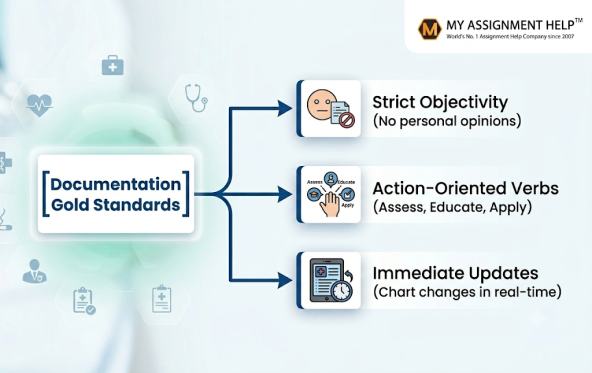
Let’s be completely honest—balancing complex care plans alongside pharmacology quizzes, anatomy lectures, and exhausting shift rotations can feel completely overwhelming. Professors use a nursing care plan assignment to evaluate your critical thinking and clinical judgment before you are handed a license to work with real human lives.
If you are currently feeling stuck, falling behind, or struggling to organize your thoughts, remember that you don’t have to navigate this journey alone. We have developed an extensive library of premium academic resources to support your studies.
You can access our comprehensive nursing diagnosis care plan PDF files to analyze real-world, professionally structured clinical templates. For a deep academic foundation, you can also access our comprehensive nursing care plan book PDF free download option, which provides a massive database of scenarios to help you master the material.
Whether you need a dedicated clinical tutor to review your diagnostic statements or expert, custom assistance on a challenging ncp assignment, we provide the professional homework help you need to save time, reduce stress, and secure the top grades you deserve.
Answer: What is included in the basic care plan format is a structured layout containing five core elements: a thorough patient assessment (both subjective and objective data), a formal NANDA-I nursing diagnosis statement, clear and measurable patient-centered SMART goals, detailed evidence-based nursing interventions with rationales, and an evaluation section to track progress.
Answer: To write an ineffective health management nursing diagnosis statement, identify the patient’s struggle to follow a health treatment plan, link it to a clear cause, and list the observed symptoms. For example: Ineffective Health Management R/T complexity of the therapeutic regimen AEB patient missing four consecutive hemodialysis sessions and an elevated serum potassium level.
Answer: The patient care plan should be updated immediately whenever a patient experiences a significant change in their physiological baseline, exhibits new symptoms, or fails to meet an established SMART goal outcome. At a minimum, care plans must be reviewed and documented once per nursing shift to ensure clinical safety and accuracy.
Answer: The best way to learn how to make ncp documents is to practice breaking down a nursing case study writing example using the ADPIE method, review verified templates, and study comprehensive nursing care plan smart goals examples or look into current nursing research topics to understand how to write measurable patient outcomes.
Answer: How do you individualize a patient’s care plan effectively comes down to modifying generic textbook interventions to align with the patient’s unique cultural background, age-specific needs, structural home environment, and personal health preferences, ensuring the care plan is uniquely suited to them.

I am a health and biology specialist with a strong research background. I deliver well-referenced, scientifically accurate academic content across medical, healthcare, and life-science disciplines.










 WhatsApp

