


 22 April,2026

Table of Contents
The way people learn has changed completely over the past decade. Today you do not have to be in a classroom to learn something new. Nowadays students, professionals and organizations use digital platforms for education. The Learning Management System is at the center of this ecosystem.
Whether you are a student at a university, corporate trainer, teacher or the owner of a business the Learning Management System helps you access, deliver or keep track of your learning progress. LMS systems are not just a content delivery tool; they are highly intelligent, AI-powered personalized solutions for smarter learning.
In this blog, by MyAssignmentHelp, we will talk about the LMS platforms, how they work and what is trending in this arena.
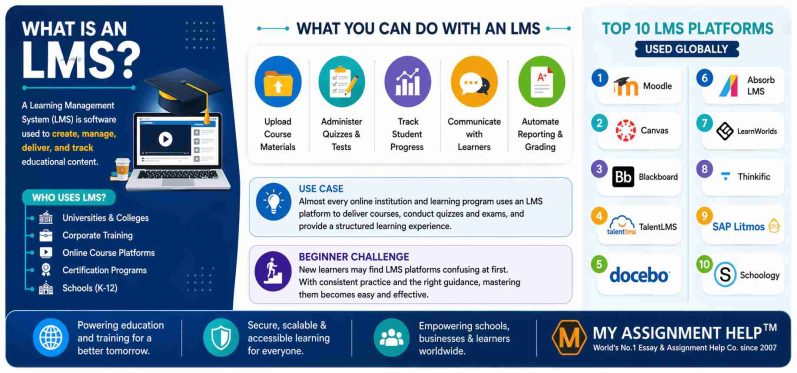
A Learning Management System (LMS) is a software which is used to create, deliver, control and monitor educational content.
It is commonly used by:
With an LMS, institutions and educators can:
Use case: Almost every online institution and learning program is based on some LMS platform for delivering educational content, conducting quizzes and online exams.
Based on requirements and online course design, these platforms provide an initial learning framework for students. This is where students are required to adapt to new learning methodologies in order to successfully complete their online coursework.
However, this is also the point where most students face difficulty understanding how the learning platform works at a beginner level. When overwhelmed, they often flood internet, searching “can someone do my online class for me” in the hope of finding the right support. At the initial stage or as a beginner online learner, you may face difficulty with these platforms but with consistent approach and right guidance mastering these platforms and understanding their framework is not a big deal.
Using LMS platforms for studies is becoming common, as Gen Z learning habits are shifting toward digital and flexible education methods. Let’s explore the most popular LMS platforms used across the United States.
It is one of the most popular LMS systems globally known for its easy-to-use interface and features. It works best with institutions looking to have full control over customization.
Key Features:
Best for: Online institutions, universities and open-source flexibility.
It is quite popular in the USA education system due to its clean design and easy to use interface. Canvas majorly focuses on user experience and offers a smooth experience to both instructor and student.
Key Features:
Most suitable for: University and colleges.
Blackboard is widely used by large universities and institutions. It is designed for offering a highly structured and powerful learning environment.
Its core capabilities include virtual classrooms which support live academic sessions, discussions, collaboration, and exams. The platform heavily focuses on offering accessibility and setting standards for students with disabilities.
Key Features:
Best used: In large institutions and enterprise-level education.
Companies that want to launch quick training sessions for their employees use TalentLMS. It is easy to use and ideal for companies looking for quick training solutions.
It also allows businesses to create relevant courses without technical expertise using simple drag and drop tools.
Key Features:
Ideal use: Corporate training and small businesses.
Docebo is getting immense popularity in the market because of its strong AI capabilities. It uses machine learning to recommend courses, make learning strategies and automate content delivery.
The platform is also known for offering social learning opportunities, which means students can share knowledge and collaborate with each other in a secure learning environment.
Features
Best usage: AI powered corporate learning.
Absorb LMS comes with a clean interface and strong AI capabilities. It is quite useful for those businesses that want to monetize their online AI courses through built-in e-commerce functionality.
The platform allows companies to create a branded learning portals, where training programs are initiated as per the learner requirement
Key Features:
Best for: Businesses and professional training
LearnWorlds is known for allowing businesses to create and launch online courses. This particular LMS platform goes beyond the traditional LMS settings by offering website building capabilities.
Key Features:
Best for: Online course creators and entrepreneurs
The simplicity and accessibility of this LMS platform stands it out from others. It allows users to create and launch online courses without having any complication and requirement of any coding skills.
The platform also supports multi payment gateways ensuring smooth course buying and selling experience. It is preferred by users for its simplicity and engaging user interface
Key Features:
Best for: Course creators and small businesses
It is quite popular among large businesses and organizations. The platform is used for offering employee training and compliance programs by organization. It has a vast library of ready-made online courses that can be deployed instantly as per the demand.
Key Features:
Best for: Corporate and compliance training
Schoology is quite popular among K-12 schools across the United States. The platform is quite appreciated for its LMS functionality with a social networking feature that makes learning interactive and engaging.
Using this tool, teachers can easily manage assignments, quizzes, discussions, and collaborate with students effortlessly
Key Features:
Best for: K-12 education
These are some popular LMS tools known for offering structured and advanced learning environments. However, if you are not familiar with these platforms, you might face difficulty while taking your online course. In such a situation, getting expert help can ease your stress by allowing you to hire experts to understand these tools.
Source: iSpring LMS
Source: Market.biz
Source: E-learning industry
When choosing an LMS, it is quite important for students to focus on features that truly matter and are effective for their learning.
No matter what platform you are selecting, make sure it comes with a user-friendly interface. The platform should be easy for both instructors and learners to navigate.
Your LMS should be mobile compatible which means learners should be able to access courses on smartphones and tablets.
Make sure your LMS has analytics and reporting features . With this you can track your performance and work on those areas that are weak and require your attention. Tracking learning progress is essential for improvement.
The LMS should be capable of integrating with tools like Zoom, Google Drive, and CRM systems. This will help you make your learning experience better and engaging.
Make sure the LMS platform you are picking has customization capabilities. This will add an extra layer of benefits and ensure smooth learning throughout the coursework.
AI powered LMS platforms not only boost engagement but also help students complete their online course successfully.
Artificial Intelligence is changing Learning Management System platforms in the most constructive ways. It is not about just processing information anymore. It is about making Learning Management System platforms smarter and more personalized for the people who use them.
Artificial Intelligence looks at how students behave and how well they perform. Then it suggests customized learning paths for them.
For example:
This way every single person who uses the Learning Management System gets the personalized Learning experience.
AI powered LMS systems help learners find relevant and career oriented courses.
They can recommend students what they should perform such as:
This saves them time and helps them do things more efficiently with the Learning Management System platform.
Systems that use Artificial Intelligence can:
This helps instructors and makes the learning process more efficient and effective.
Artificial Intelligence can predict how well students will do based on their performance’s behavior patterns.
This helps the educators:
A lot of Learning Management System platforms now use Artificial Intelligence chatbots.
They can:
This provides 24/7 support for learners.
AI enhances gamification features such as:
These features increase motivation and participation.
Artificial Intelligence helps students have adaptive learning using real-time experiences.
For example:
This makes learning effective and engaging.
AI tools help instructors:
This saves instructors time, which they can use for other tasks.
LMS platforms that are powered by AI have a number of advantages:
For Students
Personalized learning experience
For Educators:
For Organizations:
Although AI has numerous advantages, there are certain issues:
Nevertheless, with the development of technology, all these issues are being resolved.
The LMS market worldwide is expected to grow at a higher rate. Integration of AI, data science and data analytics making the LMS tools into smart learning systems for absolute learning.
Future trends include:
The future of education is digital, and LMS platforms will play a central role in shaping it.
LMS systems have changed the way we learn. Now we can learn using digital devices at our own pace and time. From traditional classroom setup to E-learning, LMS platforms have made education more flexible and efficient.
Today’s Learning Management Systems are getting better with AI integration. They are not just tools, they are intelligent systems that have potential to reshape the entire learning. Choosing the right LMS not only enhances your learning but also contributes towards your skill development process and ensures absolute success.
Choosing one LMS platform is not possible as use case vary as per requirements. Canvas and Blackboard are popular among universities, whereas Docebo and TalentLMS are good training platforms for corporations.
AI enhances LMS systems by providing personalized learning, automatic grading, predictive analytics, and intelligent content suggestions.
Yes, platforms such as TalentLMS, Thinkific, and LearnWorlds can be used by small businesses and startups.
Yes, at LMS platforms such as Thinkific and LearnWorlds allow users to create, sell and market online courses.
Always ensure your LMS platform has simplicity, mobile friendliness, analytics, integration, personalization, and artificial intelligence.

I am an experienced class-help specialist supporting students across all subjects. I assist with online classes, coursework, and exam preparation, delivering structured academic guidance, reliable subject coverage, and consistent support to help students succeed confidently.










 WhatsApp

