


 12 June,2026

Table of Contents
Technology is changing rapidly. From self-driving cars to smart AI-powered chatbots, technology is becoming an essential part of our lives. This is the reason why students are interestingly focusing on career opportunities in the field of robotics and machine learning. In today’s time, these are the two fields that consistently appear at the top of career discussions. Both technologies are known for offering amazing career opportunities and learning possibilities.
However, the potential of both technologies and career opportunities often confuse students, and leave them wondering: Robotics vs machine learning: which should I go with in 2026?
The answer completely depends on one’s interests, career, goal, and skills they have. Robotics contributes to building intelligent machines that are capable of interacting with the physical world, whereas machine learning is known for creating algorithms that allow computers to learn from data to make informed decisions.
This guide by MyAssignmentHelp will help you explore the relationship between robotics and machine learning, how they are different and what career opportunities they offer to students.
Robotics is a vast field which comprises designing, building, programming and operating the robot.
A robot is a machine that can execute various tasks with little human intervention. These machines are able to do repetitive, dangerous or precise tasks more efficiently than humans.
The fundamentals of robotics integrate concepts from many disciplines such as:
Nowadays, robots are used in a variety of industries such as:
Example of Robotics in Action
Consider a robotic arm in an auto manufacturing facility.
The robot can:
With robotics, these tasks are performed efficiently, accurately and consistently. This ensures better productivity, speed and lower error possibilities.
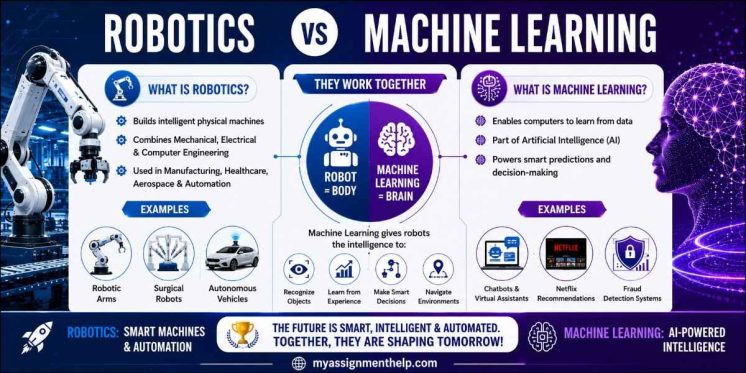
Machine Learning (ML) is a subset of Artificial Intelligence (AI) that is used by computer systems to learn from data without having to be programmed to do so.
Unlike robotics, machine learning does not follow just programmatic instructions; it identifies algorithms, recognizes patterns and learns from information to train its environment for better performance over time.
Technologies based on machine learning and commonly used by humans include:
Example of Machine Learning in Action
It is machine learning algorithms that cause Netflix to recommend movies based on the users’ interests and their viewing history.
Similarly, e-commerce websites use machine learning to identify users’ interest, their purchasing power, behavior patterns. Based on these information companies recommend products to customers.
Also Read: Machine Learning vs Deep Learning: Comparison Guide
The debate around Robotics vs Machine learning, mostly talk about their differences as people consider they are completely separate fields. But in reality they are connected closely and share a big amount of information and even work together in most cases.
The easiest way to understand their relationship is:
Example: Consider a robot as a body and machine learning is its brain that handles all the complicated things. A robot can move, pick up objects, and interact with its environment. Machine learning enables that robot to:
Without machine learning, robots are simply devices programmed to follow a fixed set of instructions. Machine learning enables them to learn from data, adapt to changing environments, and make decisions based on real-time situations. Students enrolled in online machine learning or robotics courses often misunderstand the relationship between these two fields and treat them as completely separate disciplines, which can lead to confusion later in their academic journey.
As coursework becomes more technical and demanding, some students even search for services using phrases like “do my online class for me” to manage their workload while trying to keep up with complex concepts in robotics and machine learning.
The use of robotics is quite common in current technology. It has also transformed and become more powerful with machine learning integration, making robots smarter and more autonomous.
In advanced warehouses you can simply witness the capabilities of robots and how they use machine learning to identify products and packages.
Autonomous robots are trained using various real-life scenarios and patterns. This data training helps them understand how to move through complex environments without collisions.
Industrial robots also use historical data and events to predict and avoid failures before they occur.
Service robots are trained over human actual voices and commands so that they can understand voice commands and respond intelligently.
Surgical robots are designed using machine learning capabilities that improve precision and support doctors during procedures.
As we can see the use of robotics and machine learning is becoming an integral part of every industry’s success. This is why demand for professionals with robotics, machine learning and AI skills are high in demand in 2026.
Although these fields overlap, they focus on different goals.
| Feature | Robotics | Machine Learning |
|---|---|---|
| Main Focus | Building physical machines | Teaching computers to learn from data |
| Nature of Work | Hardware and software | Mostly software and data |
| Core Skills | Engineering, electronics, programming | Programming, statistics, mathematics |
| Output | Robots and automated systems | Intelligent algorithms and models |
| Work Environment | Labs, factories, testing facilities | Offices, remote work, tech environments |
| Hardware Requirements | High | Low |
| Remote Work Potential | Moderate | High |
| Learning Focus | Mechanics, sensors, automation | Data analysis, AI, predictive modeling |
Yes. Robotics continues to grow as companies invest in automation to improve productivity and reduce costs.
Several industries are increasing their use of robots, including:
Robotics engineering courses are highly rewarding but complicated in nature and may demand higher concentration and efforts more than any other engineering course. Handling continued pressure often makes students wonder, can I pay someone to do my online engineering class for me? You may experience the same but don’t worry. Handling these scenarios is not a challenge these days if you are fully aware of the options available. Yes, you heard it right. By following smart learning strategies such as online class help services you can smooth your academic journey and pass with flying colors..
Machine Learning is considered one of the fastest-growing technology careers.
Organizations across virtually every industry are investing in AI-powered solutions to:
Machine learning professionals are currently among the most sought-after technology workers in the United States.
The demand is especially strong in:
So, the answer is yes. Machine learning is a good career option for students. No matter which academic background you belong to, having machine learning skills on your resume always adds additional value to your portfolio. You can upskill yourself through online machine learning courses while managing your job or full-time studies. And if you are worried about how you would manage your job and online courses, rest assured, these online classes are highly flexible, and you can take them according to your schedule without facing any difficulties.
Students pursuing robotics should develop expertise in both engineering and programming.
Machine learning professionals need strong mathematical and programming foundations.
Having good programming skills is a must for a successful machine learning career. To improve this skill, you can always seek programming assignment help to improve your command over programming languages and successfully build an exciting career in ML, robotics and AI.
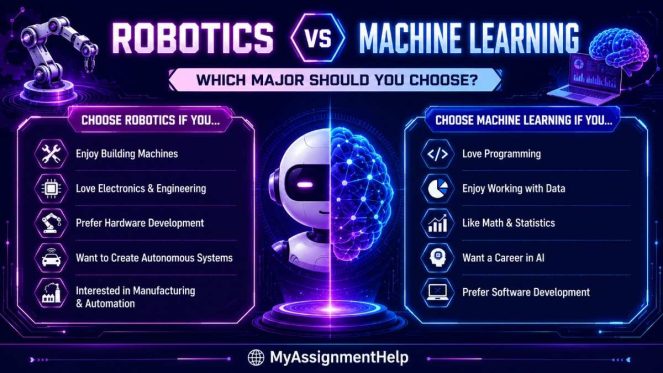
Your choice should depend on your interests.
There is no universally better choice. The best option is the one that aligns with your strengths and interests.
Students interested in robotics often pursue degrees such as:
Many universities also offer specialized robotics programs and research opportunities.
Machine learning professionals typically come from backgrounds such as:
Advanced degrees can be particularly valuable for research-oriented positions.
| Field | Job Role | Average Salary (USA) |
|---|---|---|
| Robotics | Robotics Engineer | $95,000–$145,000 |
| Robotics Software Engineer | $110,000–$170,000 | |
| Automation Engineer | $90,000–$135,000 | |
| Control Systems Engineer | $95,000–$150,000 | |
| Embedded Systems Engineer | $100,000–$155,000 | |
| Autonomous Vehicle Engineer | $120,000–$190,000 | |
| Machine Learning | Machine Learning Engineer | $125,000–$190,000 |
| Data Scientist | $120,000–$185,000 | |
| AI Engineer | $130,000–$200,000 | |
| Deep Learning Engineer | $140,000–$220,000 | |
| Computer Vision Engineer | $125,000–$195,000 | |
| NLP Engineer | $125,000–$190,000 | |
| AI Research Scientist | $150,000–$250,000+ |
When comparing job demand, Machine Learning currently has an advantage.
Reasons include:
However, robotics is also experiencing significant growth due to:
Both fields offer strong employment prospects.
The future of robotics looks promising because businesses are investing heavily in automation.
Growth areas include:
Experts expect robotics adoption to continue accelerating throughout the next decade.
Machine learning remains one of the most important technologies driving innovation.
Growth areas include:
As organizations generate more data, machine learning professionals will remain highly valuable.
Overall, Machine Learning has a slight edge in 2026 due to broader industry adoption, higher salaries, and stronger demand. However, Robotics remains one of the most exciting engineering careers available and will continue growing as automation expands worldwide.
There is no competition between Robotics vs Machine Learning, but rather the choice between two different paths and how they can align with your interests and professional objectives.
Robotics involves the design and development of robots that can interact in real-world scenarios, whereas Machine Learning is targeted towards the development of algorithms that enable computers to learn from data and make decisions.
If we talk about career opportunities, Robotics is the best fit for students who have an interest in engineering, automation, hardware design, manufacturing, healthcare, aerospace and autonomous systems. Whereas Machine Learning is highly recommended for students who love coding, data analysis, artificial intelligence and software development.
Job opportunities, salary, and long-term viability are both excellent in 2026 for both careers. But for now, Machine Learning is a little bit better when it comes to salaries, demand, and the extent of its use within the industry. Ultimately, the decision is all yours. Choose the one that fits with your skills, interests and future prospects
Machine Learning currently offers more job opportunities and higher salaries, while Robotics is ideal for students interested in engineering, automation, and intelligent machines.
Yes. Many modern robots use machine learning for navigation, object recognition, decision-making, and automation. Learning both skills can significantly improve career opportunities.
Yes. Robotics professionals often use programming languages such as Python, C++, and Java to control robots and automate tasks.
Machine Learning can be challenging because it requires programming, mathematics, statistics, and analytical thinking. However, with consistent practice, students from many backgrounds can succeed in the field.
Machine Learning and AI-related roles generally offer the highest salaries. Experienced AI Engineers, Deep Learning Engineers, and AI Research Scientists can earn well over $200,000 annually.

I am an experienced class-help specialist supporting students across all subjects. I assist with online classes, coursework, and exam preparation, delivering structured academic guidance, reliable subject coverage, and consistent support to help students succeed confidently.










 WhatsApp

