


 22 December,2025

Table of Contents
Anatomy is a branch of biology that looks at how living organisms are built, especially humans. It is an important subject in medical science and fields like nursing, biology, and engineering. Anatomy is not only about learning body parts. It helps us understand how organs and systems work together to keep the body healthy.
Today, new tools and research methods are helping the field grow. Students and researchers now have many areas to explore. In this blog, you will find over 100 anatomy research topics, from basic ideas to advanced areas like brain and clinical anatomy. You can also visit MyAssignmentHelp for study support and learning resources.
Anatomy research is vital in fields ranging from medicine to engineering. It’s the backbone of understanding how the human body functions, how it reacts to disease, and how medical treatments can be improved. As technology advances, especially in areas like 3D imaging, molecular biology, and genetics, anatomy research becomes increasingly complex and interdisciplinary.
Access top-notch resources, research paper samples, and writing help
What is Anatomy?
Anatomy refers to the scientific study of the structure of organisms and their parts. The term primarily applies to the human body in medicine, but also to other organisms in biology. In humans, anatomy explores everything from the skeletal system to the intricate pathways of the nervous system. With technological advances, the scope of anatomy research now includes fields like:
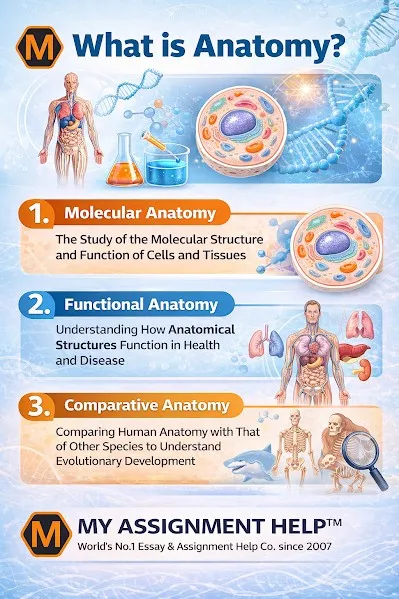
Molecular Anatomy involves the examination of the biochemical aspects of the body’s anatomical structures. This often overlaps with chemical processes; students exploring this link may benefit from chemistry class help to better understand molecular interactions.
Example:
One key example of molecular anatomy is the study of cancer at the cellular level. Researchers examine the DNA mutations and gene expressions that lead to cancerous growth. For instance, in breast cancer, scientists study the overexpression of the HER2 gene that triggers abnormal cell growth in breast tissue. At the molecular level, this involves understanding how the mutation alters the structure of proteins and disrupts normal cell signaling pathways, leading to uncontrolled cell division and tumor formation.
Functional Anatomy is the study of how the structure of anatomical parts works together to perform specific functions in the body. It not only focuses on the structure itself but also on how those structures contribute to physiological processes in health and disease.
Example:
A classic example of functional anatomy is the human musculoskeletal system. In health, bones provide the body with structural support, while muscles generate movement. When studying a knee joint, functional anatomy explores how the ligaments, tendons, and muscles work together to allow bending and extension. In disease, functional anatomy might investigate how conditions like arthritis or osteoporosis affect the function of joints. For example, in osteoarthritis, cartilage degradation impairs the smooth movement of bones, reducing joint mobility and causing pain, which is a direct impact of altered anatomical function.
Comparative Anatomy involves comparing the anatomical structures of different species to understand the evolutionary relationships and adaptive changes over time. This field helps us understand how the structure of different organisms has evolved to meet specific environmental demands.
Example:
One of the most famous examples of comparative anatomy is the study of the vertebrate limb. Humans, dogs, whales, and bats all have limbs with similar bone structures (i.e., humerus, radius, and ulna), even though these species use their limbs for vastly different functions—walking, swimming, and flying. By comparing these limbs, researchers can trace the evolutionary changes that have occurred over millions of years, demonstrating how the same basic anatomical structure has been modified to serve different functions. This is a clear example of adaptive evolution, where the anatomical structure has been conserved, but its function has diversified.
For students embarking on their anatomy dissertation, structuring the paper is crucial. Below is an outline that will guide you through the process:
Example:
If you’re researching neuroanatomy and the role of brain plasticity in recovery from stroke, your introduction could start by saying:
“This dissertation explores the concept of neuroplasticity in the human brain, specifically in the context of recovery after a stroke. Neuroplasticity is the brain’s ability to reorganize itself by forming new neural connections, and understanding this process is vital for developing effective rehabilitation therapies.”
Tip: Your introduction should provide a concise explanation of the research topic and highlight its relevance to real-world issues or gaps in current anatomical knowledge. Always include the purpose of your research and its potential impact on the field.
Example: Previous studies have shown that neuroplasticity plays a significant role in recovery from stroke (Smith et al., 2020; Johnson, 2019). However, much of the research focuses on the effects of neuroplasticity in younger patients, leaving a gap in understanding how the elderly brain responds to such changes (Miller, 2021).”
Tip:
The literature review should give a comprehensive overview of the existing research related to your topic, focusing on both foundational studies and the latest findings. Identify research gaps that your dissertation will address to establish the significance of your study.
Example:
“This research will employ functional MRI (fMRI) scans to observe the changes in brain activity in stroke patients undergoing rehabilitation. Additionally, we will conduct neuroimaging studies before and after therapy to assess neural recovery.”
Tip: Your methodology should be clear and detailed, outlining how you will collect and analyze data. Mention specific tools or techniques, such as imaging (MRI, CT scans), dissection methods, or experimental procedures, and explain why you’ve chosen them for your research.
Results and Discussion: Present your findings and provide a detailed analysis.
Example: “The functional MRI scans revealed significant changes in the brain’s motor cortex activity in patients who underwent therapy. Specifically, elderly patients showed less reorganization in the brain compared to younger individuals, suggesting age-related limitations in neuroplasticity (Figure 3).”
Tip: In this section, present the data clearly through graphs, tables, and figures. Then, discuss the significance of these findings in relation to existing literature. Make sure your discussion connects the results to your research question and highlights any new insights.
Example: “In conclusion, this study underscores the importance of age in the brain’s capacity for neuroplasticity following stroke. Future research should explore targeted therapies for older patients to improve recovery outcomes.”
Tip: Summarize your key findings and their broader implications. Propose directions for future research based on limitations or unanswered questions that arose during your study. Suggest ways in which your research could inspire new studies or improvements in medical practices.
Importance of Anatomy Research
Anatomy research plays a key role in medical sciences, engineering, and various other fields. Some of the most notable applications include:
Anatomical knowledge is fundamental for medical practice, whether diagnosing illnesses, planning surgeries, or developing new treatment protocols. Research in this area leads to a better understanding of diseases, injuries, and surgical procedures. Given the rigor of these studies, many students seek medical assignment help to master complex clinical scenarios.
Essential for patient assessments and post-operative care. For those balancing clinical rotations with academic writing, nursing essay help can be a vital resource.
Biomedical engineers rely on anatomical understanding to design prosthetics. Students specializing in this niche may require engineering class help to bridge the gap between mechanics and biology.
Forensic scientists use anatomical knowledge to investigate criminal cases, particularly in determining the cause of death, the extent of injuries, or the presence of diseases.
Anatomy research isn’t just limited to understanding the structures of organs and tissues. It also involves investigating how these structures work together. Some interesting anatomy topics include:
Anatomy Research Methodologies
Anatomy research employs various methodologies, ranging from traditional methods like dissection to modern imaging techniques. Some of the most important methodologies include:
Imaging technologies such as CT scans, MRIs, and X-rays provide 3D images of the body’s internal structures. These tools allow researchers to study anatomy in living subjects, which was previously not possible with traditional dissection.
Understanding the molecular makeup of anatomical structures, such as proteins, genes, and cells, has opened up a new world of research possibilities. For example, studying how molecular changes contribute to diseases like cancer or Alzheimer’s is an emerging area of research.
Researchers use computational tools to create digital models of the human body, which can be used for educational purposes, surgical planning, or even testing hypotheses. This methodology has expanded the scope of anatomy research significantly.
Using model organisms or lab-grown tissues, scientists can study the development and function of anatomical structures. This research often focuses on development, injury recovery, or disease progression.
Let us help you with custom research papers and expert advice.
Below are some of the most trending anatomy research topics for students in 2026:
Example:
Research could examine how Alzheimer’s disease leads to the shrinking of the hippocampus, a key brain structure for memory. This anatomical change helps explain the cognitive decline seen in patients.
Tip:
Focus on how brain structure and neurological diseases like Alzheimer’s, Parkinson’s, and stroke are connected. Use brain scans or neuroimaging studies to visualize anatomical changes.
Since this field often intersects with behavioral science, students can find additional support through psychology exam help when studying the brain-mind connection.
The impact of collagen on bone strength and density.
Example:
Research how joint mechanics in the knee, such as the relationship between the femur and tibia, affect movement and contribute to conditions like arthritis.
Tip:
Investigate joint function and muscle strength. Discuss how anatomical variations or conditions like osteoporosis affect overall mobility and skeletal health.
Example:
Examine how the structure of the heart affects its ability to pump blood, and how structural changes, like valve damage, contribute to conditions like heart failure.
Tip:
Focus on how heart anatomy affects cardiovascular health. Discuss the impact of disease on the heart’s structure and its ability to circulate blood.
The anatomy of the small intestine and its role in nutrient absorption.
Example:
Study how the stomach and small intestine work together to absorb nutrients and digest food, and how disruptions in this system lead to conditions like IBS.
Tip:
Research the digestive process and organ functions, emphasizing how anatomical changes affect digestion and nutrient absorption.
Example:
Research how lung anatomy influences the process of gas exchange during breathing and its role in diseases like COPD.
Tip:
Study the anatomy of the lungs and airways. Explain how anatomical variations or diseases disrupt normal lung function and oxygen exchange.
Example:
Research the thyroid gland’s anatomy and its role in regulating metabolism. Investigate how thyroid imbalances lead to disorders like hyperthyroidism or hypothyroidism.
Tip:
Study the endocrine glands and their role in hormone regulation. Focus on how anatomical changes in glands like the thyroid or adrenal glands contribute to metabolic and hormonal disorders.
Anatomy Presentation Topics
Here are some fascinating anatomy presentation topics for academic or professional settings:
The intricate structures and functions of the brain, spinal cord, and neurons.
Example: Present how electrical signals travel through neurons and how damage to the myelin sheath causes disorders like multiple sclerosis.
Tip: Use diagrams or animations of nerve pathways to simplify complex concepts and keep the audience engaged.
How the heart structure influences its efficiency and cardiovascular disease development.
Example: Explain how blocked coronary arteries disrupt blood flow and increase the risk of heart attacks.
Tip: Include flow charts showing blood circulation—visuals make cardiac processes easier to understand.
How stem cells contribute to healing and regenerating damaged tissues and organs.
Example: Highlight stem cell use in repairing damaged spinal cord tissue after severe injury.
Tip: Add recent case studies or clinical trials to make the presentation more practical and research-oriented.
How technology, such as 3D imaging and AI, will shape the future of anatomical education and research.
Example: Discuss how AI-based 3D organ mapping is helping surgeons visualize anatomy during minimally invasive procedures.
Tip: Include emerging tech trends (VR, AI, 3D imaging) and mention ethical considerations to show critical thinking.
Writing an anatomy dissertation requires picking a topic that is both meaningful and researchable. Below are some innovative dissertation ideas:
Clinical anatomy applies anatomical knowledge to medical practices. Some trending research topics include:
For students looking to explore anatomy through practical projects, here are some exciting ideas:
Using software or 3D printing to design a functional model of the human heart.
Example: Create a 3D-printed heart showing chambers, valves, and blood flow pathways for a biology fair.
Tip: Use contrasting colors to highlight key structures like ventricles and arteries for better visualization.
Constructing a skeletal model using materials like cardboard, clay, or 3D printing.
Example: Design a life-size cardboard or clay skeleton demonstrating joint movement and bone articulation.
Tip: Focus on major bones first (skull, femur, ribs) before adding smaller structures to save time.
Using VR technology to create an immersive experience for studying human anatomy.
Example: Develop a VR module allowing users to navigate through organ systems and zoom into tissues.
Tip: Include interactive labels or quizzes to boost engagement and learning retention.
Here are a few examples of anatomy thesis topics:
Example: Study how mutations in the COL1A1 gene lead to brittle bone disease, causing bones to break easily due to abnormal collagen production.
Tip: Focus on the connection between genetics and bone structure. Use genetic research to explore how specific mutations cause deformities.
Example:
Research how the shrinking of the hippocampus in Alzheimer’s disease affects memory and cognitive function.
Tip:
Investigate brain imaging studies to understand how anatomical changes in brain regions contribute to conditions like Alzheimer’s or Parkinson’s.
Conclusion
Anatomy research is vast and offers endless possibilities for exploration. Whether you are working on a dissertation, presentation, or project, there is a rich array of topics waiting to be explored. Anatomy not only enhances our understanding of the human body but also contributes significantly to fields like medicine, healthcare, engineering, and even forensic science. As new technologies and research methodologies continue to emerge, the future of anatomy research is incredibly exciting.
If you need nursing essay help, biology assignment help, or medical assignment help while researching anatomy topics, there are plenty of academic resources available to guide your studies. Take advantage of these opportunities and dive deep into one of the most exciting and essential fields of science.

I am a senior academic consultant with deep expertise in business, management, and MBA-level research. I specialize in dissertations, theses, and case studies, delivering strategic, well-structured, and academically rigorous content.










 WhatsApp

