


 05 December,2025

Table of Contents
Business law gives the rules for how businesses work. It includes contracts, employment, intellectual property, taxes, and company structure. It also explains the rights and duties of people and businesses.
For students in law or business, it is important to see how business law works in real situations. Case studies help with this. They show how rules are applied and decisions are made in real disputes.
This guide gives clear business law case study examples with explanations and key points. Each example shows how courts use legal reasoning in business problems. Whether you are doing an assignment or looking for business law case study help, these examples can help you understand how the law affects the business world. Students can also find study materials and Assignment Help on our academic portal.
A business law case study shows a legal problem or dispute. It can be based on real or hypothetical situations. Students need to find the important facts, identify the legal issues, use the right laws or past cases, and give solutions with clear reasoning.
Studying these examples allows students to apply classroom theories to practical challenges faced by companies and individuals.
When preparing or reviewing a case study in business law, always structure your analysis around:
Business law covers multiple legal branches that interact in the corporate world. Below are the most common categories of cases in business law you should know before diving into the examples:
Disputes over agreements between two or more parties — such as breaches, non-performance, or unfair terms.
Focus on the internal structure and operation of companies — including shareholder rights, director duties, and company formation.
Deal with product quality, unfair business practices, and consumer protection.
Cover wrongful acts that cause harm to others, such as negligence or defamation.
Protects creative works and inventions under patents, copyrights, and trademarks.
Regulate the legal process when individuals or companies cannot meet their financial obligations.
Understanding these categories will help when reviewing the business law case study examples that follow. You can also explore more Commercial Law case study examples for related insights.
Below are landmark and illustrative cases frequently discussed in business law courses. Each example includes the background, legal issue, and key learning outcome.
Background:
Mrs. Donoghue drank a bottle of ginger beer that had a decomposed snail in it. She became ill. She sued the manufacturer even though she did not buy the drink herself.
Legal Issue:
Can a manufacturer owe a duty of care to the final consumer if there is no direct contract?
Decision:
The House of Lords said the manufacturer was responsible. It created the “neighbour principle,” meaning everyone must take reasonable care to avoid harming others.
Takeaway:
This case started modern tort law and product liability. It reminds businesses to keep their products safe and maintain quality for all consumers.
Background:
Mr. Salomon turned his leather business into a limited company. When the company went bankrupt, the creditors tried to make him pay the debts personally.
Legal Issue:
Should shareholders have to pay the company’s debts themselves?
Decision:
The court said the company is a separate legal person from its shareholders.
Takeaway:
This case introduced the idea of corporate legal personality. It protects investors from personal liability. It is an important principle in business law cases about companies.
Background:
The company promised £100 to anyone who used its product and still caught influenza. Mrs. Carlill did and fell ill. The company refused payment.
Legal Issue:
Was the advertisement a binding contract?
Decision:
Yes. The court held that the company’s promise was a unilateral offer accepted by performance.
Takeaway:
Shows how advertising statements can become binding agreements if intent and consideration exist — a classic contract law case study example.
Background:
This case looked at when a bank or lender might pressure a borrower in a mortgage agreement.
Legal Issue:
How can courts protect borrowers from unfair pressure or manipulation?
Decision:
Banks must make sure clients get independent legal advice before signing risky agreements.
Takeaway:
The case highlights fairness and informed consent. It is important for ethical banking and contract rules.
Background:
A farmer mortgaged his property to help his son’s failing business. The bank did not explain the risks properly.
Legal Issue:
Did the bank act unfairly and create an unequal contract?
Decision:
The court saw that the farmer had less bargaining power and ruled in his favor.
Takeaway:
The case shows that fairness matters in contracts. Courts can step in when one party takes advantage of another.
Background:
Mr. McSmith returned a leased car to GM. The company charged him for missing documents he never got from the supplier.
Legal Issue:
Can a customer be held responsible for something not in the original contract?
Decision:
The supplier, not Mr. McSmith, was responsible.
Takeaway:
The case shows consumer protection rules. Companies must be clear and fair, and they should not punish customers for their mistakes.
Background:
DHS, a smartphone manufacturer, hired CDS Software to develop an app. Midway, CDS delayed work and demanded additional payment. DHS canceled the deal.
Legal Issue:
Who breached the contract, and what remedies apply?
Decision:
DHS had grounds to terminate since CDS failed to deliver as agreed.
Takeaway:
Demonstrates the importance of clearly defined deliverables and timelines in contracts.
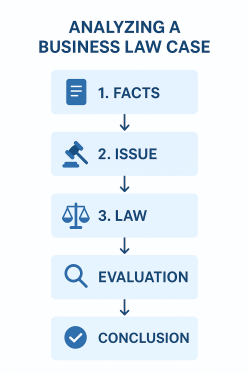
Effective analysis is essential for assignments or exams involving business law case study examples. Follow this five-step method:
Pro Tip: If you struggle with structuring complex scenarios, you can refer to legal resources or seek Expert Case Study Writing Service for guidance — but always ensure your analysis reflects your own understanding. Students can refine their presentation by learning best practices for writing the Business Law case report.
Studying business law cases gives more than just knowledge of laws. It also shows how legal decisions affect businesses. Through case studies, students learn:
Pro Tip: In professional life, this knowledge aids managers, entrepreneurs, and lawyers in making informed, legally compliant decisions.
Understanding the accounting implications in Business Law cases can reveal how financial documentation supports legal decisions. Whether you analyze famous precedents or use academic examples, remember: each case study of business law is a lesson in problem-solving, reasoning, and justice.
Pro Tip: Always properly cite your legal sources (APA Citation) to avoid academic errors. Students who struggle with structuring legal arguments can seek Professional Law Assignment Help for guided learning.
| Step | Action | Focus |
| 1. Restate Thesis | Rephrase your original thesis statement using new language. | Remind the reader of your main claim. |
| 2. Summarize Main Points | Briefly review the 2–3 main techniques (P-E-A paragraphs) you used to support your thesis. | Synthesize the evidence presented in the body. |
| 3. Final Insight | End with a powerful closing statement that addresses the work’s larger significance or suggests future implications. | Leave a lasting impression. |
Pro Tip: For broader context, check more general Legal Case Study examples covering torts and civil law.
Business law case study examples help students learn how legal problems happen. They show how to find an issue, use the law, and see how decisions are made. Cases about negligence, contracts, or company mistakes show how laws work in real business situations.
When you read a case or write your own analysis, follow a simple plan. First, explain the main problem. Then, list the laws that relate to it. Finally, describe what you learned from the case and how it might apply in real life.
For comprehensive academic and practical assistance, students can access Comprehensive Business Law and Management Assistance to strengthen both legal and business understanding. If workload is overwhelming, you can also pay an expert to handle your complex assignments while you focus on building core legal skills.
It is a summary of a legal problem in business. It focuses on the facts, the laws that apply, and clear solutions.
Common topics include contract law, company rules, consumer protection, torts, intellectual property, and bankruptcy.
Find the facts, identify the legal problem, use the right laws or past cases, and explain your answer clearly.
Some well-known cases are Donoghue v Stevenson, Salomon v Salomon, Carlill v Carbolic Smoke Ball, and RBS v Etridge.
Students can check legal databases like LexisNexis or Google Scholar. They can also use university law blogs or textbooks with solved examples. For extra help, students may use business law case study resources or tutorials that explain how to approach each case.

Hi, I am Mark, a Literature writer by profession. Fueled by a lifelong passion for Literature, story, and creative expression, I went on to get a PhD in creative writing. Over all these years, my passion has helped me manage a publication of my write ups in prominent websites and e-magazines. I have also been working part-time as a writing expert for myassignmenthelp.com for 5+ years now. It’s fun to guide students on academic write ups and bag those top grades like a pro. Apart from my professional life, I am a big-time foodie and travel enthusiast in my personal life. So, when I am not working, I am probably travelling places to try regional delicacies and sharing my experiences with people through my blog.










 WhatsApp

