


 31 December,2025

Table of Contents
Greenhouse growing began many centuries ago as a practice mainly used by royalty. Early greenhouses helped protect rare plants and grow medicinal crops. They were symbols of wealth and curiosity and were later adopted by universities for plant research and agricultural studies.
Today, the greenhouse effect is discussed for a very different reason. With rising concern about climate change and global warming, people are debating whether the greenhouse effect is helpful or harmful. Students researching these impacts can explore Climate Change Research Topics for in-depth academic ideas
The greenhouse effect works like a natural blanket, trapping heat and keeping the planet warm enough to support life. Without it, Earth would be frozen. The real issue is that human activities have made this process too strong. Large amounts of gases like carbon dioxide and methane now trap too much heat. This has led to rising temperatures, stronger heatwaves, severe storms, and coastal flooding. Understanding the disadvantages of the greenhouse effect is key to understanding the risks facing our planet today.
The greenhouse effect is created when gases in the air trap heat from the sun and keep the Earth warm. This heat would normally escape into space. Greenhouse gases stop that from happening and keep Earth warm.
In natural balance, this process supports life. However, human activities such as burning coal, oil, and gas, cutting down forests, and intensive farming have increased greenhouse gas levels. This has strengthened the greenhouse effect beyond safe limits.
The result is global warming. This warming affects weather patterns, oceans, ecosystems, and human systems across the planet.
The real problem isn’t just higher temperatures or stronger storms — it’s that global warming disrupts the balance of nature itself. Plants, animals, and humans all rely on stable weather, predictable seasons, and healthy ecosystems. When this balance breaks, food, water, and livelihoods are at risk. What were once rare disasters become normal, and the planet’s ability to support life weakens.
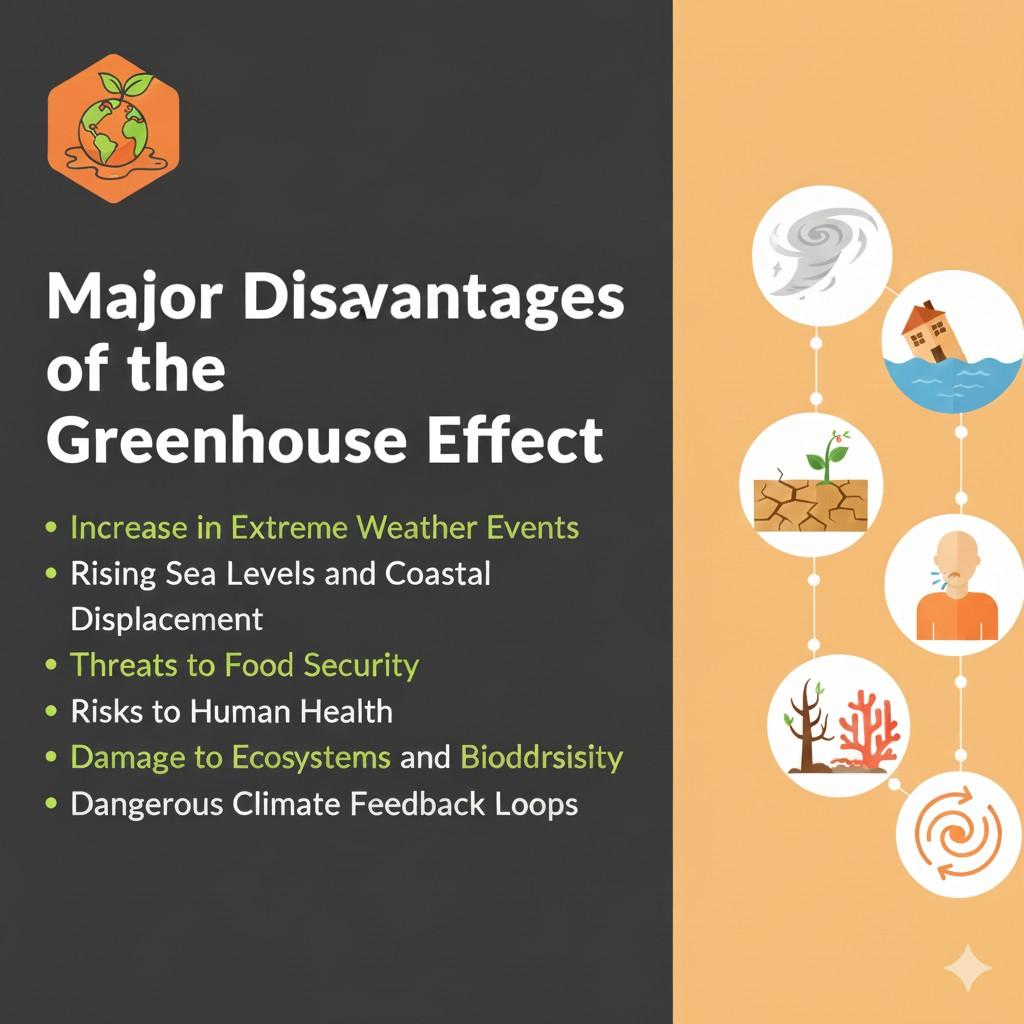
One major disadvantage of the enhanced greenhouse effect is extreme weather. Higher temperatures change how water moves through the environment. Some regions face heavier rainfall and floods. Others suffer from long periods of drought.
Heatwaves now last longer and reach higher temperatures. Warmer oceans provide more energy to storms, making hurricanes and cyclones stronger. According to the National Oceanic and Atmospheric Administration (NOAA), climate-driven weather extremes are becoming more frequent and more intense.
These events damage homes, roads, farms, and power systems. They also put lives at risk. What were once rare disasters are becoming more common, and emergency services are struggling to keep up.
As the planet warms, ice sheets and glaciers melt. This meltwater flows into the oceans. At the same time, warmer seawater expands. Both processes raise sea levels.
Data from NASA’s Climate Change program and the National Oceanic and Atmospheric Administration (NOAA) show that global sea levels are rising at an accelerating rate. Coastal cities, island nations, and low-lying areas now face regular flooding.
Saltwater enters freshwater sources and farmland, making them unusable. Millions of people may be forced to leave their homes, increasing social and political pressure in many regions.
Food production depends on stable weather. The greenhouse effect disrupts this balance. Droughts reduce crop growth. Heavy rains destroy harvests. Heat stress harms both crops and livestock.
According to the UN Food and Agriculture Organisation (FAO), rising temperatures and changing rainfall patterns are already reducing yields of major crops such as wheat, rice, and maize in vulnerable regions.
When food supply drops, prices rise. Low-income communities suffer the most. Over time, food shortages can lead to hunger, poor nutrition, and social unrest.
The enhanced greenhouse effect has serious health impacts. High temperatures increase cases of heat exhaustion and heatstroke. Older adults, children, and outdoor workers face the greatest risk.
The World Health Organisation (WHO) warns that climate change increases deaths linked to heat stress and worsens air quality, leading to higher rates of respiratory and heart disease.
Warmer climates also allow insects like mosquitoes to spread into new areas. Diseases such as malaria, dengue, and Zika are now appearing in regions where they were once rare.
Plants and animals struggle to adapt to rapid climate change. Coral reefs bleach as ocean temperatures rise. Forests face more fires, pests, and drought stress.
Many species lose their natural habitats. Some cannot survive these changes and face extinction.
When ecosystems break down, they stop providing key services. These include clean water, pollination, and carbon storage. This makes climate change even worse.
One of the most serious disadvantages of the greenhouse effect is the risk of feedback loops. These loops speed up warming.
For example, melting ice exposes darker land and water. These surfaces absorb more heat. Thawing frozen soil releases methane, a powerful greenhouse gas.
| Feedback Loop | Why It’s Dangerous |
| Ice-albedo loss | Less ice → more heat absorbed |
| Permafrost thaw | Releases methane (80× CO₂ power short-term) |
| Forest dieback | Turns carbon sinks into emitters |
Once these loops start, they accelerate global warming and become hard to stop.
Climate change creates high economic costs. Storms, floods, and fires destroy infrastructure and disrupt businesses. Governments spend billions each year on recovery and repair.
Poorer countries often suffer the most damage. They also have fewer resources to adapt. This increases inequality between nations.
Social impacts include forced migration, job losses, and conflict over water and land. These pressures threaten long-term stability.
Greenhouse gases stay in the atmosphere for decades. Every year of delay locks in more warming.
If temperatures pass certain limits, the damage may become permanent. The cost of fixing problems later will be far higher than acting now.
Early action reduces risk, saves money, and protects lives.
The disadvantages of the greenhouse effect are serious, but solutions exist. Switching to renewable energy reduces emissions. Using energy more efficiently lowers demand. Protecting forests helps absorb carbon dioxide.
Governments can set strong climate policies. Businesses can adopt cleaner practices. Individuals can reduce waste and energy use.
Education and awareness play a key role. When people understand the risks, they are more likely to support change.
The greenhouse effect once made life on Earth possible. Today, its rapid intensification threatens our future. Rising temperatures, extreme weather, health risks, and economic losses are already shaping daily life. The choices made now will affect generations to come.
Acting quickly can reduce damage and protect the planet. Ignoring the problem will only make the consequences harder to manage.
If you’re studying science or preparing assignments related to climate change, our Science Assignment Help can guide you in completing projects effectively.
Get expert-written, plagiarism-free assignments delivered on time.
Curious about the benefits as well? Read our complete article on the advantages of the greenhouse effect to see how it supports life on Earth.
Ans: While the natural greenhouse effect keeps Earth warm, human activities like burning fossil fuels, deforestation, and industrial processes add extra greenhouse gases, making the planet hotter than normal.
Ans: Low-lying coastal areas, small island nations, and regions prone to drought or extreme weather are most at risk. Vulnerable populations often face the biggest economic and health impacts.
Ans: Yes. Renewable energy, carbon capture, reforestation, and sustainable agriculture can lower greenhouse gas emissions and help stabilise the climate. However, global cooperation is critical.
Ans: Trees absorb carbon dioxide. When forests are cut down or burned, CO₂ is released back into the atmosphere, reducing Earth’s natural ability to regulate heat and increasing global warming.
Ans: Yes. If greenhouse gas emissions are not reduced, some impacts like ice sheet melting, biodiversity loss, and dangerous climate feedback loops may become irreversible.
This article is informed by publicly available reports and datasets from globally recognised scientific and public health institutions, including:

I am a scientific writing expert specializing in STEM and medical research. I create technically precise, research-driven academic documents, including dissertations, lab reports, and advanced scientific assignments.










 WhatsApp

