


 11 June,2026

Table of Contents
When I first started helping college students analyze business case studies, I noticed a major recurring theme. Most young entrepreneurs focus entirely on product development, marketing, and coding, while completely ignoring how to protect their brand name.
During my time writing term papers on legal frameworks, I realized that ignoring intellectual property rights is one of the costliest mistakes an aspiring business owner or student can make, often requiring professional law assignment help to understand correctly.
Whether you are preparing a term paper analysis, studying for a business law curriculum final exam, or launching a side hustle from your dorm room, understanding how a brand identity stays safe is vital.
Let us dive into the legal mechanics of how symbols and words establish market value and maintain institutional trust.
A question I am frequently asked during exam prep sessions is: “What can actually count as a valid mark?”
A trademark is a recognizable sign, design, phrase, or expression that identifies products or services from a specific source and distinguishes them from competitors. Legally, a trademark serves as a distinctive source identifier that prevents market confusion and secures exclusive rights for brand owners.
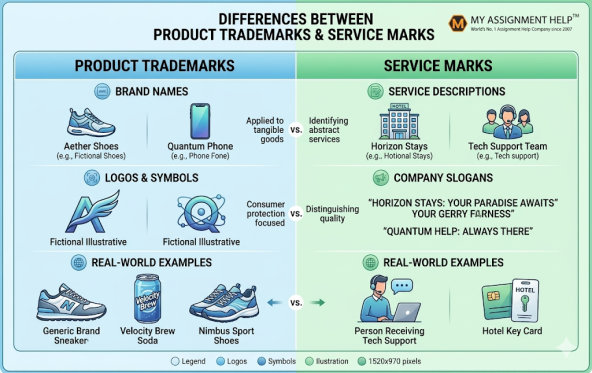
When someone asks for a simple definition of trademark protections, I tell them to think of it as a commercial fingerprint. In intellectual property law, it ensures that when a buyer looks at a label, they know exactly who made the product. If you are working on a trademark definition for students, remember that its primary job is acting as a trusted source identifier in the public marketplace.
When looking at a trademark definition in business law, remember that the law grants these rights to create a fair playing field.
To understand how does a trademark work, you have to look at how businesses operate under modern statutory guidelines. A trademark does not just sit on a document. It actively protects a business name, its market share, and its public consumer goodwill.
Here is a simple breakdown of the lifecycle and functionality of a working trademark:
Without a robust trademark law definition, any copycat could open up a shop using your exact logo, stealing your revenue and destroying your brand identity overnight.
The actual intent of an intellectual property trademark can be split into two main structural benefits:
Trademarks protect buyers by serving as an explicit guarantee of quality and origin. When you see a protected mark, you know exactly what level of product performance you are purchasing, protecting you from counterfeit items.
A company spends years and millions of dollars building a solid reputation within the global business environment. That accumulated market trust is known as goodwill.
The purpose of a trademark is to give companies a legal shield to lock down that goodwill, ensuring that their market equity cannot be legally or illegally drained by competitors.
One of the most common mix-ups I see on college business law exams is using the terms trademark, copyright, and patent interchangeably. They protect entirely different assets. Let us look at this clear comparative grid table to permanently separate these concepts for your syllabus.
| Feature | Trademark | Copyright | Patent |
|---|---|---|---|
| What it Protects | Brand Identifiers (Names, Logos, Slogans, Symbols) | Original Artistic & Literary Works (Books, Music, Code, Videos) | Functional Inventions and Scientific Processes |
| Primary Goal | Prevents Consumer Confusion in the Market | Prevents Unauthorized Duplication of Expression | Prevents Others from Making or Selling the Technology |
| Governing Body | USPTO (Federal Registration) | US Copyright Office | USPTO (Federal Patent Law) |
| Duration | Indefinite (As long as it is renewed and used in commerce) | Author’s life plus 70 years | Generally 20 years from the filing date |
| Real-world Example | The Nike Swoosh / The name “Apple” | The text of a business law textbook | The physical touchscreen mechanism of a phone |
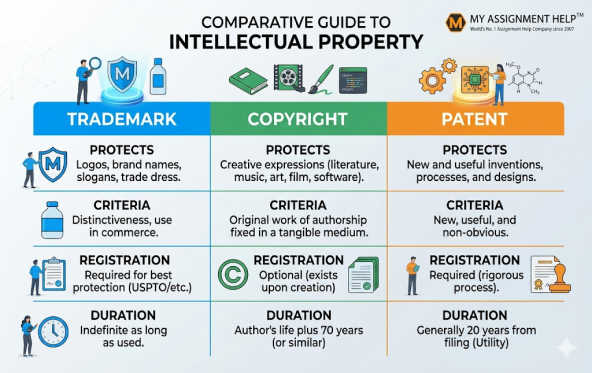
To break this down even further, think about a commercial video game. The actual technical coding and game mechanics might be covered under a patent. The storyline, cinematic scripts, background music, and character artwork are protected by a copyright. However, the title of the game, the studio logo, and the character names used to market the merchandise are protected by a trademark.
To be eligible for legal ownership and protection, an item must be a distinctive mark. This means it cannot be a generic word that everyone needs to use to describe a product. For instance, you cannot trademark the word “Apple” if you are selling fresh fruit from an orchard, but you can absolutely trademark it if you are selling computers.
A registered trademark (®) is officially registered with a government office, granting nationwide exclusive rights, legal presumption of ownership, and strong protection against infringement. An unregistered mark (™) relies on common law rights built through actual business use. Protection is limited only to the specific geographic area where it operates.
If you see the ™ (trademark) or ℠ (service mark) symbol, it means the business is claiming common law trademark rights. They have not registered their asset with the federal government. Instead, their ownership is based purely on geographic usage and local commercial activity.
The ® symbol stands for a verified, fully certified registered trademark. This means the owner has successfully filed their asset through the official USPTO trademark framework. A registered trademark grants the owner sweeping, nationwide exclusive rights.
If you want to secure nationwide legal ownership of your brand asset, you must complete the official federal trademark registration track. Here is the chronological path to executing a proper application:
Under the Lanham Act (the primary federal trademark statute in the United States), trademark infringement occurs when an unauthorized party uses a mark that is confusingly similar to a registered trademark on related goods or services.
To win an infringement case in a US court, a trademark owner must prove that there is a high likelihood of confusion for the average consumer.
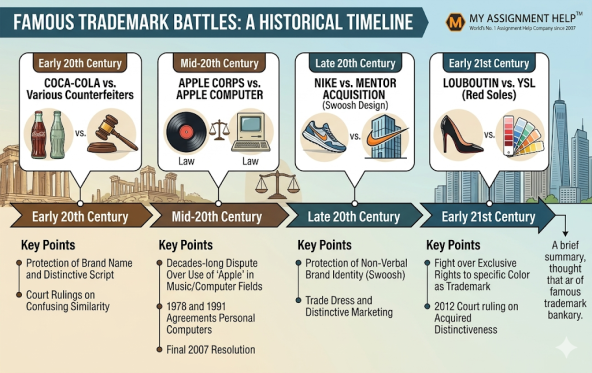
In 1978, Apple Corps (founded by the band The Beatles) sued Steve Jobs’ upstart company, Apple Computer, for trademark infringement. The two parties reached an agreement where Apple Computer promised never to enter the music business. Decades later, when Apple Computer introduced the iPod and the iTunes Music Store, Apple Corps sued them again. The multi-million dollar dispute was only settled when Apple Inc. acquired the ownership of all trademark rights related to the name “Apple” and agreed to license them back to the music company.
Receive high-quality, original papers, free from AI-generated content.
The global sportswear giant Adidas has filed numerous lawsuits against retail brands like Forever 21 for producing clothing items featuring parallel two-stripe or four-stripe designs.
Over the years, Adidas has filed numerous lawsuits against retail brands like Forever 21 for producing clothing items featuring parallel two-stripe or four-stripe designs.
Adidas argued that these designs intentionally capitalized on their sportswear reputation and created a distinct likelihood of consumer confusion. These cases highlight how even a simple geometric pattern can serve as a multi-billion dollar source identifier protected under federal statutes.
Navigating the landscape of intellectual property law can feel overwhelming at first, but mastering these core pillars is a huge advantage for your upcoming assignments and capstone projects.
Whether you are defining a mark on an exam sheet, mapping out a business model, or analyzing case studies, always keep the primary purpose in mind: trademarks exist to identify the source, protect the brand identity, and maintain consumer trust.
When reading corporate documents or textbook case studies, you will notice different symbols next to brand names.
A federal trademark registration lasts for an indefinite period, meaning it never expires as long as the owner continues using the mark in active commerce and timely files its maintenance documents. To keep the registration active, the owner must submit a Declaration of Use between the 5th and 6th years after registration, and file a renewal application every 10 years.
You can easily define a trademark by stating that it is a distinctive word, phrase, logo, or design that legally identifies the source of a product or service. To get full points from your professor, make sure to state that its main legal objective is to provide source identification and prevent consumer confusion in the marketplace.
No, you cannot register a single trademark that covers the entire world automatically, because trademark rights are strictly territorial. However, you can use the Madrid System managed by the World Intellectual Property Organization (WIPO) to submit a single international application that allows you to request protection across more than 130 member countries simultaneously.
A trademark’s strength depends on its level of distinctiveness, which is measured along a legal spectrum of five categories: fanciful, arbitrary, suggestive, descriptive, and generic. Fanciful marks (invented words like Exxon) and arbitrary marks (real words applied to unrelated items like Apple computers) are inherently strong, while descriptive or generic terms are weak and legally difficult to protect.
The primary difference is that a trademark protects specific brand identifiers like names and logos, whereas trade dress protects the overall visual image and configuration of a product or its packaging. Trade dress includes elements such as the distinct shape of a Coca-Cola bottle or the unique interior layout and color scheme of an Apple retail storefront.

I am an analytical content writer covering social sciences, trends, and general educational topics. I deliver insightful, experience-based content that connects academic concepts with real-world relevance.










 WhatsApp

