


 12 May,2026

Table of Contents
Online learning has made education flexible and easily accessible for everyone. Now students can enroll in any online course based on their preference from a remote location. The flexibility allows students to manage several activities while pursuing a full-time academic degree.
While this convenience has benefited millions of students, it also comes with some silent problems that often overwhelm students with day-to-day activities. These problems not only affect the students’ academic growth but also severely impact their mental health.
Today, academic stress is no longer restricted to classrooms, exams, or strict deadlines. In online education, academic stress often appears in various forms. Students need to deal with assignment overload, isolation, time management, lack of interaction, technical issues, and much more.
Over time, if precautionary steps are not taken students may start experiencing a lack of confidence, poor concentration, and low motivation. This impacts their overall efficiency and academic performance.
This blog by MyAssignmentHelp explores how academic stress impacts online course performance, supported by facts, research findings, realistic examples, and case studies.
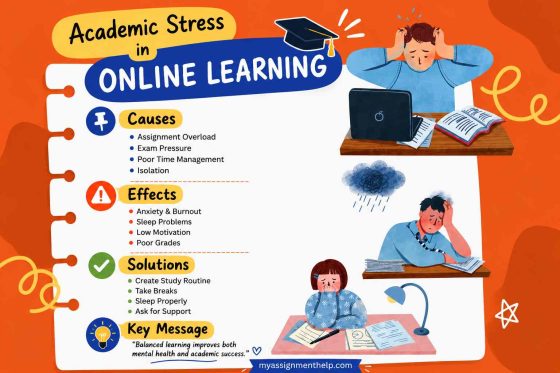
Academic stress is all about experiencing mental and emotional pressure due to the demanding nature of online courses. The pressure often becomes unmanageable because students are supposed to handle everything independently. As a result, students start experiencing stress and exam anxiety.
Common causes of academic stress in online education include:
Note: As per the Indonesian university’s research it is found that there is a significant relationship between online learning and academic stress. Researchers concluded that the change in the learning habits in digital education increases stress level among students.
In academics stress and academic pressure are co-related. Whenever the academic pressure increases stress also increases. It often starts with facing a heavy workload, approaching deadlines, upcoming exams, and quizzes.
Students who are not well prepared for these academic activities, often experience mental and emotional stress.
Academic stress can lead to:
The same study also reported that stress contributes to:
Digital learning platforms are gaining immense popularity among students. They are known for offering flexible and easily accessible learning solutions. However, they have some downsides, which are directly linked to increased academic stress and workload.
In a traditional classroom setting, students can directly connect with teachers and classmates. But in online mode of education there is limited opportunity for direct interaction. Moreover, students in online courses often hesitate to ask questions during virtual sessions. As a result they start feeling disconnected from instructors and lose interest.
Example: Alex was pursuing his academic degree through online courses. In the beginning, everything was quite smooth, but over time when coursework turned demanding, he started experiencing loneliness and anxiety.
Since classes were recorded, he started skipping them. Without classroom and peer interaction he not only lost his motivation but also failed in two modules.
Online courses come with various writing tasks. Students participation is must in all these tasks in order to have a consistent academic growth.
Some of the Online course requirements include:
Students often complain that online learning has more homework compared to on-campus learning.
A number of institutes believe students studying remotely have extra time which increases workload pressure.
Several academic research studies show that “task overload” is one of the biggest reasons for academic stress in online learning environments.
In online courses, there are many instances where students need to work with several overlapping academic tasks. Suppose you are pursuing your MBA degree online and this week you need to
Things become complicated when all these tasks share the same deadlines. In such a scenario getting stuck in online courses and being able to match the instructor’s expectations become the major challenge.
During assessment periods, students often complain that they get less than 5 hours of sleep per day. This not only affects mental health, concentration but also triggers stress and anxiety which results in poor grades.
Time management is the biggest challenges among online students. Things become more complicated when they need to manage jobs and online classes simultaneously.
Most of the students in online courses are working professionals either full-time or part-time. Due to this, time management becomes crucial for them for consistent academic growth. Lack of proper time management skills leaves students exhausted, low energized and stressed.
Which later turn into:
Students trying to balance their academics and personal lives often wonder, how can I pay someone to take my online class for me? This reflects the real struggles students face in managing coursework, deadlines, exams, and personal responsibilities successfully. With increasing academic pressure and limited time, many students look for reliable academic assistance to maintain their grades and reduce stress.
Academic stress not only affects grades, but also impacts emotional and physical well-being. Students dealing with excessive stress often experience.
A 2022 study titled “Academic Stress and Mental Well-Being in College Students” published in Frontiers in Psychology found that high academic stress is strongly linked to poor mental well-being, anxiety, depression, emotional exhaustion, and lower productivity among students.
Online exams create a different type of stress as compared to traditional classroom exams.
Students often worry about:
This pressure increases exam anxiety and forces students to look for support systems where they can ask, Can I pay someone to take my online exam for me? Research shows highly anxious students score significantly lower compared to low-anxiety peers.
Several studies have confirmed that academic stress has the potential to negatively impact online learning, performance and productivity.
Source: Frontiers in Psychology
Stress is part of students’ academic journey. However, with the proper planning and strategies, anyone can avoid it and ensure a smooth learning experience.
To handle your online course effectively, you need to create a fixed study schedule. This will help you to
With this, you can easily improve your productivity and overcome the fear of falling behind.
Do not pile up tasks until the last moment. Try to complete them in a given timeframe, and if the task feels overwhelming, break that task into smaller parts. It will help you to complete your task and reduce workload pressure.
Do not hesitate to ask questions in the online classes. Keeping unresolved doubts causes confusion, and increases stress during exams.
If you are thinking that studying in one go will work for you, then you are completely wrong. Continuous screen exposure promotes fatigue. That’s why it is a must for you to take a short break during long lectures to get back to concentration.
Do not sacrifice your sleep if you want to have healthy mental state. Lack of sleep directly affects:
Try to sleep for at least eight hours a day so that you can regain your energy and perform tasks effortlessly. Healthy routines improve academic performance.
When academics feel overwhelming and realize you are unable to match the demanding nature of the coursework, don’t waste time to seek academic support from reliable sources. Many students today seek:
This way you can reduce stress and stay organized.
Online education will continue to grow in the coming years. However, institutions must understand that flexibility alone does not guarantee student success.
Educational platforms need to:
Student well-being should become a core part of online education strategies.
The rise of online courses has exploded with various learning opportunities. It allows students to access education based on their preferences. Now, students can learn at their own pace without any geographical boundaries.
However, the biggest challenge that is associated with online learning is academic stress. While online courses come with several benefits, they demand students to manage everything independently. From assignment overload, exam anxiety, deadline to isolation, these are some major challenges of online learning which can gradually affect students’ academic growth and performance.
However, all these challenges can easily be overcome with the right planning and strategy. Education institutions should also work on minimizing the workload in online courses and focus on creating a learning environment that prioritizes both student success and mental well-being.
Stress in online learning reduces concentration, motivation and productivity which negatively impacts grades and course performance.
Academic stress is often caused by the fear of falling behind. It is usually linked with assignment overload, online exams, poor time management, isolation, and technical issues.
Yes, online learning can affect mental health. When students are pressurized they feel anxious, burned out and tired all the time. All these combined can affect mental health.
To reduce or avoid the academic stress you need to follow a simple tips mentioned below
Following these tips will help you stay consistent, motivated and avoid stress during your learning journey.

I am an experienced class-help specialist supporting students across all subjects. I assist with online classes, coursework, and exam preparation, delivering structured academic guidance, reliable subject coverage, and consistent support to help students succeed confidently.










 WhatsApp

