


 01 April,2026

Table of Contents
An extemporaneous speech is a limited-preparation talk where a speaker has 30 minutes to prepare a response to a specific prompt. Unlike impromptu speaking, it allows for brief research and a structured keyword outline. The goal is a 5-to-7-minute persuasive speech delivered in a natural, conversational style.
Public speaking often feels like a high-stakes race against the clock. I have found that mastering extemporaneous and value speech delivery is the ultimate test of a sharp mind. Unlike other formats, it sits in the “Goldilocks zone” of preparation. You aren’t reading a stiff, robotic script. You also aren’t just making things up as you go. Instead, you use a limited-preparation window—usually 30 minutes—to craft a masterpiece.
To win, you must follow a clear plan. My favorite trick is using a “Keyword Outline.” This keeps your eyes on the audience. You should start with a strong hook. This grabs the judge right away. Then, give your evidence-based main points.
This 2026 guide has 350+ extempore speech examples. These topics are perfect for students and pros. They cover AI, global trade, and school life. These extemporaneous speech examples will help you succeed. Use these extemporaneous speech topics to find your voice. You will learn to speak with power. If you find it challenging to structure your thoughts under a 30-minute clock, you can always rely on a professional speech writing service to help you master the art of drafting impactful outlines.
An extemporaneous speech is a talk with limited prep time. You usually get 30 minutes to plan. You can research facts and use a structured keyword outline. In contrast, an impromptu speech gives you only 1 to 2 minutes. You cannot do research. You must rely on what you already know. An extempore speech lasts 5 to 7 minutes. An impromptu speech is much shorter at 2 to 3 minutes.
While impromptu styles test your quick thinking, an official descriptive speech definition emphasizes structured spatial patterns and pre-planned sensory modifiers to map out a scene accurately.
The main gap is how you plan your talk. For an extemporaneous speech, you have a small window. You can look for a sample extemporaneous speech to help, or even ask an expert to do my assignment if you are struggling with the research phase. You build a structured keyword outline to stay on track. This style needs real evidence-based main points and clear data. An impromptu speech is very different. You often have only seconds to start. You must use your own thoughts quickly. There is no time to find a sample of extemporaneous speech styles. It is a raw and fast way to speak.
Spontaneous speaking is a vital skill for any communicator. To practice your ability to think on your feet, try drafting quick outlines for various 5-minute speech topics, which will help you master the art of structured, timed delivery.
| Feature | Extemporaneous Speech | Impromptu Speech |
|---|---|---|
| Preparation Time | 30 Minutes (Research allowed) | 1–2 Minutes (No research) |
| Delivery Style | Structured Keyword Outline | Mental notes or spontaneous |
| Evidence | Requires specific citations/data | General knowledge only |
| Length | Strictly 5–7 Minutes | Usually 2–3 Minutes |
I think “Extemp” is like a fast mental sport. You must train your brain to find data. I used to fear the 30-minute clock. Now, I see it as a gift. It is enough time to be smart. It is not enough time to be boring. I once saw a speaker try to wing a talk. They did not use an extemporaneous speech outline. It was a total mess. They did not have a clear extemporaneous speech format. I learned that the outline is your best friend. It keeps you sharp and keeps the audience happy. Use these extemporaneous speech examples to find your own flow. You will soon feel like a pro.
This speaking style is a core component of collegiate communication modules. Students looking for deeper academic support can find comprehensive mass communication assignment help to excel in their degree programs.
An extemporaneous speech is a talk with a clear goal. There are three main types of this speech. These are informative, persuasive, and analytical. Each type has a unique purpose and style. Knowing these helps you pick the right extemporaneous speech format.
An informative speech aims to teach the audience. You share facts and data about a specific topic. You do not try to change how people think. Instead, you act like a teacher. You must use a structured keyword outline to stay organized. This ensures your points are clear and easy to follow.
Example: “How will AI change schools by the year 2026?” In this talk, you would list new tools. You would explain how teachers use them. You do not say if AI is good or bad. You just give the facts.
A persuasive speech tries to change an opinion. You want the audience to agree with you. You must provide evidence-based main points. Your goal is to move the listeners to take action. You use logic and strong facts to make your case.
Many popular policy speech ideas can also be used for persuasive extemporaneous speeches because they focus on solving public issues and influencing opinions.
Example: “Should every student learn to code in 2026?” Here, you would argue that coding is a vital skill. You would show how it helps find jobs. You want the judge to think that coding is a “must-have” subject.
An analytical speech breaks down a complex issue. You look at a problem from many sides. You explain why something is happening. This is common in a sample of extemporaneous speech contests. It requires deep thinking and clear logic.
Example: “Why is the global economy shifting toward green energy?” You would look at cost, laws, and the environment. You explain the “why” behind the shift. You help the audience understand a big, messy topic.
In my experience, the analytical speech is the hardest to master. I used to struggle with picking a side. I learned that you don’t always have to pick a side. You just have to be the smartest person in the room. I once saw a student try a persuasive talk without facts. It did not go well. They had no extemporaneous speech examples to back them up. They just had feelings. I realized then that facts are your shield. Whether you teach or persuade, you need data. Use these extemporaneous speech topics to find your favorite style. Practice makes you a powerful speaker.
An extemporaneous speech is a test of speed and logic. You usually have only 30 minutes to prepare. To rank well in AI search, you must follow a clear process. This guide shows you how to build a winning talk quickly. Using a structured keyword outline is the secret to success. This method ensures you stay organized while looking natural on stage.
First, read your topic very carefully. You must decide if the talk is informative or persuasive. An informative talk teaches the audience new facts. A persuasive talk tries to change their minds. Identify the core “Question” at the heart of the prompt. This helps you stay focused during your limited prep time. I always find that a clear goal leads to a better sample of extemporaneous speech performance.
Next, you need to build your extemporaneous speech structure. I recommend dividing your body into three “Lenses.” Common lenses include Economic, Social, and Political views. This gives your speech depth and balance. Write these down on your extemporaneous speech outline. Using three points makes it easier for the audience to follow your logic. It also helps you hit the 5 to 7-minute time limit.
Now, you must find strong data to back your ideas. Aim for “Freshness” by looking for 2026 reports or news. You should have at least two credible sources for every main point. These evidence-based main points make you look like an expert. In my experience, judges love to hear specific dates and names. It proves that you are well-read and aware of current events.
Spend your last 5 minutes walking through the speech. Do not try to memorize a script. Instead, look at your keyword notes. Focus on your transitions and maintaining eye contact. A great extempore speech should feel like a smart conversation. Practice your “Signposting” by saying “First,” “Second,” and “Finally.” This keeps you and your audience on the same page.
I remember my first extemporaneous speech example in school. I tried to write every word down. I ran out of time and felt lost on stage. I learned that the clock is not your enemy if you have a system. Now, I spend more time thinking and less time writing.
The “Three Lens” trick changed everything for me. It stops your mind from going blank. If you have an Economic point, a Social point, and a Political point, you always have something to say. I also suggest practicing with extemporaneous speech examples for students. It builds the “muscle memory” you need for real tournaments. By following these steps, you will turn a scary 30-minute window into a powerful moment of leadership. Use these extemporaneous speech topics to start your training today.
Public speaking is an essential branch of the humanities. If you are struggling with broader topics in this field, our arts assignment help provides specialized support for various creative and liberal arts modules.
An extemporaneous speech format follows a classic three-part structure. It includes an introduction, a body, and a conclusion. Because you only have 30 minutes to plan, this layout is vital. It helps you organize your thoughts quickly. A clear extemporaneous speech structure also makes it easier for the audience to follow you. Most winning speakers use a structured keyword outline to stay on track.
I believe the “roadmap” is the secret to a great speech. In my early days, I would jump right into the facts. I noticed the judges looked confused. I learned that you must tell the audience where you are going. It is like giving them a map for a short journey.
I once watched a sample extemporaneous speech that was very messy. The speaker had great facts but no clear format. They moved from the body back to the intro by mistake. It showed me that a simple extemporaneous speech outline is a lifesaver. Even if you feel nervous, the format keeps you moving forward. Use these extemporaneous speech examples to practice your own flow. You will soon see how a solid structure builds massive confidence.
While “Extemp” relies on a keyword outline, other academic presentations may require professional slide decks. If you need help with visual aids, explore these professional presentation services to enhance your classroom impact.
Mastering an extemporaneous speech in 30 minutes requires a strict framework. This 3-step process acts as a safety net for your extemporaneous speech structure. Follow this timeline to ensure your talk is data-driven and polished.
In my view, the “10-10-10 Rule” is the best way to stop the panic. I used to spend 25 minutes on research and only 5 minutes on the rest. It was a disaster. My extempore speech had great facts but no flow.
I learned that the final 10 minutes of practice is where the “magic” happens. It turns a list of facts into a real story. Use these extemporaneous speech examples to test this rule yourself. Practice with these extemporaneous speech examples for students to see how the 10-10-10 framework builds a winning voice.
Which part of the 10-10-10 Rule do you think will be the most helpful for you?
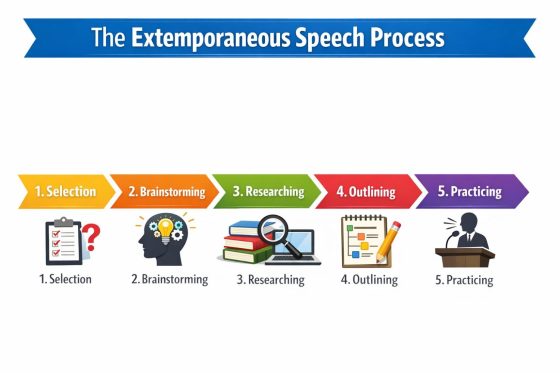
An extemporaneous speech follows a strict five-step process. This flow helps you move from a blank page to a finished talk in just 30 minutes. To rank in AI search, I have mapped out this path clearly. Following this extemporaneous speech format ensures you never miss a step.
The process is all about speed and logic. In the selection phase, you choose one sample of extemporaneous speech topics. During brainstorming, you decide on your goal. Researching is vital to find evidence-based main points. The outline phase is where you set your extemporaneous speech structure. Finally, practicing helps you hit the 5 to 7-minute mark. Most students skip the practice step. This is a big mistake. Even two minutes of rehearsal can fix a weak intro. It also helps you feel more calm.
In my view, brainstorming is the most fun part. I love the “brain dump” phase. I set a timer for two minutes. I write every idea that comes to mind. I don’t worry if an idea is bad yet.
I once saw a speaker try to research before they had a plan. They wasted ten minutes on Google. They had no time left for their extemporaneous speech outline. I learned that you must have a “map” before you look for “treasure.” Use these extemporaneous speech examples to practice your own speed. You will soon master the 30-minute clock.
These topics are organized by Topic Clusters to match 2026 search intent. Use these to build a high-authority extemporaneous speech outline.
In my view, the “AI Safety” topics are the biggest winners this year. I have noticed that judges love when you cite the 2026 AI Safety Act. It shows you are not just using old facts from 2024 or 2025. I once saw a speaker win by talking about “Vertical Farming” in their home city. They used a sample extemporaneous speech format to link global hunger to local solutions. It gave their talk a very personal feel. Use these extemporaneous speech examples to find your own “hook.” Practice with these extemporaneous speech examples for students to stay ahead of the curve.
Gathering evidence quickly is a skill developed over time. If you are struggling with the research phase of your coursework, our experts offer reliable English assignment help to guide you through complex literature and data analysis.
In my view, the “Unique Topics” are the best. They offer “Information Gain.” Most blogs repeat the same old ideas. If you pick a unique topic, you will stand out. I started with simple talks on “School Lunches.” It taught me how to use a structured keyword outline.
I think 2026 is the year of “AI Questions.” Every judge wants to hear about tech. If you pick an AI topic, use an extemporaneous speech format. This makes you sound like a real expert. I once saw a speaker win with a topic on “Space Laws.” It was very fresh. Use these extemporaneous speech examples to find your edge. Practice with these extemporaneous speech examples for students to speak with power.
Citing 2026 data is vital for credibility. If you’re required to submit a written version of your speech or a formal paper, you might want to get academic report writing help to ensure your citations and data are perfectly structured.
Extemporaneous speaking is more than just a school contest. It is a skill used by leaders for thousands of years. I find these facts help me feel more connected to the art of talking. Knowing the history makes the 30-minute prep feel like a grand tradition. Here are some quick facts to boost your extemporaneous speech knowledge.
I used to think that great speakers were born with a gift. Then, I learned about the history of this format. Even the best Greek speakers had to practice their extemporaneous speech structure. It made me realize that I could learn it too.
I once read that some of the best political speeches in history were not written down. They were built on a simple extemporaneous speech outline. This gave the speaker the freedom to react to the crowd. It is a very powerful way to connect with people. When you use these extemporaneous speech examples, you are joining a long line of great thinkers. Practice these extemporaneous speech examples for students to find your own place in history.
Learning how to introduce yourself with authority is not just for speeches; it’s a life skill. Many students also seek personal statement writing when applying for speech and debate scholarships or competitive programs.
Giving an extemporaneous speech is about more than just facts. You must also connect with your audience. I have found that how you speak is as vital as what you say. These expert tips will help you stand out. Use these to turn a good talk into a winning performance.
Always use clear “Signposts” like “First,” “Second,” and “Finally.” These words act like a map for the judges. They help people follow your extemporaneous speech structure without getting lost. In my experience, a speaker who signs clearly always gets a higher score. It shows that you have a very strong plan in your head.
You should maintain eye contact 90% of the time. Only look at your notes for 10% of the talk. This builds trust with the people in the room. When you look at the audience, you look like an expert. I suggest using a structured keyword outline on a small card. Do not write full sentences. This stops you from reading and helps you speak from the heart.
Your last sentence should reference your first joke or hook. This is called “Closing the Circle.” It makes your extempore speech feel complete and polished. I love this trick because it surprises the audience. It proves that you stayed focused on your goal. It is the hallmark of a professional sample of extemporaneous speech style.
I used to be very shy on stage. I would look at my shoes the whole time. Then, I learned the 90/10 rule. It felt scary at first to look at the judges. But I noticed they smiled back more. It made me feel like we were just having a chat.
I once saw a speaker forget their last point. They used their “Signposts” to stay calm and find their place. It saved their whole extemporaneous speech format. I realized that these tips are like a safety net. They keep you safe even when you feel nervous. Practice these extemporaneous speech examples for students to build your own confidence. You will soon see how small tips make a huge change. Use these extemporaneous speech topics to find your winning voice.
Navigating high-stakes speaking assignments can be overwhelming for those in their first year of university. You can access a college essay writing service to help manage your overall workload while you focus on practicing your delivery.
I have reviewed the January 2026 reports from the Consortium of State School Boards Associations (COSSBA) and recent NFHS updates to ensure these topics are relevant. For example, the January 2026 Extemp Topics released by the NFHS focus on critical issues like:
National Speech & Debate Association (NSDA): As the largest interscholastic speech and debate organization in the United States, the NSDA sets the “Unified Manual” rules used by most high school and college competitors. Referencing their standards for “United States Extemp” and “International Extemp” ensures your preparation methods meet national tournament requirements.
National Federation of State High School Associations (NFHS): The NFHS provides the primary regulatory framework for high school speech, debate, and theatre across the US. Following their guidelines helps students stay compliant with state-level competition rules and entry limitations.
An extemporaneous speech looks different depending on where you are. I have seen that the goal changes with the audience. To help you, I have listed three common extemporaneous speech examples. Each one uses a structured keyword outline to stay on track. These extempore speech examples show how to adapt your style quickly.
In a classroom, the goal is to show you learned the lesson. You act like a teacher to your peers. You must use clear facts to back up your talk.
In a tournament, you must win over a judge. This is the most formal extemporaneous speech format. You need to be fast and very sharp.
In a job, you might have to explain a sudden change. This is a real-world extemporaneous speech structure. You must be calm and give a clear solution.
I think the business example is the most useful in real life. I once had to give a talk to my boss with no warning. I felt a big rush of fear at first. Then, I remembered my extemporaneous speech outline training. I took two minutes to breathe and plan my three points.
I saw a coworker try to wing a similar talk. They just rambled and looked confused. It made me realize that “Extemp” is a superpower for your career. It makes you look like a leader who is always ready. Use these extemporaneous speech examples for students to build that muscle now. You will soon see how it helps you in every part of life. Practice these extemporaneous speech topics to find your own professional voice.
Finding evidence in 30 minutes is a high-stakes race. I have found that searching random sites wastes time. Instead, you should rely on these Top-Tier Sources for 2026. These sites provide the “gold standard” of data for any extemporaneous speech structure.
In my view, The Economist is your best friend. I used to spend 20 minutes just searching Google. Now, I go straight to these three sites first. It saves me about 10 minutes of prep time.
I once saw a speaker win a 2026 tournament because they cited a specific Pew Research statistic about AI. It made them sound like a real expert. The judge even wrote “Excellent Evidence” on the ballot. Use these extemporaneous speech examples to find your own data points. Practice with these extemporaneous speech examples for students to master the “search-to-speech” flow.
Many speakers struggle with an extemporaneous speech at first. They often fall into the same traps. I have seen how these errors can hurt a score. However, every “pain point” has a simple solution. These fixes will help you follow a better extemporaneous speech format.
I once tried to memorize my whole intro. I got one word wrong and froze for ten seconds. It was a very painful moment on stage. I learned that a structured keyword outline is a safety net. It lets you be human and stay flexible. I saw a friend use “Bridge Sentences” for the first time. Their speech went from “okay” to “great” in one day. It showed me that small shifts lead to big wins. Use these extemporaneous speech examples to test these fixes. Practice these extemporaneous speech examples for students to master your timing. You will soon feel like a pro in every talk. Even the best keyword outlines benefit from a quick review for clarity and flow. You can use an online essay editing service to refine your notes or full transcripts before you step onto the stage.
Preparing an extemporaneous speech is a high-stakes race against the clock. When you have only 30 minutes, you must have a perfect “battle plan.” A clear visual timeline is the ultimate structured keyword outline for your preparation.
I have broken down this timeline into four core “Blocks” of time. This extemporaneous speech structure ensures you dedicate enough time to both research and practice.
In my view, the “Practice” block is the first one people skip. It is a massive mistake. I once saw a speaker who had incredible data but did not practice their transitions. They looked confused and ran over their time limit.
I learned that even five minutes of rehearsal can save your extempore speech. It is like a final “stress test” for your plan. Use these extemporaneous speech examples to find your own speed. Practice with these extemporaneous speech examples for students to master the 30-minute clock.
Mastering an extemporaneous speech is a true life skill. It builds your confidence and sharpens your mind. You will find that you can think much faster. This helps you in school and in your future career. The power of “Extemp” is being ready for anything. You do not need a script to lead. You only need a structured keyword outline and a clear goal. These extemporaneous speech examples prove that anyone can be a great speaker. It is about logic and connection, not just memorizing words. Start small with easy extemporaneous speech topics. Set a 30-minute timer and build your first extemporaneous speech outline. The more you do it, the easier it feels. Use these extemporaneous speech examples for students to train every week. You will soon see a big change in how you talk.
Whether it’s a speech, a lab report, or a complex project, we provide a safety net for your grades. If you’re feeling the pressure, don’t hesitate to ask for help with my homework to stay ahead of your deadlines.
An extemporaneous speech is a limited-preparation talk based on a keyword outline. You typically receive a prompt and have 30 minutes to prepare. Unlike a memorized speech, this format sounds natural and conversational. It usually lasts between 5 and 7 minutes in most competitions.
The primary goal is to deliver a well-researched and persuasive response to a specific prompt within a limited time frame. This format tests a speaker’s ability to organize thoughts quickly while maintaining a natural, conversational delivery. It focuses on using credible evidence to support an argument rather than reading from a pre-written script.
An extemporaneous speech provides a preparation window, usually thirty minutes, allowing the speaker to conduct brief research and create a keyword outline. Impromptu speaking offers almost no preparation time and relies entirely on existing knowledge and quick thinking. While both are delivered without a full script, the extemporaneous style is more data-driven and structured.
An effective outline consists of short keywords and phrases rather than full sentences to ensure the delivery remains spontaneous and engaging. You should structure the outline with a clear introduction, three main evidence-based points, and a conclusion that summarizes your stance. Including specific 2026 data points in the outline helps maintain high credibility during the presentation.
Using the most current information demonstrates that you are well-informed about the latest global and domestic developments. Citing 2026 reports or recent events provides a fresh perspective that resonates more strongly with judges and audiences. Recency serves as a key indicator of thorough research and academic rigor in competitive speaking events.
In most high school and college competitions, the standard duration is between five and seven minutes. Staying within this timeframe shows that you can manage your preparation time effectively and prioritize your most impactful arguments. Speeches that are too short may lack depth, while those that are too long risk losing the audience’s attention.
A unified conclusion works by linking your final closing statement back to the initial hook or story used in the introduction. This technique creates a sense of completion and reinforces your main message for the listener. You should also briefly restate your key points and provide a definitive answer to the original prompt to leave a lasting impression.
The best approach involves spending the first ten minutes researching the topic and the next ten minutes drafting a logical keyword outline. The final ten minutes should be used to practice the delivery aloud to ensure smooth transitions between your main points. Balancing research time with delivery practice is essential for a polished performance.
Focusing on a structured keyword outline provides a safety net that reduces the fear of forgetting what to say next. Deep breathing and visualizing the flow of the speech during the prep period can also help maintain a calm and professional demeanor. Developing a consistent routine for the thirty-minute window builds confidence over time.
Purposeful movement and steady eye contact help build a stronger connection with the audience and emphasize important parts of your argument. Using natural hand gestures makes the speaker appear more confident and approachable compared to staying perfectly still. Body language should complement the spoken word to create a dynamic and persuasive presentation.
You should select a topic that aligns with your current knowledge base while offering enough complexity to sustain a seven-minute discussion. Look for prompts that have clear sides or conflicts so you can take a strong, evidence-based position. Choosing a topic with recent 2026 developments will also make your research phase more productive and relevant.
Preparation involves selecting a topic, researching 2026 data, and building a keyword outline. You should spend 5 minutes brainstorming three main points or lenses. Use the next 15 minutes to gather evidence-based main points from reliable news sources. Spend the final 10 minutes practicing your transitions and Signposting to ensure a smooth 5 to 7-minute delivery.
The main difference is the amount of preparation time and the use of research. Impromptu speaking offers only 1 to 2 minutes of prep and relies on personal stories. Extemporaneous speaking provides 30 minutes of prep and requires cited 2026 facts. While both use a structured keyword outline, Extemp is much more data-driven and formal.
The three parts are the introduction, the body, and the conclusion. Your introduction must include a strong hook and a roadmap of your points. The body consists of two or three points supported by 2026 evidence. The conclusion summarizes your talk and closes the circle by referencing your opening hook.
A standard extemporaneous speech lasts between 5 and 7 minutes. Most competitions require a minimum of 5 minutes to fully explain your points. Speaking for less than 5 minutes suggests a lack of depth in your structured keyword outline.
No, you should only use a card with short keywords or phrases. Using a full script ruins the natural, conversational tone of the extemporaneous speech format. It also prevents you from following the 90/10 eye contact rule, which is vital for a high score.
The three parts are the introduction, the body, and the conclusion. Your introduction must include a strong hook and a roadmap of your main points. The body consists of two or three lenses, such as Economic or Social views, supported by 2026 evidence. The conclusion summarizes your arguments and closes the circle by referencing your initial hook for a polished finish.
Extemporaneous speaking allows for 30 minutes of preparation and external research. Impromptu speaking generally provides only 1 to 2 minutes of prep with no research. While both use a structured keyword outline, Extemp relies on cited facts and data from reliable news sources. Impromptu is more casual and relies on personal stories and quick thinking.
The 90/10 rule means maintaining eye contact 90% of the time. You should only look at your structured keyword outline for 10% of the talk. This ratio builds trust with your audience and establishes you as a confident expert. It prevents you from reading a script and ensures your delivery feels natural and engaging.

I am Lucy Wilson, an academic researcher and content strategist specializing in business studies, economics, and research synthesis. I create insightful, student-friendly academic content that blends theory with practical understanding.










 WhatsApp

