


 28 June,2026

Table of Contents
When I first had to sit down and figure out how to write a bio, I remember staring at a completely blank screen for what felt like hours. It is completely normal to feel stuck.
Writing about yourself feels weird, but writing a bio or learning how to create a bio is simply like building a personal bridge between you and the person reading your work. At its core, what is a personal biography? A personal biography is a short, focused written summary that tells people exactly who you are, what you excel at, and what you care about.
In the world of bio writing, your text acts as your silent ambassador when you apply for a college program, upload a resume, or leverage professional SOP writing services to create a professional networking account.
What Is a Bio? A personal biography is a short, focused written summary that covers your identity, your biggest academic or career achievements, and your future goals.
The Golden Rule: Always write for your target reader. Use a professional, third-person format for resume setups, and an engaging, first-person narrative for casual portfolios or social media accounts.
The Perfect 3-Sentence Formula:
Sentence 1 (The Hook): State your full name and your current status (like your college major or high school grade level).
Sentence 2 (The Proof): Highlight one or two of your best academic projects, milestones, or technical skills.
Sentence 3 (The Goal): Clearly explain your next major objective along with a memorable personal interest.
When I first had to sit down and figure out how to write a bio, I remember staring at a completely blank screen for what felt like hours. It is completely normal to feel stuck. Writing about yourself feels weird, but writing a bio or learning how to create a bio is simply like building a personal bridge between you and the person reading your work.
At its core, what is a personal biography? A personal biography is a short, focused written summary that tells people exactly who you are, what you excel at, and what you care about. Think of it as your professional story, compressed into a few clean paragraphs or sentences. In the world of bio writing, your text acts as your silent ambassador when you apply for a new college program, upload a resume, or create a professional networking account.
Mastering the foundational format for biography writing does not have to be a guessing game. Whether you are creating a bio for yourself from scratch or looking for an easy-to-follow guide to writing a bio with examples, using a structured, step-by-step formula keeps your writing clean, clear, and perfectly balanced.
Let us break down the exact sequence of how to write bio copy that flows naturally:
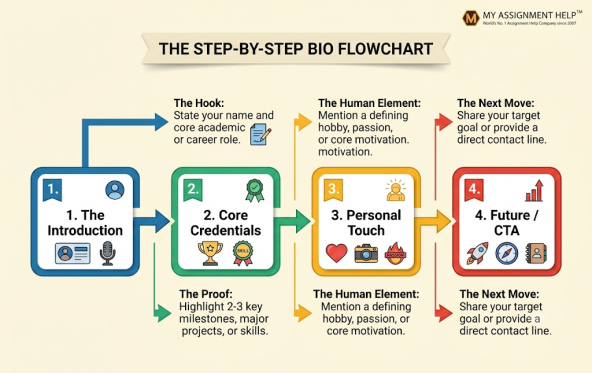
Share your target goal, look into professional LOR writing services for recommendations, or provide a direct contact line.
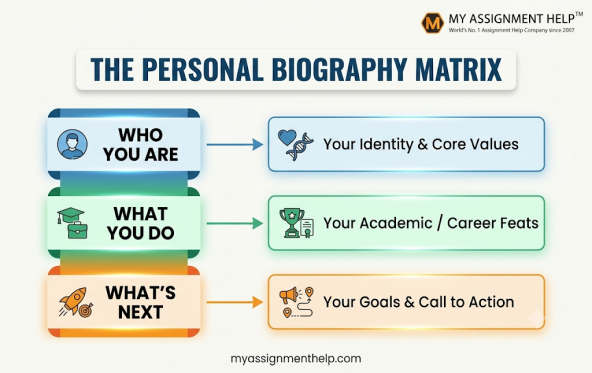
Every great profile follows a distinct, predictable shape that readers can digest quickly. I always recommend using a classic three-part narrative arc:
Here is exactly what youWhen you are trying to figure out what to include in a personal bio or sorting out what should i include in my bio, remember this simple rule: Keep it relevant to your target audience.
If you are writing a piece for a college admissions counselor, skip the casual social media facts, consider consulting a college essay writing service, and focus heavily on your academic drive.
need to track:
One size does not fit all when you are handling writing a personal bio. An essay meant for a high school history class or a college application requires a very different approach than a short pitch written for a professional corporate environment, though both can benefit from expert guidance on scholarship essays.
Let us view these two spaces side-by-side so you can adjust your tone perfectly:
| Metric / Attribute | Academic Bio (how to write biography essay) | Career Bio (how to write a career bio) |
|---|---|---|
| Primary Audience | Admissions Boards, Academic Instructors, Scholarship Committees | Recruiters, Hiring Managers, Potential Professional Clients |
| Core Voice / Tone | Formal, deeply reflective, educational, and structured | Crisp, action-oriented, professional, and impact-driven |
| Core Focus Areas | Academic focus, research interests, school clubs, term papers | Job skills, metrics, internships, key business solutions |
| Typical Length | 150 to 300 words (or full essays depending on prompts) | 50 to 150 words maximum |
| Primary Platform | College apps, admissions portfolios, school publications | LinkedIn profiles, professional resumes, team directories |
When you take on a full assignment like a how to write biography essay task, you are usually telling a deeper story.
Whether you are learning how to write a biography about yourself for a college admissions essay, reviewing a practical autobiography example, or writing about a historical figure, you need to use clear, formal paragraphs.
Focus heavily on your academic growth, your major project milestones, and how your current studies prepare you for future goals. Keep the narrative in a logical chronological order, and make sure your transitions between school years feel natural and smooth.
For additional context on mapping your scholarly voice across high-level essays, you can always check out academic writing benchmarks on the Harvard University Admissions Blog or look through the Stanford University Undergraduate Admission Resources to see what top-tier admissions boards look for in student bio profiles.
If you shift gears to learn how to write a career bio or how to structure a strong resume summary, brevity is your absolute best friend. Busy recruiters scan profiles in seconds.
Your text needs to explain the concrete problems you solve and what you bring to a team. Use clear, punchy active verbs (like managed, developed, organized) and focus entirely on the value you add to a workplace or professional environment.
For a masterclass on designing these executive summaries for professional settings, review the official LinkedIn Profile Optimization Guide.
Because your needs change as you advance through different tiers of higher education in the United States, your blueprint for how to write bio materials must change too. Let us break down how to handle creating a bio for yourself across three major life stages.
At this stage, you might not have a long list of corporate jobs yet. That is completely fine! Your goal here when researching how to write bio about myself is to highlight your reliability, your thirst for learning, and your school involvement. Focus on your GPA if it is high, your advanced placement classes, and your extracurricular activities.
Once you are in college, the focus shifts toward specialization. You need to explain how to write a biographical statement that reflects your specific major and your initial steps into your industry.
At the graduate level, your bio must show deep subject-matter expertise. When you are writing a complex how to write a personal biography about yourself document for an academic journal or a high-end fellowship, you must present yourself as a true researcher and junior colleague.
To make things incredibly easy, I have put together a plug-and-play workspace. You can literally copy these sentence structures, fill in your own information, and have a highly professional, human-sounding bio ready to go in less than five minutes.
“I am [Your Full Name], a [Year of Study, e.g., Sophomore] at [Name of School / University] majoring in [Your Major Field]. Throughout my studies, I have developed a strong focus on [Name a specific skill or subject you love], which helped me complete a major project on [Name of a key paper, presentation, or project]. My ultimate goal is to apply this knowledge toward a career in [Your Target Industry], and outside of class hours, I love [Your Favorite Grounded Hobby].”
“[Your Full Name] is a dedicated [Current Academic Status, e.g., Senior] studying [Your Major Field] at [Name of School]. Known for a strong work ethic and expertise in [List 1-2 Technical Skills], they recently completed a successful term as a [Job Title / Internship Title] where they helped [Mention a real problem you solved or task you handled]. [Your Last Name] plans to bring these skills into a full-time roles within [Target Field Name] upon graduation this upcoming spring.”
Let us look at how these rules translate into actual, natural text. You can use these real-world examples as a direct baseline when learning how to write an interesting bio about yourself or looking for a comprehensive guide to writing a bio with examples.
“I am Marcus Vance, a senior at Ohio State University pursuing a Bachelor’s degree in Marketing. Over the last two years, I have successfully managed social media campaigns for two local non-profit organizations, boosting their community engagement by over twenty percent. I specialize in content strategy and data analytics, and I am deeply passionate about helping eco-friendly brands find their digital voice. When I am not working on my senior capstone project, you can find me hiking through state parks or practicing landscape photography.”
“Economics Major at NYU | Passionate about sustainable urban development. Sharing my college journey, favorite city coffee spots, and daily design inspiration. Check out my latest project portfolio below!”
Get expert support, track results and non AI content
When you want to know how to make biography sample entries look truly professional, the secret lies in the polishing phase, where utilizing an essay editing service can ensure a fantastic bio is not derailed by minor grammatical slips or an awkward narrative flow.
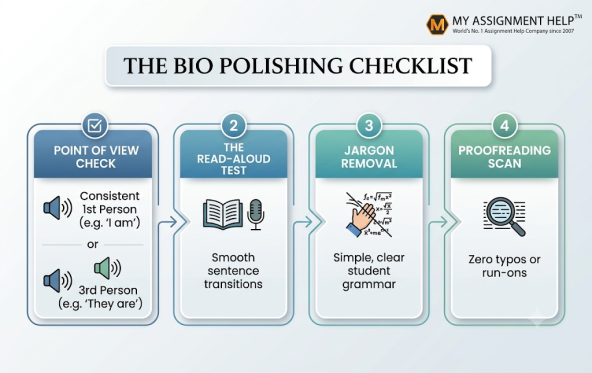
Follow this simple, professional checklist when writing a personal bio, handling a how to write self biography draft, or editing how to write a personal biography about yourself essays:
Keep your point of view consistent: Decide early on if you are writing in the first person (“I am a biology major”) or the third person (“Sarah is a biology major”). Do not mix them together within the same paragraph.
Use the read-aloud test: Read your draft out loud to yourself. If you run out of breath during a sentence, that sentence is too long. Break it up into two simple sentences.
Ditch the heavy corporate jargon: Use clear, honest words and practice essential english skills to keep your writing relatable. Instead of writing “I utilize synergistic paradigms to optimize academic outputs,” simply write “I use organized study groups to finish my projects on time.”
Keep a close eye on your length: If your target platform requests a short blurb, respect that space limit. Learning how to write a brief biography of yourself means knowing exactly how to cut out repetitive words while keeping your key achievements intact.
Answer: You should include your full name, your current academic status or professional job title, two or three major accomplishments, and a short note about your personal passions or interests. Always tailor these elements to match what your specific reader cares about most. For instance, an academic audience needs to see your research and study focus, while a professional audience wants to see your real-world skills and problem-solving abilities.
Answer: A new hire biography example should be warm, concise, aligned with standard organisational behaviour cultures, and focused on introducing yourself to your new team members. It should highlight your role, your professional background, and your excitement for the position.
Here is a short template:
“I am delighted to join the team as the new Junior Graphic Designer. Prior to this role, I completed my degree in Visual Arts at Texas A&M University and interned with a local creative agency. Outside of design work, I love exploring local food trucks and cooking Italian dishes at home.”
Answer: Yes, using a professional biography writing service example templates is a smart way to understand structural layouts, but you must write the actual text yourself to ensure it sounds like a real human. Templates give you an excellent visual guide for sentence length and formatting. However, customizing the content with your own authentic experiences ensures your voice stays unique, natural, and relatable to admissions officers and recruiters alike.
Answer: You can write an incredible biography by focusing entirely on your academic projects, leadership in school clubs, personal volunteer hours, and specialized skill sets. Hiring managers and admissions boards do not expect a student to have a decade of career history. Instead, they are looking for passion, dedication, and a willingness to learn. Highlight large research papers, technical skills you learned in class, or events you helped organize for student clubs.
Answer: The ideal length for a standard professional biographical statement is between 100 and 150 words, broken down into one or two short paragraphs. If you are writing a micro-bio for a social media site like LinkedIn or X, you should aim for 1 to 2 punchy lines. If you are preparing a document for an academic catalogue or a program introduction panel, you can expand your text up to 250 or 300 words max. Always check the exact platform limits before you begin formatting your drafts.

I am an academic writing expert with a strong command of essay and assignment writing. I help students present ideas clearly, logically, and in line with university-level academic standards.










 WhatsApp

