


 30 December,2025

Table of Contents
Writing assignments are a regular part of college and university life, but many students find them confusing and time-consuming. Often, the problem is not a lack of knowledge—it is not knowing where to start or how to structure the assignment properly. Learning how to write an assignment step by step helps you stay organized, avoid common mistakes, and score better grades. This guide explains the complete assignment writing process in a simple, student-friendly way, with clear tips and examples.
According to the Purdue OWL (Purdue University, USA), academic assignments are tasks or prompts instructors give to students that explain goals and expectations for writing, research, and organization in structured academic work.
In academic contexts, assignments are designed to help students develop and evaluate essential skills such as research, writing, critical thinking, and the ability to present arguments in a structured format. They can take many forms, including essays, reports, case studies, research papers, and reflective tasks, depending on the learning objectives.
Academic assignments are given in different formats depending on the subject and learning objective. Common types include:
Projects and Dissertations – Extended research work involving planning, data collection, and analysis
This guide focuses mainly on essays, reports, and research-based academic assignments commonly used in colleges and universities. The step-by-step process explained here applies to assignments that include an introduction, structured main body, conclusion, and proper referencing.
A writing assignment is an academic task where students present ideas, research, or arguments in a structured written format.
For students, writing assignments help to:
Writing assignments are not just about marks—they help you develop long-term academic and professional skills.
Well-structured assignments help students:
However, when deadlines are tight or instructions feel overwhelming, many students search for reliable do my assignment support to stay on track. When you clearly understand what an assignment expects, writing becomes much easier and far less stressful.
To truly learn how to write an assignment step by step, you must understand what makes an assignment effective and high-scoring.
Before you start writing, identify the goal of the assignment. Most assignments have one or both of these purposes:
Some assignments combine both.
✅ Example
❌ Write an essay on climate change.
✅ Analyze how human activities contribute to climate change using recent research studies.
The second version clearly tells us what to do, how to do it, and what to focus on.
💡 Pro Tips for Students
Clear goals help you stay focused and avoid adding irrelevant content.
Assignments are not isolated tasks. They connect directly to what you are learning in class.
Understanding this connection helps you:
✅ Example
If your course is about Digital Marketing, and the assignment is on social media strategies, you should:
💡 Pro Tips for Students
Inclusive assignments allow students from diverse backgrounds to engage meaningfully.
As a student, you should:
✅ Example
Instead of discussing an issue from only one country or group, include:
💡 Pro Tips for Students
Connecting academic theory with real-world experiences and ethical considerations can strengthen your work and show critical thinking.
Many students lose marks because they misunderstand instruction words like:
✅ Example (Step-by-Step Clarity)
💡 Pro Tips for Students
Every assignment follows specific academic rules.
You must identify:
✅ Example
A report uses headings and subheadings, while an essay does not.
Using the wrong format can reduce marks—even if your content is strong.
💡 Pro Tips for Students
If you need more knowledge on formatting your assignment correctly, including details about the assignment cover page format, you can check this blog here.
Examples make expectations clear and reduce confusion.
Good assignments often include:
✅ Example
Compare:
Notice differences in structure, clarity, and evidence.
💡 Pro Tips for Students
If examples are not provided, review past assignments or academic samples from your discipline.
After submitting your assignment, reflect on the feedback you receive.
Ask yourself:
✅ Example
If feedback says “weak argument”, focus on:
💡 Pro Tips for Students
Continuous improvement leads to better academic writing over time.
Understanding the assignment question correctly is the most important step. Many students lose marks not because their writing is poor, but because they answer the wrong question.
Never rush through the assignment prompt. Read it at least two to three times before starting.
You should:
If anything is unclear, ask your instructor early instead of guessing.
✅ Example
Assignment Question:
“Analyze the impact of social media on student mental health using at least three academic sources.”
After reading carefully, you should identify:
If you only describe social media effects instead of analyzing them, your answer will not meet the assignment goal.
💡 Pro Tips for Students
Instruction verbs tell you exactly what the assignment requires.
| Verb | What It Means |
|---|---|
| Analyze | Break into parts and examine |
| Compare | Show similarities and differences |
| Argue | Support a clear position |
| Evaluate | Judge using evidence |
Missing these verbs often leads to incorrect answers.
Most academic assignments include:
Understanding this structure saves time and improves clarity.
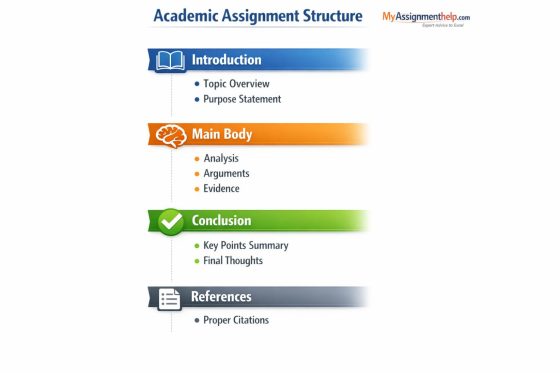
An introduction explains what the assignment is about, why the topic matters, and what the assignment will do. It usually takes up 10–15% of the total word count.
Climate change is a major global issue affecting the environment and human life. This assignment analyzes how human activities contribute to climate change by examining recent scientific research and environmental data.
An assignment outline is a structured plan that shows what each section of the assignment will cover. It is written before starting the full draft.
A methodology explains how information was collected and analyzed in the assignment. It is mainly used in research-based assignments.
This assignment follows a qualitative research method using peer-reviewed journals, government reports, and case studies to analyze climate change impacts.
An assignment example shows students what a complete, well-structured answer looks like.
A conclusion restates the main argument and summarizes key points without adding new information.
In conclusion, this assignment shows that human activities play a significant role in climate change. The evidence highlights the urgent need for sustainable practices to reduce environmental damage.
References are in-text citations that show where ideas or data come from.
Excessive screen time increases stress among students (Smith, 2022).
📌 Tip:
Always match the citation style required by your institution.
A bibliography lists all sources consulted, even if they are not directly cited.
Smith, J. (2022). Social media and student mental health. Oxford University Press.
An abstract is a short summary of the entire assignment, usually 150–250 words.
This assignment examines the impact of social media on student mental health using qualitative analysis of academic sources. The findings reveal a strong link between excessive use and increased anxiety levels.
A reflection explains what you learned, the challenges faced, and how your skills improved.
This assignment improved my research and academic writing skills. I faced challenges in time management but learned how to plan and structure tasks more effectively.
📌 Tip:
Use first-person writing unless told otherwise.
Acknowledgements thank people who supported your work.
I would like to thank my instructor for their guidance and feedback throughout this assignment. I am also grateful to my classmates for their valuable discussions.
A cover page provides basic assignment information in a formal format.
1. Assignment Title
2. Student Name
3. Course Name
4. Instructor Name
5. University Name
6. Submission Date
An index helps readers locate key topics in long assignments or projects.
📌 Note:
An index is different from a table of contents. An index lists topics, not sections.
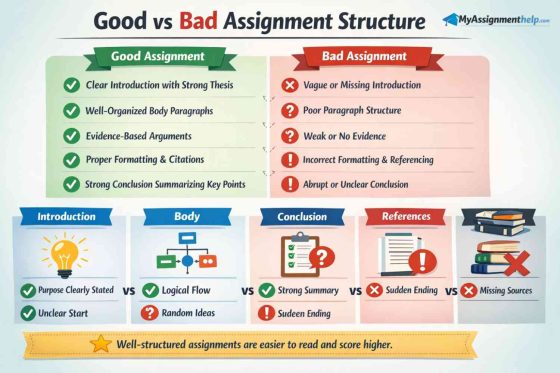
| Assignment Element | ✅ Good Assignment Structure | ❌ Bad Assignment Structure |
|---|---|---|
| Introduction | Clearly introduces the topic and states a strong thesis | Vague opening with no clear purpose |
| Structure & Flow | Logical order with headings and smooth transitions | Random ideas with no clear flow |
| Main Body | Each paragraph supports the main argument | Paragraphs lack focus or repeat ideas |
| Evidence & Sources | Uses credible academic sources with citations | Few or no references, weak evidence |
| Formatting | Follows required style (APA/MLA/Harvard) | Incorrect or inconsistent formatting |
| Conclusion | Summarizes key points and reinforces argument | Abrupt ending or repetition |
| Overall Clarity | Easy to read and understand | Confusing and difficult to follow |
❌ Bad Introduction:
Climate change is a big problem in today’s world and many people are affected by it.
✅ Good Introduction:
Climate change is one of the most pressing global challenges today. This assignment analyzes how human activities contribute to climate change, using recent scientific research to evaluate environmental and social impacts.
👉 Why the good one works:
It clearly states the topic, purpose, and direction of the assignment.
❌ Bad Paragraph:
Social media affects students in many ways. Some people like it and some do not.
✅ Good Paragraph:
Social media significantly affects student mental health by increasing anxiety and reducing attention span. Studies by the American Psychological Association show a direct link between excessive screen time and stress levels among university students.
👉 Why the good one works:
It includes a clear point, evidence, and academic tone.
💡 Pro Tips to Turn a Bad Assignment into a Good One
Your instructor is your main reader, but write clearly as if explaining to an informed student.
Avoid:
Most assignments require a clear argument, not just information.
A strong argument:
Simply summarizing information is not enough.
Evidence may include:
Always cite your sources correctly to avoid plagiarism.
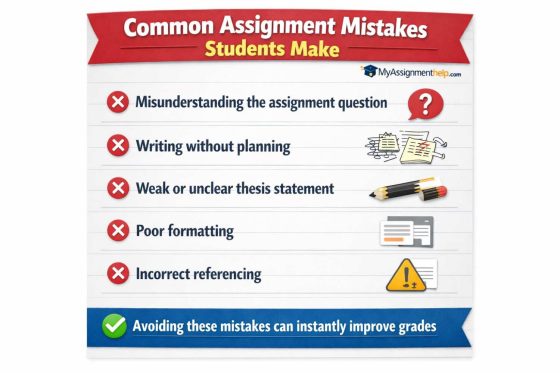
Many students lose marks due to:
Avoiding these mistakes can instantly improve your grades.
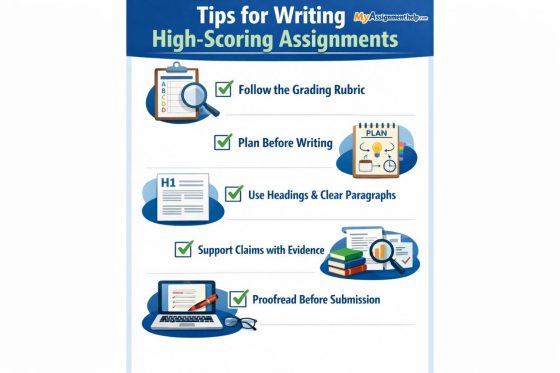
Use this checklist before submission:
If you are short on time or unsure about grading criteria, getting reliable assessment help can guide you in meeting academic expectations and improving your overall score.
Learning how to write an assignment step by step helps students reduce stress and improve academic performance. By understanding assignment goals, following instructions carefully, using strong evidence, and reflecting on feedback, students can submit high-quality assignments with confidence. Whether you are new to academic writing or looking to improve your grades, these steps will help you write better assignments consistently.
A good assignment answers the question clearly, follows instructions, uses proper structure, and supports arguments with academic sources.
Students struggle due to unclear instructions, poor time management, and lack of understanding of academic writing rules.
By reading the question carefully, identifying instruction verbs, reviewing examples, and asking questions early.
Arguments demonstrate critical thinking and show instructors how well students understand a topic.
Regular practice, feedback analysis, proper research, and structured writing help students improve over time.

I am an academic writer experienced in essay structuring, assignment development, and foundational research writing. I focus on clarity, logical flow, and strong academic argumentation.










 WhatsApp

