When I first faced my own major nursing research project in college, I remember sitting at my desk for hours staring at a blank screen. I kept asking myself: How do I choose a topic that is fresh, makes a real difference in patient care, and satisfies my professors? If you are feeling overwhelmed right now, I want you to take a deep breath. You are not alone, and I am here to help you navigate this academic milestone.
Navigating higher studies in nursing means you must blend clinical knowledge with structured academic writing. In this ultimate guide, I will share a curated list of over 150 high-impact nursing research topics, clear structural outlines, and practical writing tips tailored for US college standards. My goal is to give you everything you need to transform your initial ideas into a brilliant, publication-ready research paper.
What is a Nursing Dissertation and Why Does It Matter?
A nursing dissertation is an independent, data-driven academic research project completed at the end of a nursing program that applies clinical evidence to analyze healthcare delivery systems, improve patient outcomes, and advance evidence-based practice (EBP).
It bridges the gap between classroom theory and clinical reality, requiring you to critically evaluate medical literature, analyze data, and propose real-world solutions to complex healthcare challenges.
It is your opportunity to explore a specific healthcare problem, analyze data, and contribute new knowledge to Evidence-Based Practice (EBP).
When you write a dissertation, you demonstrate to the academic world that you can think critically, evaluate complex medical literature, and propose real-world solutions to improve healthcare outcomes. It bridges the gap between classroom theory and clinical reality, showing your readiness for advanced clinical roles.
Nursing Thesis vs. Dissertation: A Comparative Analysis
Many college students use the words “thesis” and “dissertation” interchangeably, but in the United States higher education system, they often represent different academic benchmarks. Understanding these differences helps you scope your project correctly to earn your college credits. Here is Nursing Thesis vs. Dissertation analysis for better understanding:
Feature
Nursing Thesis
Nursing Dissertation
Primary Academic Level
Typically required for BSN Capstone or MSN (Master’s) degrees.
Required for terminal degrees like a PhD in Nursing or DNP.
Research Scope
Often a comprehensive literature review or an analysis of existing data.
Demands original empirical research that fills a distinct gap in literature.
Methodology
Focuses on demonstrating strong mastery of existing research methods.
Requires a novel study design, data collection, and deep theoretical analysis.
IRB Approval
Rarely required unless conducting limited primary data collection.
Institutional Review Board (IRB) approval is mandatory before data collection.
Healthcare administration students often focus their research on clinical management trends, finding that a dedicated dissertation on leadership helps them measure hospital staff retention and nursing team morale.
Ultimate List of Master & PhD Nursing Dissertation Topics for 2026
To help you get started, I have organized a diverse list of prospective titles across different academic tiers. These topics are built around contemporary healthcare changes, emerging clinical technologies, and leadership models relevant for 2026.
Master of Science in Nursing (MSN) Research Topics
The impact of tele-health monitoring on readmission rates among rural heart failure patients.
Evaluating the effectiveness of charge nurse leadership training on ICU staff retention.
Nurse-led educational interventions for post-discharge stroke survivors: A randomized control study.
Assessing continuous glucose monitoring adherence in adolescent type 1 diabetic patients.
The role of clinical nurse specialists in reducing medication administration errors in urban emergency rooms.
Barriers to implementing evidence-based sepsis protocols among evening-shift floor nurses.
Impact of mindfulness-based stress reduction programs on burnout scores among critical care nurses.
Evaluating the impact of wearable biometric sensors on early deterioration detection in home-bound COPD patients.
The role of mobile health (mHealth) applications in improving medication adherence among elderly hypertensive patients in urban clinics.
Effectiveness of dedicated nurse navigation roles on time-to-treatment intervals in outpatient oncology clinics.
Assessing the clinical efficacy of virtual reality simulation training on rapid response team competency scores.
Impact of electronic health record (EHR) optimization bundles on reducing documentation-induced nursing fatigue.
Evaluating decentralized versus centralized nursing station layouts on bedside response times in medical-surgical units.
The efficacy of barcode medication administration (BCMA) overrides audits on clinical error minimization.
Implementation of a nurse-led transition coach model to reduce 30-day readmissions in underserved heart failure demographics.
Assessing the impact of structured peer mentoring on first-year graduate nurse retention rates in acute care facilities.
Evaluating clinical decision support system (CDSS) alerts on nurse adherence to tight glycemic control protocols.
Developing a theoretical framework for nurse-family communication patterns in long-term palliative care.
A mixed-methods longitudinal study on the career trajectories of minority nurse educators in the United States.
Epigenetic markers and sleep disturbances: Investigating chronic fatigue patterns in shift-working nurses.
Evaluating macro-level healthcare policy shifts on autonomous practice boundaries for nurse practitioners.
A grounded theory approach to understanding patient autonomy during psychiatric involuntary admissions.
Machine learning predictive algorithms in nursing informatics: Optimizing early pressure ulcer detection protocols.
Developing a grounded theory model for post-intensive care syndrome (PICS) family adaptation trajectories.
A longitudinal analysis of systemic racial disparities in pain assessment scores across metropolitan emergency networks.
Quantifying the economic and clinical impacts of full practice authority legislation for family nurse practitioners across rural state lines.
A mixed-methods investigation into the lived experiences of male nursing faculty in prestigious US academic institutions.
Modeling the relationship between structural hospital safety climates and the incidence of missed nursing care.
Evaluating the long-term efficacy of mindfulness-based cognitive therapy on secondary traumatic stress in emergency personnel.
Investigating genomic profiles and systemic inflammatory markers in patients experiencing prolonged critical illness muscle wasting.
Developing a predictive machine learning framework for inpatient fall risk metrics utilizing real-time mobility stream data.
A phenomenological inquiry into the moral distress of nurse administrators during public health emergency resource allocations.
Mapping the professional identity adjustments of bedside clinicians transitioning into executive healthcare leadership.
Specialized Clinical Nursing Research Topics by Area
If you want your research to stand out, focusing on a specific clinical specialty or choosing targeted quantitative nursing research topics is an excellent strategy Below are targeted topic lists clustered by medical discipline.
Mental Health & Psychiatric Nursing Dissertations
Effectiveness of trauma-informed care frameworks in reducing physical restraint utilization in acute psychiatric wards.
Evaluating peer-support interventions alongside traditional psychiatric nursing for severe clinical depression.
Nursing strategies for mitigating compassions fatigue among healthcare providers working in adolescent behavioral health units.
Assessing the impact of regular outdoor sensory therapy on anxiety scores among geriatric dementia patients.
Efficacy of telephone-delivered cognitive behavioral therapy (CBT) for postpartum depression in rural health networks.
Evaluating de-escalation training frameworks on the incidence of occupational injuries in psychiatric emergency departments.
The impact of animal-assisted interventions on social engagement metrics in veterans diagnosed with treatment-resistant PTSD.
Correlating nurse-led sleep hygiene bundles with acute stabilization timelines in adult bipolar manic episodes.
Barriers to outpatient medication compliance among schizophrenic patients managed by community health centers.
Evaluating trauma-informed intake procedures on therapeutic alliance scores within juvenile justice mental health facilities.
The role of psychiatric mental health nurse practitioners (PMHNPs) in expanding buprenorphine access for opioid use disorders.
Assessing mindfulness-based interventions on executive functioning metrics in adolescents with attention-deficit/hyperactivity disorder.
Efficacy of early nurse-led delirium screening tools on length of stay outcomes in geriatric inpatient psychiatric settings.
Analyzing family-centered psychoeducational programs on caregiving burden indexes in early-onset Alzheimer’s presentations.
Evaluating the impact of proactive nurse-administered scalp cooling therapy on mitigating chemotherapy-induced alopecia in breast cancer.
Effectiveness of regular nurse-led chlorhexidine oral care protocols on reducing severe mucositis scores in stem cell transplant units.
Assessing patient adherence to oral oncology chemotherapy regimens managed via remote nurse practitioner telephone follow-ups.
Impact of a specialized nurse vascular access team on minimizing extravasation injuries during vesicant chemotherapy administrations.
Evaluating non-pharmacological nurse comfort bundles (guided imagery vs cold packs) on breakthrough pain scores in terminal bone cancer.
Barriers to early home-subcutaneous immunoglobulin infusion compliance among adult primary immunodeficiency cohorts.
The role of oncology nurse navigators in shortening timelines from initial suspicious biopsy to definitive clinical staging.
Assessing bedside nurse documentation compliance for complex blood product transfusion reaction parameters in acute oncology settings.
Efficacy of specialized nurse-led survivorship care planning seminars on post-treatment anxiety scores among colorectal cancer survivors.
Evaluating standardized nurse-driven central line flushes (heparin lock vs saline) on maintaining long-term port-a-cath patency profiles.
Disaster Preparedness, Infection Control, & Public Health Response
Impact of mandatory hospital-wide nurse mock disaster drills on institutional emergency triage accuracy scores.
Evaluating front-line nurse adherence to strict personal protective equipment (PPE) donning/doffing sequencing during infectious outbreaks.
Effectiveness of public health nurse-led localized contact tracing frameworks on minimizing community-acquired syphilis outbreaks.
Assessing barriers to annual influenza and COVID-19 vaccine compliance among clinical bedside staff in private hospital networks.
Impact of standardized nurse-driven environmental surface ultraviolet-C (UV-C) sanitization workflows on room turnover safety.
Evaluating emergency department nurse preparedness metrics for handling chemical, biological, or radiological mass casualty presentations.
The efficacy of nurse-managed antibiotic stewardship audit-and-feedback loops on reducing empirical broad-spectrum prescribing variations.
Assessing public health nursing education campaigns on lowering childhood lead exposure vectors in historical urban neighborhoods.
Impact of structured nurse-led post-exposure prophylaxis (PEP) counseling protocols on treatment completion metrics in emergency rooms.
Evaluating a standardized nurse triage protocol for identifying emerging global respiratory viral pathognomonic markers at points of entry.
Nursing Education, Simulation, & Ethical Legal Practice
Evaluating the clinical efficacy of high-fidelity human patient simulation training on undergraduate nursing student resuscitation competence.
Impact of formal bioethics education seminars on reducing moral distress scores among critical care nursing personnel.
Effectiveness of dedicated preceptor training modules on lowering transitional anxiety indexes among first-year graduate nurses.
Assessing nursing student proficiency scores in electronic health record (EHR) navigation following integrated academic electronic charting labs.
Barriers to implementing evidence-based pedagogical frameworks among clinical nurse educators in asynchronous online settings.
The role of standardized patient simulation testing on developing cultural humility competencies in family nurse practitioner students.
Evaluating front-line clinician understanding of medical malpractice boundaries and documentation standards in high-acuity environments.
Impact of systematic secondary-victim support frameworks on retention metrics among clinical staff involved in medical errors.
Assessing the educational value of peer-led physical assessment validation check-offs on clinical skills retention in BSN tracks.
Evaluating nursing professional development certification incentive bundles on advanced speciality credentials attainment profiles.
What makes a strong nursing research topic?
A strong nursing or Evidence-Based Practice (EBP) topic transforms a general clinical interest into a structured, answerable question. To guide your selection, ensure your topic meets four key criteria:
Clinical Relevance: It directly impacts patient outcomes, nursing workflows, or healthcare delivery.
Specificity: It defines exactly who is being studied, what is being changed, and where the study takes place.
Measurability: It focuses on concrete, trackable metrics (e.g., readmission rates, infection scores) rather than vague concepts.
Feasibility: It is narrow enough to be thoroughly investigated within your timeframe, budget, and resource access.
Topic Contrast: Weak vs. Strong
Vague & Weak Topic
Refined & Strong EBP Topic
“Diabetes in hospitals”
“The impact of continuous glucose monitoring protocols on readmission rates among elderly type 2 diabetic patients in urban US hospitals”
Too Broad: Reads like a general textbook chapter; provides zero clinical focus or direction.
Highly Specific: Explicitly defines the precise population (elderly, type 2) and setting (urban US hospitals).
No Intervention: Does not propose a concrete action, protocol, or nursing strategy to evaluate.
Clear Intervention: Focuses on a distinct clinical tool and process (continuous glucose monitoring protocols).
Unmeasurable: Lacks a defined outcome to track, analyze, or prove.
Measurable Outcome: Targets a clear, quantifiable metric (hospital readmission rates).
Quick Tip: If your topic can be answered by a single textbook chapter, it is too broad. A strong EBP topic requires synthesizing peer-reviewed evidence to solve a specific clinical problem.
International Perspectives: UK vs. US Nursing Research Frameworks
If you look at international research data, such as nursing dissertation ideas from the UK, you will notice distinct structural differences compared to the United States system.
In the United Kingdom, academic work is heavily structured around the National Health Service (NHS) frameworks, National Institute for Health and Care Excellence (NICE) guidelines, and Nursing and Midwifery Council (NMC) standards. UK research often emphasizes centralized public health pathways, service improvement projects, and clinical audits within a single-payer system.
Conversely, in the United States, your research must align with the American Nurses Association (ANA) scope of practice, state-specific nursing boards, and multi-payer healthcare insurance networks. US studies focus deeply on healthcare economics, private-hospital resource management, and individual institutional evidence-based practice models. Keeping this regional context in mind ensures your paper remains relevant to your US professors.
How to Write a Nursing Dissertation Step-by-Step
Writing a massive academic paper becomes much easier when you break it down into clear, manageable steps. Here is the exact process I recommend you follow:
Formulate Your Research Question: Use structured academic frameworks like the PICOT layout to nail down a precise, researchable clinical question.
Conduct a Thorough Literature Search: Mine databases like CINAHL, PubMed, and Cochrane to gather high-quality, peer-reviewed study articles.
Draft Your Formal Proposal: Secure institutional authorization and pass your college’s internal review board standards before beginning data collection.
Choose Your Methodology: Explicitly state whether your study will use quantitative data, qualitative interviews, or a systematic literature matrix review.
Collect and Analyze Data: Organize your clinical statistics or qualitative responses using precise analytical software or thematic coding maps.
Interpret the Findings: Connect your raw numbers back to your original problem statement, highlighting limitations and future implications for the nursing field.
Writing a Winning Nursing Dissertation Proposal
Before you can write your full dissertation, you must complete your nursing dissertation proposal. This document serves as your action plan. It proves to your dissertation committee that your chosen topic is doable, ethical, and academically valuable.
When drafting your proposal, focus on building a bulletproof methodology section. You must explicitly explain how you plan to protect patient privacy, how you will collect your data, and what statistical tools you will use to analyze it. If you feel stuck during this early stage, seeking professional nursing dissertation help or seeking professional research proposal help from your academic advisor is a smart way to ensure you build a strong foundation.
Get Your High-Scoring Nursing Dissertation Now – 20% Discount for New Students!
Receive high-quality, original papers, free from AI-generated content.
The strength of your entire project rests on your research questions. To develop high-impact nursing dissertation questions, I always advise students to use the PICOT method to refine their ideas into sharp, research-ready questions.
Problem Area
General Topic Idea
High-Impact PICOT Research Question
Infection Control
CLABSI reduction in hospital units.
In adult ICU patients (P), how does a nurse-led chlorhexidine bathing bundle (I) compared to standard soap water care (C) affect central line-associated bloodstream infection rates (O) over a 6-month period (T)?
Shift Management
Nurse fatigue and shift lengths.
Do acute care nurses working 12-hour shifts (P) experience higher medication administration error rates (O) compared to those working 8-hour shifts (C) within a medical-surgical unit context (T)?
Skin Integrity
Pressure ulcer prevention in nursing homes.
In bedridden geriatric residents (P), does turning every 2 hours (I) compared to using advanced alternating-pressure mattresses alone (C) reduce sacral pressure injury incidence (O) during long-term stay (T)?
Structuring Your Nursing Literature Review Topics
A literature review is not just a summary of papers you read; it is a critical synthesis of the current state of knowledge. When grouping your nursing literature review topics, focus on identifying conflicting viewpoints, historical trends, and gaps in research.
To make this step stress-free, I highly recommend using a Literature Review Matrix. Create a table with columns for Author, Sample Size, Methodology, Key Findings, and Limitations. This organizational tool allows you to see common patterns across dozens of studies instantly, preventing you from getting lost in a mountain of text.
When choosing an academic topic focused on acute patient care, evaluating how clinicians utilize the clinical reasoning cycle to minimize diagnostic errors provides an excellent framework for your research papers
Real-World Nursing Dissertation Examples and Structuring Guides
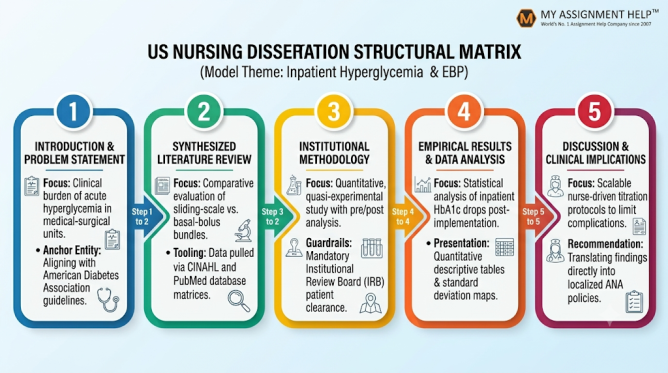
To give you a clear picture of how a professional, human-centric paper looks, let us examine a sample structure for a BSN capstone or MSN study focused on diabetes care. Evaluating the impact of nurse-led phone consultations on HbA1c monitoring compliance and sliding-scale insulin administration safety among type-2 diabetic outpatients.
Img text: 5 core stages of a US Nursing Dissertation on inpatient hyperglycemia and evidence-based translation.
BSN/MSN Structural Template: Hyperglycemia & Diabetes Care
Title Page: Clear title specifying the clinical problem and population.
Abstract: A 250-word snapshot covering background, methods, results, and clinical impact.
Chapter 1: Introduction & Problem Statement: Exploring the burden of uncontrolled hyperglycemia in acute care settings.
Chapter 2: Literature Review: Current evidence on nurse-driven insulin titration protocols.
Chapter 3: Methodology: Describing a quantitative, quasi-experimental study design within a community hospital clinic.
Chapter 4: Results & Data Analysis: Statistical breakdown of HbA1c reductions post-intervention.
Chapter 5: Discussion & Clinical Implications: How bedside nurses can implement these workflows to prevent long-term diabetic complications.
Sample Outline Excerpt:
————————————————–
Topic: Standardizing Bedside Nursing Workflows for Hyperglycemia Management
I. Introduction
A. Background: Inpatient Hyperglycemia Risks
B. Context: US Community Hospital Settings
II. Methodology
A. Setting: 30-Bed Medical-Surgical Unit
B. Intervention: Nurse-Driven Fast-Acting Insulin Titration
————————————————–
If you need more structural guidance, I recommend looking at a complete BSN nursing dissertation examples PDF from your university library database. Reviewing actual examples of nursing dissertations helps you visualize the flow, tone, and formatting style required for an elite grade.
While general clinical studies provide a broad foundation, exploring specialized child health nursing research topics allows advanced practice students to address critical gaps in early childhood intervention ecosystems.
FAQ 1: How do I choose the best nursing dissertation topic?
To choose the best nursing dissertation topic, you must isolate a recurring operational challenge from your clinical rotations and match it against an unresolved gap in medical literature. Begin by selecting a healthcare sector you intend to practice within, such as neonatal care or psychiatric nursing. Filter your initial problem statements through the structured PICOT framework to confirm the question is narrow enough for primary or secondary data analysis. Finally, perform an exploratory query on PubMed or CINAHL to ensure there is an adequate volume of peer-reviewed data to support your literature review matrix.
FAQ 2: Where can I find reliable examples of nursing dissertations in PDF?
You can find reliable nursing dissertation examples in PDF format by navigating directly to your university’s digital library portal or through authenticated repositories like ProQuest Dissertations & Theses Global. Most major US higher education institutions maintain a dedicated, open-access electronic archive where past BSN capstone projects, MSN theses, and DNP papers are hosted. Reviewing these verified files provides an excellent reference map for observing how your peers successfully implemented APA 7th edition citation formatting, structural page orders, and academic headers.
FAQ 3: What are the most trending nursing research topics for 2026?
The most popular research areas right now center on nursing informatics, machine learning applications for patient risk assessment, public health dissertation topics, nursing staff retention strategies post-pandemic, and health equity improvements in rural or underserved communities. Additionally, significant academic funding and interest are shifting toward empirical studies evaluating nurse burnout mitigation frameworks, healthcare economics within private multi-payer hospital groups, and evidence-based nurse bundling strategies engineered to minimize hospital-acquired infections (HAIs).
FAQ 4: Is there a thesis in nursing?
Yes, a formal research thesis is typically a mandatory requirement in nursing programs at the Master of Science in Nursing (MSN) level. While undergraduate BSN tracks usually conclude with a shorter practical capstone, master’s degree pathways require a comprehensive data-backed thesis. While undergraduate Bachelor of Science in Nursing (BSN) degrees often conclude with a shorter, practical evidence-based capstone or clinical project, master’s degree pathways require the production of a deeply rigorous, data-driven thesis assessing specific healthcare delivery systems or nursing education methodologies.
I am an experienced class-help specialist supporting students across all subjects. I assist with online classes, coursework, and exam preparation, delivering structured academic guidance, reliable subject coverage, and consistent support to help students succeed confidently.


 09 June,2026












 WhatsApp

