A value speech is a persuasive argument focused on the ‘rightness’ or ‘worth’ of an idea rather than just its factual truth. It relies on establishing ethical or moral criteria to evaluate a subject
In the landscape of modern rhetoric, the ability to articulate not just what is true, but why something is worthwhile, is the hallmark of a master communicator. Whether you are a student in a Public Speaking 101 course or a professional advocate, mastering the values speech is essential. To explore a wider variety of ideas beyond value propositions, you can browse through this extensive list ofspeech topics for all academic levels.
As we move through 2026, the digital information space is crowded with facts. However, facts alone rarely move an audience. It is the speech values—the ethical, aesthetic, and moral frameworks we apply to those facts—that drive human decision-making. This guide provides an exhaustive inventory of value speech topics and a deep dive into the theory of value speaking.
What is a Value Speech? Definition and Core Principles
To understand what values speaking truly entails, we must first define the medium. A value speech (often referred to as a proposition of value speech) is a type of persuasive oratory where the speaker attempts to convince the audience that something is right or wrong, good or bad, better or worse, or more or less desirable. Because this format is a spoken form of argumentation, many students find it helpful to consult a professional persuasive essay service to understand how to structure evaluative claims.
Unlike a speech of fact (which argues truth) or a speech of policy (which argues for a specific action), a speech of value focuses on the worth of an entity, idea, or action.
The Three Pillars of Value Oratory:
The Evaluative Term: Every value topic contains a “judgment word” (e.g., “ethical,” “unjust,” “beautiful,” “harmful”).
The Criterion: You must establish a standard by which you are measuring value. For example, if you argue a behavior is “unethical,” you must first define what “ethical” means in that context.
The Justification: This is where how values speech functions—by providing evidence that your subject meets or fails the established criterion. For those analyzing existing speeches, learninghow to write a rhetorical analysis can provide deep insights into these justifications.
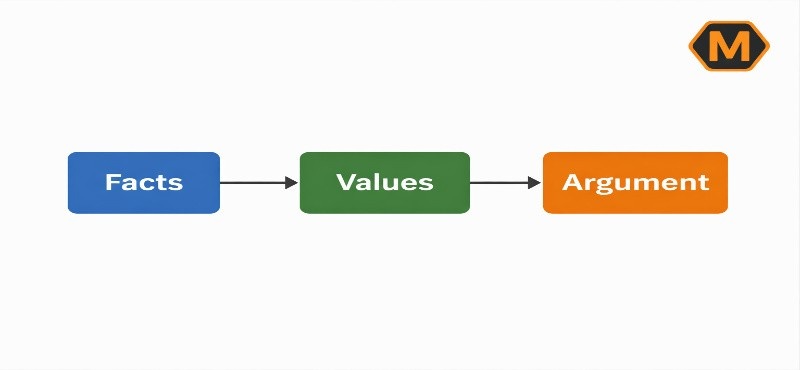
What is the difference between value, facts and arguments?
Understanding the distinction between facts, values, and arguments is essential for clear communication and critical thinking.
Facts
Facts are objective statements that can be verified through data or observation. They exist independently of personal opinion. For example, stating that “The Earth orbits the Sun” is a fact because it can be proven true using scientific evidence. Facts serve as the foundation for any logical discussion because they provide a shared reality.
Values
Values are subjective judgments based on personal beliefs, ethics, or societal norms. They describe what people consider to be good, bad, right, or wrong. For instance, the statement “Privacy is more important than convenience” is a value-based claim. Unlike facts, values cannot be proven true or false; they reflect what an individual or group prioritizes.
Arguments
Arguments are logical structures used to persuade others. An argument combines facts and values to support a specific claim or conclusion. For example, “Because exercise improves heart health (fact) and health is a vital part of a happy life (value), people should exercise daily (argument).” While facts provide the evidence, the logic used to connect them determines the overall strength of the argument.
Question of Value vs. Fact vs. Policy
To achieve high authority in the Google Knowledge Graph, it is vital to distinguish between the three types of persuasive claims. Misidentifying your claim is one of the most common reasons for a “bad speech topic” or a failed presentation.
Comparative Analysis: Claim Types
Feature
Question of Fact
Question of Value
Question of Policy
Primary Goal
To prove something is true or false.
To prove something is right or wrong.
To prove a specific action should be taken.
Focus
Evidence and data.
Morality, ethics, and aesthetics.
Feasibility and necessity.
Example
“Does the US drinking age reduce traffic deaths?”
“Is the current US drinking age an unjust infringement on liberty?”
“The US should lower the drinking age to 18.”
Key Keyword
Is / Is not
Good / Bad, Just / Unjust
Should / Should not
How to Choose a Value Topic That Actually Matters
Choosing from a list of value-persuasive speech topics is only the first step. To ensure your presentation provides a value-added presentation, follow this US-standard academic selection process:
Identify a Conflict of Principles: The best topics involve two competing values (e.g., Security vs. Privacy). This often overlaps with high-stakesdebate topics seen in competitive forensics.
Evaluate Regional Relevance: For a US audience, consider constitutional values, democratic ideals, or contemporary social shifts.
Assess Content Knowledge: Select a topic where you can provide extensive details and select topic examples. If you are struggling to finalize your script, aspeech writing service can help polish your delivery and logic.
Narrow the Scope: Instead of “Values in America,” try “The value of digital privacy in the age of AI.”
Test the “Question of Value” phrasing: Ensure your topic can be phrased as: “Is [X] more [Evaluative Term] than [Y]?”
50+ Trending Value Speech Topics for 2026
Below are the top-performing claim of value topics categorized by theme. These are curated to meet 2026 search trends and academic rigor.
Cluster 1: Ethics, Technology, and the Future
Is AI-generated art a “lesser” form of human expression?
The morality of using deepfake technology for historical education.
Is the pursuit of digital immortality (uploading consciousness) ethical?
The value of “The Right to Disconnect” in a 24/7 remote work culture.
Is algorithm-based dating devaluing human serendipity?
The ethics of autonomous weapons systems: Can a machine make a “just” decision?
Is social media’s influence on self-worth more harmful than its value for connectivity?
Cluster 2: Environmental Values and “Ethical Farming”
Ethical farming: Is the industrialization of agriculture a violation of animal dignity?
The value of “Rewilding” vs. the value of urban expansion.
Is nuclear energy the most “moral” solution to the climate crisis?
The value of deep-sea mining: Is economic gain worth ecological risk?
Patriotism vs. Appetite: Analyzing the ethical choice of food sustainability over consumer convenience.
Is “Fast Fashion” an aesthetic value that outweighs its environmental cost?
Cluster 3: Social Justice and US Constitutional Values
Is the right to privacy more valuable than the right to absolute security?
The value of the Electoral College in representing a diverse republic.
Is a “Universal Basic Income” a requirement for a moral society?
The ethics of the “Death Penalty”: Is retribution more valuable than rehabilitation?
Drinking age examples: Is the 21-year-old age limit an unjust form of ageism?
The value of affirmative action in achieving true meritocracy.
Is censorship ever “good” in the pursuit of social harmony?
When your speech touches on high-level legal or social frameworks, seeking professional academic support can be a game-changer. Experts in the field can help you decode Supreme Court precedents, structure airtight logical syllogisms, and ensure your value judgments are backed by authoritative sources. This level of guidance ensures your oratory moves beyond personal opinion into the realm of scholarly, persuasive discourse. Issues regarding justice often requirepolitical science assignment help to navigate the legal and ethical nuances of the US Constitution.
Cluster 4: Education and Personal Growth
The value of a Liberal Arts degree in a tech-dominated economy.
Is “Standardized Testing” an unfair metric of human potential?
The ethics of “Legacy Admissions” in prestigious US universities.
Is “Failure” more valuable than “Success” as a teaching tool?
The value of mandatory national service for young adults.
Is “Home-schooling” a superior method for preserving family values?
Cluster 5: Media, Culture, and Aesthetics
Is “Reality TV” a devaluing force in American culture?
The value of “Public Funding for the Arts” in a capitalist society.
Is “Cancel Culture” a valid form of social accountability or a violation of grace?
The morality of “True Crime” entertainment: Are we devaluing victims for profit?
Is “Minimalism” a superior lifestyle value for the 21st century?
While value speeches are persuasive, adescriptive speech can be used within your presentation to illustrate the aesthetic worth of your subject.
I think these are not enough, so here I am giving more than 50 examples.
Cluster 6: AI Ethics and the Human Experience
These topics evaluate the worth of human-led processes versus machine-assisted outcomes.
The Value of “The Human Flaw”: Is imperfect, human-made music more valuable than “perfect” AI compositions?
The Ethics of AI Grief Bots: Is it morally harmful to “reanimate” deceased loved ones using LLMs?
Algorithmic Governance: Is a neutral algorithm a more “just” judge than a biased human?
The Aesthetic of Reality: Is an unedited photograph more “authentic” than a generative AI masterpiece?
Cognitive Outsourcing: Is the convenience of AI-assisted thinking devaluing the virtue of intellectual rigor?
AI in Therapy: Is a non-judgmental AI counsellor more “valuable” than a human therapist with limited availability?
The Morality of AI Companionship: Is it pathetic or profound to find emotional fulfilment in a digital partner?
Data Sovereignty: Is personal data privacy a “sacred” right or a commodity to be traded for progress?
The “Dead Internet” Theory: Is a digital space populated by bots fundamentally “worthless” for human culture?
Prompt Engineering vs. Craftsmanship: Does the “vision” of a prompter hold the same artistic merit as the “skill” of a painter?
If you are stuck choosing speech topics, you must analyse speeches centred on the mind. You take benefit from exploring our specificpsychology speech topics to better understand your audience’s motivations.
Cluster 7: Modern Work and Economic Morality
Students debating these topics frequently look for business ethics assignment help to build stronger cases. So, I believe, these topics question the values underlying our 2026 labor market and financial systems.
The Four-Day Workweek: Is employee well-being a greater corporate “good” than 24/7 productivity?
The “Gig Economy” Dignity: Does the flexibility of freelance work outweigh the value of traditional job security?
Quiet Quitting vs. Hustle Culture: Which is the more “virtuous” approach to a career in a post-burnout world?
The Ethics of Luxury: Is the existence of billionaires a moral failure in a world with extreme poverty?
Gamified Investing: Is the “democratization” of the stock market through apps devaluing the seriousness of financial health?
Remote Work Isolation: Is the efficiency of “Work From Home” worth the loss of social cohesion?
Meritocracy as Myth: Is the “self-made” narrative a harmful devaluing of systemic support?
The Value of Manual Labor: Has society unfairly devalued trade skills in favor of “knowledge work”?
Corporate Activism: Is it “right” for brands to take stances on social issues, or is it performative capitalism?
Consumer Responsibility: Is the “moral burden” of ethical consumption unfairly placed on the individual?
Cluster 8: Environmental Philosophy & Bioethics
Deep dives into the value of nature and the limits of biological intervention.
De-extinction Ethics: Is bringing back the Woolly Mammoth a “scientific triumph” or an “ecological ego trip”?
The Value of “Dark Skies”: Is the right to see the stars more important than the utility of satellite constellations?
Lab-Grown Meat: Is “slaughter-free” meat more ethical even if it feels “unnatural”?
The Morality of Space Tourism: Is it ethical for the elite to spend carbon on leisure while the planet warms?
Genetic Editing (CRISPR): Is “fixing” human disabilities a moral obligation or a slide into eugenics?
The Aesthetic of the “Wild”: Is a manicured park less “valuable” than an untouched, dangerous wilderness?
Right to Repair: Is a company’s right to profit more valuable than a consumer’s right to fix their own property?
Climate Anxiety: Is “doomerism” a realistic value judgment or a self-fulfilling prophecy?
Intergenerational Justice: Do we owe more to “unborn people” than to the living population today?
Bio-hacking: Is the pursuit of a “super-human” body an insult to the value of natural human limits?
Cluster 9: Social Fabric and Identity
Evaluating the “good” and “bad” of how we interact in 2026.
The Value of Anonymity: Is the “Right to be Anonymous” online a shield for freedom or a mask for malice?
Digital Minimalism: Is “disconnecting” from the world a sign of strength or an act of social abandonment?
The Ethics of Inappropriate Jokes: Is “offensiveness” a necessary price for a truly free and creative society?
Loneliness as a Policy Issue: Is “community” a public good that governments should be required to fund?
The Morality of “Shaming”: Is public call-out culture a useful social immune system or a toxic weapon?
Parental Surveillance: Is tracking a child’s location via GPS an act of love or a violation of trust?
The Value of Boredom: Is our constant “stimulation” devaluing the creative power of a quiet mind?
Politeness vs. Radical Honesty: Is “niceness” a social glue or a deceptive barrier to progress?
The Death of Subcultures: Is the “algorithmization” of taste making culture more efficient or more bland?
The “Main Character” Syndrome: Is the rise of self-romanticization on social media a healthy boost to self-esteem?
Cluster 10: Education, History, and Truth
Judging the merit of how we learn and what we remember.
The Value of “Useless” Knowledge: Is learning for the sake of curiosity more “noble” than learning for a career?
Statue Removal: Is removing “problematic” historical monuments an act of progress or an act of erasure?
The Ethics of Satire: Is parody a more “truthful” way of understanding politics than traditional journalism?
Gamified Education: Is making school “fun” through apps devaluing the discipline required for mastery?
The Right to be Forgotten: Should our “digital mistakes” follow us forever, or is “grace” a higher value?
Traditional Books vs. E-Readers: Is the tactile experience of paper a “superior” way to absorb information?
The Morality of “Spoilers”: Is protecting the “surprise” of a story a valid social etiquette or an overreaction?
Nationalism in Sports: Is the Olympics a “beautiful” display of unity or a “harmful” display of tribalism?
The Value of Discomfort: Is “Safetyism” in universities protecting students or devaluing their resilience?
The Truth Value of Memes: Are memes a legitimate “shorthand” for complex social truths or a degradation of discourse?
Whenever you give a persuasive speech on a question of value, you need to…
This long-tail query represents a critical “rule of thumb” for high-ranking content. Whenever you give a persuasive speech on a question of value, you need to follow these three mandatory steps to maintain credibility :
1. Define Your Standards (The Criteria)
You cannot say something is “unfair” without first defining “fairness.” Use established frameworks like the US Bill of Rights, Utilitarianism, or Kantian Ethics.
2. Address the Counter-Value
Every proposition of value speech has a legitimate counterargument. If you value “Security,” your opponent likely values “Liberty.” Acknowledge their value to prove your content knowledge and nuance.
3. Use Emotional and Logical Appeals
While a speech of fact relies on logos, a values speech thrives on the intersection of Pathos (emotion) and Ethos (credibility). Use value persuasive speech examples that resonate with the audience’s lived experience.
Deep Dive: Analyzing Value Persuasive Speech Examples
To provide extensive details for our readers, let’s analyze a classic proposition of value speech example.
Topic:The Value of Patriotism vs. Personal Appetite.
The Scenario: In a time of national crisis (such as the historical farming poster example), the government asks citizens to conserve food.
The Value Conflict: Individual freedom of consumption (Appetite) vs. Responsibility to the collective (Patriotism).
The Argument: The speaker argues that “Patriotism” is the higher value because it ensures the survival of the group, which is a prerequisite for any individual to enjoy “Appetite” in the future.
Topic:How a Car Engine Works (The Fact/Value Trap).
The Trap: Many students choose “How a car engine works” for a value speech.
The Correction: “How it works” is a speech of fact/demonstration. To turn this into a value topic, you must ask: “Is the internal combustion engine a ‘better’ technology than the electric motor in terms of environmental ethics?” This shifts the focus from mechanics to morality.
Common Pitfalls: What Makes a “Bad Speech Topic”?
It is a perfect analogy. A topic can be brilliant in a vacuum, but if it doesn’t “fit” the room, the speaker spends the whole time adjusting rather than connecting.
To help you round out your content, I am sharing primary pitfalls that often trip up speakers, along with why professional guidance makes the difference.
1. The “Wikipedia” Trap (Breadth vs. Depth)
When a speaker tries to cover “The History of the United States” in five minutes, they end up rushing through a shallow list of dates.
The Struggle: The audience feels overwhelmed but uninspired because there is no time for stories or nuance.
The Fix: Narrow the lens. Instead of “History,” talk about “The impact of a single 19th-century invention on modern life.”
2. The “Echo Chamber” (Ignoring the Audience)
Choosing a topic based solely on your own passion without considering the room’s knowledge level or interest.
The Struggle: Using jargon that alienates beginners or explaining basic concepts to a room full of experts.
The Fix: Perform a “Values Check.” Does this topic solve a problem, answer a question, or provide entertainment specifically for this group?
3. The “Polarization Pitfall”
Picking highly sensitive or controversial topics without a clear, constructive goal.
The Struggle: If the audience feels attacked or defensive within the first sixty seconds, they stop listening to your arguments and start rehearsing their rebuttals.
The Fix: Use a “Common Ground” approach or choose a topic where you can offer a fresh, less-combative perspective.
4. The “Missing ‘So What?'”
A topic that is informative but lacks a call to action or a takeaway.
The Struggle: The speech ends, the audience claps, and then they immediately forget everything you said because it didn’t relate to their lives.
The Fix: Ensure every topic has a “Thesis of Utility”—a reason why the audience is better off for having heard it.
Why Expert Guidance is the Secret Weapon
Even the best speakers have blind spots. Working with a professional strategist of MyAssignmentHelp helps you navigate these pitfalls by providing:
Objective Filtering: Experts help you kill your “darlings”—those ideas you love that unfortunately don’t serve the speech’s goal.
Structural Integrity: Begin with a strong “hook.” This could be a short story or a startling fact that highlights a moral conflict. You can find inspiration in these essay hook examples to grab your audience’s attention instantly. After the hook, clearly name the core value you are defending. They ensure your ideas follow a logical flow, such as the PEEL (Point, Evidence, Explanation, Link) method, so the audience never loses the thread.
Audience Calibration: Pros can help you tailor your language to specific regional standards or academic rubrics, ensuring your “outfit” is appropriate for the venue.
Confidence Through Clarity: When you know your topic is a perfect fit, the “breathing and moving” part of public speaking becomes second nature.
The Future of Values Speaking in the US
As we look toward the late 2020s, values speaking is becoming the primary tool for combating polarization. In the US, the National Speech & Debate Association (NSDA) has noted a shift toward “Criteria-based” judging. This means that whoever defines the “Value Criterion” most effectively usually wins the debate.
Who values speech? Everyone from corporate CEOs defining “Company Culture” to activists arguing for “Human Rights.” The speech of value is the common language of leadership.
Final Thoughts for the Master Communicator
Whether you are debating ethical farming, the drinking age, or the value of patriotism, remember that a value speech is a bridge between the world of facts and the world of human meaning. By selecting one of the 50+ value speech topics above and applying the rigorous proposition of value framework, you are not just completing an assignment—you are learning to shape the moral landscape of your community.
Priority Checklist for your Next Speech:
Confirmed as a Question of Value? Yes.
Defined the Evaluative Criterion? Yes.
Included selected topic examples? Yes.
Addressed the counter-value? Yes.
FAQ: Frequently Asked Questions about Value Speeches
What is the difference between a question of value and a question of policy?
A question of value looks at whether something is right or wrong, good or bad, or beautiful or ugly. It asks the audience to make a moral or ethical judgment. You are not asking people to do something; you are asking them to believe in the worth of an idea.
A question of policy goes one step further. It focuses on a specific action. It usually includes the word “should” and argues for a change to a rule, law, or behavior.
How do I start a value speech?
To start a value speech, begin with a strong “hook.” After the hook, clearly name the core value you are defending, such as justice, freedom, or equality.
Next, you must set “standards.” These are the rules you want the audience to use when they judge your argument. By defining these standards early, you create a shared ethical map that helps the audience follow your logic.
Why are value topics harder than fact topics?
Value topics are harder than fact topics because they are subjective. A question of fact can be answered with data, math, or physical evidence. For example, you can prove how many people live in a city.
Value topics rely on worldviews and personal beliefs. There is no “ruler” to measure if a painting is beautiful or if a choice is fair. To succeed, you must use clear logic and emotional appeals to connect your argument to the values your audience already cares about.
Where can I find more value persuasive speech examples?
If you need examples, look at famous historical speeches. Transcripts of U.S. Presidential speeches are great for seeing how leaders talk about national values. You can also look at archives like Vital Speeches of the Day.
Another great resource is speech and debate transcripts. These show how students use specific frameworks to argue about social ethics and morality. Watching these can help you see how to structure your own points clearly.
What is the difference between a proposition of value and a proposition of policy?
A proposition of value judges the merit, morality, or beauty of a topic (e.g., “AI is beneficial for society”). A proposition of policy advocates for a specific action or change to a rule (e.g., “The government should regulate AI”). Value focuses on “is it good?”; policy focuses on “what should be done?”
How do you establish criteria in a value speech?
In a value speech, criteria serve as the “yardstick” for judgment. To establish them, define the standards (like justice, safety, or efficiency) that a subject must meet to be considered “good” or “worthy.” Clearly link these standards to your value object to justify why your evaluation is valid.
I am a nursing and healthcare academic expert with experience in medical research and evidence-based writing. I ensure accuracy, uphold ethical standards, and maintain subject credibility in all healthcare and nursing-related academic content.


 09 April,2026












 WhatsApp

