


 16 June,2026

Table of Contents
In today’s time, technologies like artificial intelligence (AI) and machine learning (ML) are playing a major role in creating new job opportunities, changing the way people interact with technology and transparing businesses. From AI powered chat bots to instantly recommendation systems that suggest you new purchase, these technologies are now shaping our daily lives.
Due to this rapid expansion of technology, students and professionals always have one common question in their minds:
AI vs Machine Learning: Which one should you choose in 2026?
The answer is not straightforward as both the fields are interconnected. Machine learning is a subsidiary of AI but the career path, required skill and opportunities differ significantly.
To help students make an informed decision before selecting any technology for their career path
MyAssignmentHelp has brought this guide that explores AI vs machine learning in a detailed manner.
With the help of this blog, you will have complete clarity over career opportunities, salaries, skills and learning paths both the technologies offer so that you can easily select one as per your preferences.
Artificial intelligence empowers machines to make human-like decisions and responses by imitating intelligence. In simple words, we can say, artificial intelligence uses human reasoning to perform tasks.
AI systems can:
The ultimate goal of AI is to create machines that can think, reason, and act intelligently.
AI is everywhere around us.
Some common examples include:
AI is a broad field that consists of multiple technologies, including:
Think of AI as a large umbrella covering many specialized domains.
Machine learning is a subsidiary of Artificial Intelligence. It enables advanced computer systems to learn from data without being explicitly programmed.
Developers train machine learning algorithms on large datasets which eliminate the requirement of writing instructions for every possible situation.
The algorithm identifies patterns and makes predictions based on what it has learned from the uploaded data sets.
You encounter ML almost every day:
Machine Learning focuses mainly on:
AI makes machines intelligent whereas ML learns from datasets. Both the technologies are quite popular among students and that is why many pursue their dream career in these fields either online and offline.
However, before enrolling in these courses students must have some programming skills otherwise they may face difficulties during coursework. Without these skills, the coursework may feel overwhelming and exhausting, leaving students wondering, can I pay someone to take my online class for me? That is why students are required to do some homework before selecting any career path.
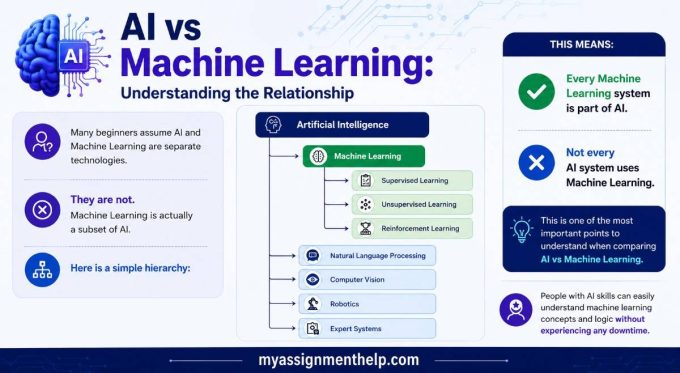
Many beginners assume AI and Machine Learning are separate technologies.
They are not.
Machine Learning is actually a subset of AI.
Here is a simple hierarchy:
Artificial Intelligence
│
├── Machine Learning
│ ├── Supervised Learning
│ ├── Unsupervised Learning
│ └── Reinforcement Learning
│
├── Natural Language Processing
├── Computer Vision
├── Robotics
└── Expert Systems
This means:
This is one of the most important points to understand when comparing AI vs Machine Learning. People with AI skills can easily understand machine learning concepts and logic without experiencing any downtime.
| Feature | Artificial Intelligence | Machine Learning |
|---|---|---|
| Definition | Broad field focused on creating intelligent systems | Subset of AI focused on learning from data |
| Goal | Simulate human intelligence | Learn patterns and make predictions |
| Scope | Very broad | More specialized |
| Data Requirement | May or may not require data | Heavily dependent on data |
| Technologies | ML, NLP, Robotics, Vision | Algorithms, Neural Networks |
| Learning Curve | Wider and longer | More focused |
| Career Options | AI Engineer, NLP Engineer, Robotics Engineer | ML Engineer, Data Scientist |
| Difficulty Level | Higher | Moderate to High |
Also read: Robotics vs Machine Learning in 2026
The popularity of AI and ML is driven by several factors.
Organizations generate enormous amounts of data every day.
AI and ML help companies:
Generative AI tools are changing industries.
These tools can:
This has increased the demand for AI professionals worldwide.
Companies want to automate repetitive tasks.
AI and ML are being used in:
If you choose AI, you can work in multiple specialized domains.
AI Engineers develop intelligent systems capable of:
NLP Engineers work on:
They create systems capable of:
Robotics Engineers build:
Research Scientists:
Machine Learning careers are highly specialized and data-centric.
One major reason students compare AI vs Machine Learning is salary potential.
AI professionals generally command higher salaries because they work across multiple technologies.
Typical roles include:
Senior AI professionals are among the highest-paid technology specialists.
Machine Learning professionals also enjoy excellent compensation.
Popular roles include:
Companies heavily rely on ML experts to extract value from their data, making these professionals highly sought after.
Generally:
Key Takeaways
AI professionals need expertise in several areas.
You should learn:
Python remains the most popular language because of its simplicity and rich ecosystem. Having a good Programming skills is essential for successful completion of coursework. If you feel your programming skills need polishing don’t wait further to get programming assignment help before enrolling in AI courses.
Strong foundations are required in:
You should understand:
Knowledge of cloud technologies is beneficial:
Machine Learning requires deep expertise in data and algorithms.
Focus on:
You should learn:
Popular frameworks include:
You must understand:
A structured roadmap can make AI easier to learn.
Start with:
Learn:
Study:
Explore:
Choose:
The Machine Learning roadmap is more focused.
Understand:
Study:
Work with:
Study:
Create projects such as:
Many beginners wonder:
AI vs Machine Learning: which is easier?
Machine Learning is generally easier to start with because:
Artificial Intelligence is broader because it covers:
Therefore:
Also Read: Cloud Computing Vs Software Engineering: Which Career Path Is Better in 2026?
The answer depends on your interests.
You:
AI is ideal for people who enjoy learning multiple domains.
You:
Machine Learning is ideal for analytical thinkers.
Absolutely.
In fact, many professionals do exactly that.
A common learning path is:
Python → Mathematics → Data Analysis → Machine Learning → Deep Learning → NLP/Computer Vision → AI Applications
Learning Machine Learning first gives you a solid foundation.
You can later specialize in AI domains that interest you the most.
This approach offers:
Learning AI and Machine Learning is challenging. Let our PhD-qualified engineering experts handle assignments, quizzes, exam and coursework while you stay ahead of deadlines.
Get Engineering Class Help5000+ Experts • 24/7 Support • Secure & Confidential
The future looks extremely promising.
Generative AI can create:
This field is expected to continue growing rapidly.
AI agents can:
Businesses are investing heavily in this technology.
AI is improving:
Edge AI allows intelligent systems to operate directly on devices without relying heavily on cloud servers.
Applications include:
Organizations increasingly want AI systems that are transparent and easy to understand.
Explainable AI is becoming a critical area of research and employment.
So, when it comes to AI vs Machine Learning, which one should you choose in 2026?
Choose Machine Learning if:
Choose Artificial Intelligence if:
For most students, the best strategy is:
This approach helps you build strong fundamentals while keeping your career options open.
The debate around AI vs machine learning will continue as both the technologies are highly advanced and evolving with the time. However, selecting one particular field depends on an individual’s interest and preferences. Machine learning offers data-driven career opportunities, whereas artificial intelligence opens the door to more innovative options.
In 2026, companies are not simply looking for AI or machine learning experts. They prefer those professionals who can combine the skill set from both the technologies and use problem solving skills to build intelligent systems that can create real world impact.
Choosing one particular field completely depends on your goal and preferences. Go with machine learning If you love working with data and algorithms whereas choose AI if you want to build intelligent systems that hold human level reasoning, like chatbot, robotics and generative AI.
Yes, machine learning is an essential subsidiary of AI that enables systems to learn from data and improve gradually.
Both AI and machine learning come with strong career opportunities. In 2026, so you can choose any of the fields as per your job preferences.
Generally, yes, AI is a bit harder to learn than machine learning because it covers multiple domains such as machine learning, NLP and computer vision which make it complicated compared to machine learning, which primarily focus on data and predictive models.
Yes, you can learn both AI and Machine learning together and secure better career opportunities.

I am an experienced class-help specialist supporting students across all subjects. I assist with online classes, coursework, and exam preparation, delivering structured academic guidance, reliable subject coverage, and consistent support to help students succeed confidently.










 WhatsApp

