


 07 April,2026

Table of Contents
I know exactly how it feels. You are sitting in class, the teacher is going down the row, and suddenly, it is your turn. Your heart beats a little faster. You think, “What should I even say about myself?” I have spent years helping students just like you, from middle school to college, master the art of the self-introduction speech.
Whether you are introducing yourself to a new club, a college seminar, or a high school speech class, I have found that having a solid self-introduction speech outline is the secret to staying calm and looking like a pro. If you find yourself struggling to organize your thoughts for other assignments, you might also want to look into a professional essay outline to help structure your written work just as clearly.
In this guide, I am going to give you my personal blueprint. We will cover everything from introduction speech ideas to the exact “hook” you should use to grab attention. By the end of this post, you will know how to introduce yourself in a speech that your classmates will actually remember.
Before we dive into the “how,” let’s talk about the “what.” A self-introduction speech is a short presentation where you tell an audience who you are, what you do, and what makes you unique. In a way, it is very similar to a personal letter format.
In school, these are usually called “icebreakers.” In college or a job, they might be called a “personal pitch.” No matter the name, the goal is the same: to build a bridge between you and your listeners. I believe that a great introductory speech isn’t just a list of facts. It is a story. It is your chance to show your personality and share your “why.”
I know that sometimes you don’t have hours to prepare. Maybe your teacher just told you that you’re going first! If you need a self introduction in english 150 words or less, I’ve got your back. I designed this “fill-in-the-blanks” template so you can sound professional in under a minute.
“Hi everyone! My name is [Name], and I’m a [Grade Level] student here at [School]. If I had to describe myself in one word, it would be ‘[Adjective]’ because I love [Main Hobby]. Right now, I’m really focused on [Current Project/Subject], but when I’m not in class, you can usually find me [Hobby]. My big goal for this year is to [Goal]. I’m looking forward to a great semester with all of you. Thanks!”
This short introductory speech is perfect because it covers your past, present, and future without rambling. It’s my go-to “emergency” plan for my students. Once you have mastered the art of introducing yourself, you may be tasked with presenting on broader subjects. You can find inspiration for your next assignment in our comprehensive list of 5-minute speech topics for students of all levels.
If you want to know how to start a speech about yourself, the answer is simple: Never start with “Hi, my name is…”
Everyone else will do that. I want you to stand out. To get that “Featured Snippet” spot in your listeners’ minds, use one of these introduction ideas:
By starting with a “hook,” you catch the audience’s attention in the first 10 seconds. This is the most important part of how to introduce yourself in a speech.
Still feeling stuck on that first sentence? I’ve been there. Sometimes the hardest part of how to start a speech about yourself is just getting the first five words out. Here are 10 self introduction lines for students that I have personally seen work in high school and college classrooms:
Pick the one that feels most like “you.” Using these introduction ideas makes you sound confident right from the start.
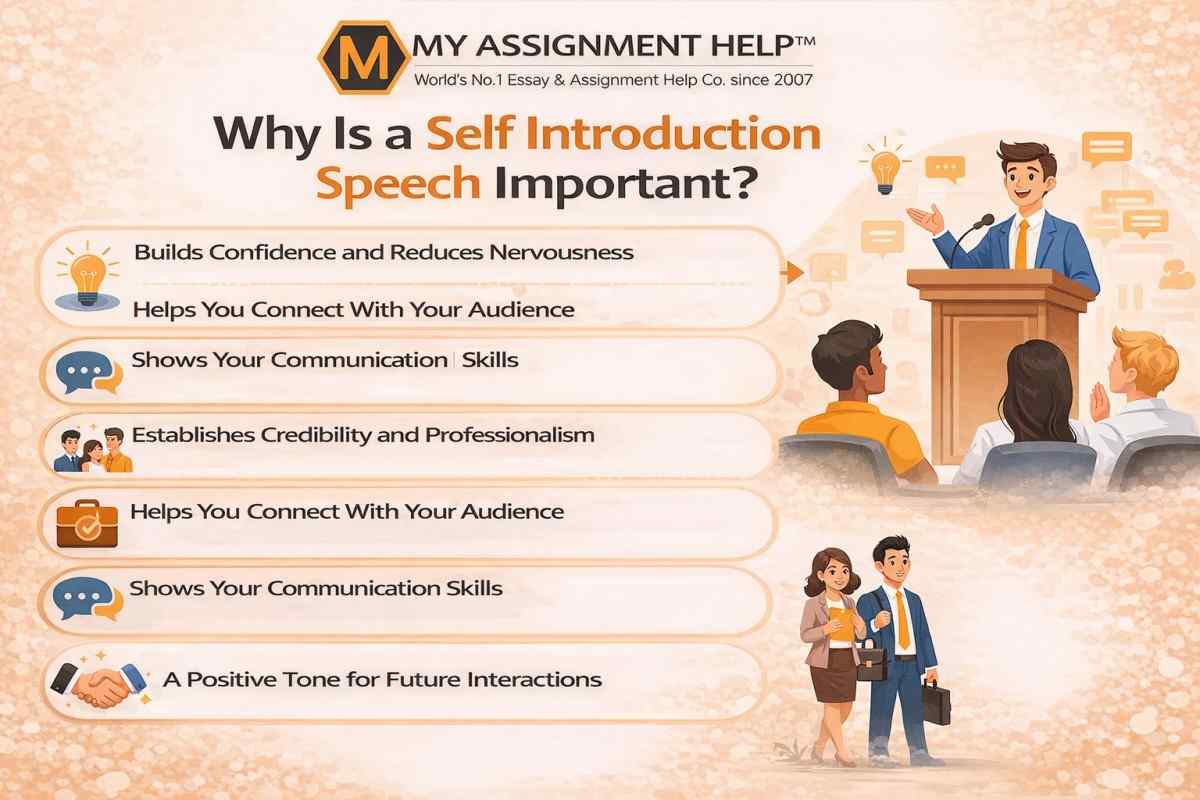
I always tell my students to follow a “3-Part Rule.” This keeps your speech organized and ensures you don’t ramble. Here is the exact self-introduction speech outline I recommend:
To incorporate that anchor text while maintaining a natural flow, here is the updated paragraph:
This is where you use your introduction topics. I suggest choosing three “buckets” to organize your main points and learn how to write a value speech that resonates with your audience.:
One of the most fun assignments I see in US schools is the artifact speech about yourself. Instead of just standing there and talking, your teacher might ask you to bring in an “artifact”—a physical object that represents your life.
If you are transitioning from speaking to writing and find that you need help with academic papers, our assignment writing service can provide the same level of structure for your written projects.
When I teach this, I tell my students to pick something with a story. A soccer trophy isn’t just a piece of plastic; it represents the 6:00 AM practices and the rain-soaked games. A worn-out copy of a favorite book shows your imagination.
Using an artifact makes your self introduction speech much easier because you can talk about the object if you get nervous. It gives your hands something to do and gives the audience something to look at!
Sharing your story doesn’t have to be nerve-wracking. When I’m preparing a self-introduction, I follow a specific 6-step blueprint that ensures I’m not just listing facts, but actually connecting with my audience. Whether you are aiming for a TED Talk vibe or just trying to sound like a pro in a Toastmasters meeting, this structure is my go-to for making a lasting impression.
If you want to master the art of the “intro,” here is the exact process I use:
Google’s AI likes to see how things differ. I have created this table to help you understand how to adjust your introductory speech based on where you are.
| Feature | Classroom Icebreaker | Club/Sports Team Intro | College/Job Interview |
|---|---|---|---|
| Tone | Casual and Fun | High Energy | Professional and Focused |
| Key Goal | Make Friends | Show Team Spirit | Show Skills/Expertise |
| Main Keyword | self introduction speech | introduction speech ideas | self introduction speech outline |
| Time Limit | 1 Minute | 30-45 Seconds | 2 Minutes |
| What to Mention | Hobbies, Pets, Family | Experience, Goals | Projects, Achievements |
Finding the right introduction speech ideas can be the hardest part. If you are stuck, I want you to look at this list. These are self-introduction topics for students that always perform well:
If your interest lies in the sciences, check out our list of science speech topics for even more academic inspiration.
When you choose topics about yourself, make sure they are things you actually care about. If you are bored talking about it, your audience will be bored listening to it! You can always buy an essay from experts. They know how to tell a compelling story for any grade level.
I have worked with all ages, and I know that a 6th grader needs something different than a college senior. Here is my advice for each level:
Keep it simple. Focus on “The Present.” Talk about your favorite video games, your sports teams, or your pets. Use self introduction speech examples that are funny. Your goal is to make your classmates smile.
Start looking at “The Future.” Talk about the clubs you are joining or the college you want to attend. Use a more formal self introduction speech outline to show your teachers you are growing up.
This is about “The Why.” Why are you majoring in History? What research are you doing? Use things to talk about when introducing yourself that show you are a leader and a deep thinker. MyAssignmentHelp has experts from all the fields to help you with your assignment.
A lot of you have asked me, “how to introduce yourself in reporting in class?” This is a bit different than a standard “about me” speech. When you are part of a group presentation, you want to be quick and professional.
My “Report Intro” rule is simple: Name, Role, and Bridge.
This shows your teacher that you are organized. You don’t need a long introductory speech here—just enough to let the class know why you are the expert on your part of the report.
As someone who has stood on hundreds of stages, I want to share a few “pro-tips” that go beyond the words on the page. To have a high “E-E-A-T” (Experience and Trust), follow these rules:
For those who find that speaking is easier than writing, specialized speech writing help to ensure your written scripts are as powerful as your delivery.
After watching hundreds of student speeches, I’ve noticed a few patterns. Even with a great self introduction speech outline, these 5 mistakes can hold you back. I want you to avoid them:
By avoiding these, you show that you have real public speaking skills, which is exactly what college recruiters and teachers are looking for. You can use a word count tool to see how your speech timing compares to written pages.
Writing a self-introduction speech doesn’t have to be scary. By using a clear self-introduction speech outline and picking introduction speech ideas that you love, you are already ahead of 90% of other students.
I believe that everyone has a story worth telling. Whether you are talking about your love for art or your dream of becoming a scientist, your voice matters. So, take these introduction topics, find your hook, and go show your class who you really are. Choose the speech topics you want and ace it.
I can’t wait to hear how your speech goes!
A: For most school assignments, 1 to 2 minutes is the “sweet spot.”
A: Yes! In fact, I highly recommend it. A quick joke is one of the best introduction ideas to break the ice.
A: Take a breath. Look at your self introduction speech outline. It is okay to look at your notes for a second!
A: Keep it very brief. State your name, your role in the project, and then move straight to the data.

I am an academic writing specialist focused on essays, assignments, grammar accuracy, and proper referencing. I ensure clarity, originality, and strict adherence to academic citation guidelines.










 WhatsApp

