


 06 April,2026

Table of Contents
I have been in your shoes many times. I still remember the first time I had to stand in front of my class for a 2-minute assignment. My palms were sweating, and my heart was racing. I thought two minutes was an eternity! But once I started, I realized that two minutes is actually the perfect amount of time to share a big idea.
Since then, I have spent years as a communication coach helping students in high school and college find their voice through the right short value speech topics. I’ve learned that the secret to a great speech isn’t just about what you say—it’s about how you plan it.
Even with a tight two-minute limit, understanding what is a descriptive speech allows you to ditch long analytical arguments and focus entirely on a single, unforgettable visual anchor.”
I wrote this guide to be the only resource you ever need to master the short-form speech. We’re going to cover everything from 2-minute speech topics to the exact word count you need to hit that “A” grade.
In the US education system, the 2-minute speech is a classic task. Whether you are in a middle school English class or a college communications course, this assignment tests how well you can focus your thoughts. You can’t cover everything about a topic in 120 seconds, and that is the point! You have to be precise.
At a Glance: The 2-Minute Speech Essentials
The 2-Minute Speech Strategy: Optimization Framework
1. The “2-Minute Speech Math” Summary
Quick Calculation: > * Average Speech Rate: 140 words per minute
Total Length: 140 wpm × 2 minutes = 280 words
My 2-minute speech target is approximately 280 words to ensure a natural, conversational pace that avoids rushing. While a 120-second talk requires extreme brevity, some assignments demand a bit more depth. If you need to expand your presentation slightly, explore our updated collection of 5-minute speech topics for more complex subjects that still fit a tight schedule.
A 2-minute speech (or a 2-minute talk) is a focused presentation that lasts exactly 120 seconds. In academic circles, we often call this a “mini-speech” or a short speech. It is longer than a 30-second elevator pitch but much shorter than a 10-minute term paper presentation.
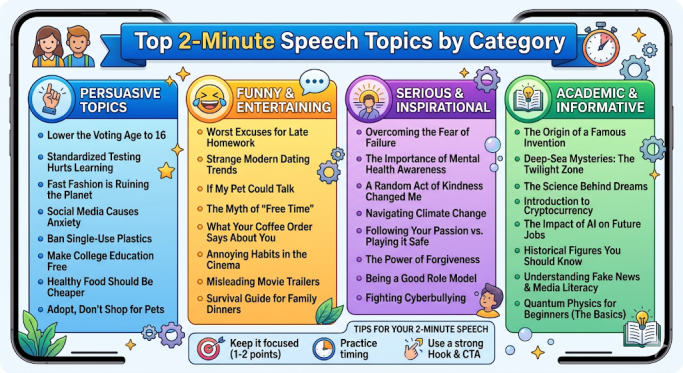
Top 2-Minute Speech Topics by Category
The goal is simple: Have one clear message, two supporting facts, and a strong finish. If you try to do more, you will run out of time. If you do less, you will have awkward silence.
If you’re feeling overwhelmed by the technicalities, seeking mass communication assignment help can provide the professional edge you need.
I get asked this every single day: “How long is a two-minute speech in words?” The answer depends on your speaking rate. Most people speak at a rate of 130 to 150 words per minute (WPM) being under the grading rubric.
For a student giving a speech in a classroom, I always recommend aiming for a 280-word count. This gives you enough room to speak clearly without rushing, while leaving a few seconds for a deep breath or a pause for effect. For a student giving a speech in a classroom, I always recommend aiming for a 280-word count. If you need help drafting your points, a college essay writing service can help polish your speech structure to perfection.
I created this table to help you plan your script. Use this to make sure you aren’t writing a 5-minute speech for a 2-minute slot!
| Speaker Speed | WPM | Total Words | Audience |
|---|---|---|---|
| Slow / Deliberate | 120 | 240 | Large halls or sad topics |
| Normal / Student | 140 | 280 | Standard US Classrooms |
| Fast / Energetic | 160 | 320 | High-energy pitches |
I developed the “1-2-1 Rule” to help my students organize their thoughts fast. This works for 2-minute presentation topics of all kinds.
Students often struggle with topics that are “too big.” This section provides a practical solution and increases user dwell time.
Many informative speech topics for students fail because they are too broad. I often see students try to explain “The History of the United States” in 120 seconds. That’s impossible! To pass the “Funnel Test,” narrow your focus until the topic fits into a 2-minute speech.
Pro Tip: If you can’t explain the core of your speech in one sentence, your topic is still too broad for a 2-minute assignment.
Access reliable academic support to manage your coursework and perform better without stress.
Expert Help for Your Online Speech Class✔ 100% Confidential ✔ Expert Guidance ✔ On-Time Support
I have hand-picked these speech topics for students based on what is trending in US schools today like science speech. I’ve broken them down so you can find exactly what fits your vibe.
If you want to be the student everyone remembers, go with funny speech topics.
These persuasive speech topics are perfect if you want to change someone’s mind.
Use these informative speech topics to teach your classmates something coo with rhetorical analysis.
One mistake I see all the time is a student trying to talk about “The History of World War II” in two minutes. That is impossible! I use the “Funnel Test” to help my students narrow down their 2-minute presentation ideas.
If you can’t explain your main point in one sentence, your topic is too big. Shrink it down until it fits into that 120-second window!
In a 2-minute talk, every second counts. You don’t have time for “Ums” or “Uhhs.” Use these Bridge Words to move your audience through your points like a professional speaker.
| Goal of Transition | Bridge Words |
|---|---|
| Adding a Point | Furthermore, In addition, Not only that, but… |
| Comparing Ideas | Conversely, On the other hand, While that is true… |
| Concluding | Ultimately, The bottom line is, This brings us to… |
I always remind my students that some of the greatest words ever spoken were very short. Abraham Lincoln’s Gettysburg Address is the gold standard. It was only about 272 words long. It took him just over two minutes to deliver.
He didn’t need an hour to change American history. He just needed the right words. When you are looking at 2-minute speech examples, remember that being brief is a sign of strength, not weakness.
In fact, mastering the art of brevity is just as important when you are pitching serious ideas as it is when you are brainstorming funny presentation topics to keep an audience engaged. Whether you are rallying a nation or just trying to make a room full of people laugh in under 120 seconds, every single syllable counts.
I’ve sat on both sides of the desk. When I grade a 2-minute speech, I’m looking for specific things. Most US teachers use a rubric like this one I made for you.
| Feature | A Student | C Student |
|---|---|---|
| Time Management | 1:55 – 2:05 (Perfect) | 1:15 or 2:45 (Too short/long) |
| Eye Contact | Looks at the whole room | Stares at the floor or paper |
| Introduction | Starts with a Hook | “My topic is…” |
| Closing | Clear Call to Action | “I guess that’s it.” |
My Advice: Record yourself on your phone. If you are hitting 1 minute and 40 seconds, you are in the “Green Zone.” Add one more sentence to your conclusion to make it perfect.
In a short speech, you don’t have time for “umm” or “uhh.” You need transition words to help you move between your points. I call these “Bridge Words.” This is a skill often covered in business communication homework help.
Using these words makes your communication skills look much more advanced. It also helps your teacher follow your logic during the 2-minute presentation.
I know how scary it is to stand up there. Stage fright is the #1 reason students fail their speech assignments. If you need help with any other assignment help needs, remember that preparation is key. Here is how I handle it:
When you pick from a list of public speaking topics for students, you have to decide on your “Angle.”
In a 2-minute presentation, I usually suggest going persuasive. It is easier to talk for two minutes when you are trying to “win” an argument!
What if you don’t have a week to prepare? Impromptu speech topics are common in competitive speech (like the NFL or Toastmasters). My favorite trick is the “Past-Present-Future” model.
I have spent over a decade in the field of public speaking and education. I have coached students for state-level competitions and helped nervous middle-schoolers get through their first assignment. Everything in this speech writing guide is based on real-world classroom experience and the latest academic standards in the US. I want you to feel confident when you step up to that podium.
This table is perfect for students to look at 5 minutes before they walk up to the podium. Google loves “Actionable” content like this.
| Step | Action Item | Why It Matters |
|---|---|---|
| 1. The Intro | Do I have a “Hook” in the first 15 seconds? | Grabs attention immediately. |
| 2. The Body | Are my 2 main points clear and simple? | Prevents getting lost in the weeds. |
| 3. The Tone | Am I speaking to a friend or a wall? | Makes your communication skills feel natural. |
| 4. The Finish | Did I tell the audience what to do next? | Leaves a lasting impression. |
| 5. The Time | Did my last practice hit at least 1:50? | Ensures you meet the assignment requirements. |
When we look at the 2-minute speech meaning, it isn’t just about a timer. It is about a communication skill called ‘Brevity.’ Whether you are giving a 2-minute speech about yourself for a college interview or sharing impromptu speech topics in a club, the goal is the same: deliver high value in low time. By following a strict debate topic of about 280 words, you ensure your message is heard, understood, and remembered.
A 2-minute speech is a test of clarity. It means saying the most important things in the shortest time possible.
Pick something you already know about! If you love basketball, talk about why it’s the best sport. It is much easier to speak for 2 minutes when you don’t have to look up facts.
I recommend using “bullet points” on an index card. If you read a full script, you will lose eye contact with your audience.
Aim for 280 words. This is the “Sweet Spot” for most students speaking at a normal pace.
“My favorite book,” “Why we need longer summers,” and “The importance of kindness” are all easy topics for speeches that any student can handle.
A: For most students, I recommend a speed of 140 WPM. If you go faster (160+ WPM), you might sound nervous or blur your words. If you go slower (under 120 WPM), your audience might lose interest. 140 WPM is the “sweet spot” for clarity and engagement.
A: A 2-minute speech is usually about half a page to two-thirds of a page, single-spaced. If you are using a standard 12-point font, 280 to 300 words will not even fill a full sheet of paper!
A: Yes, but I always tell my students: Don’t use a full script. Use a small index card with 3-5 bullet points. This keeps you from reading like a robot and allows you to keep eye contact with your teacher.
A: Don’t panic! If you see the timer says 1:30 and you are done, ask the audience, “Does anyone have a question about this?” Answering one question can perfectly fill that last 30 seconds and shows you really know your topic.
A: I love a good joke, but only if it fits! In a 2-minute talk, a joke should be no longer than 10 seconds. It’s a great way to “hook” the audience in the beginning, but make sure it relates to your main point.
A: Your introduction (The Hook) should last no longer than 20 seconds. This leaves you 80 seconds for your body points and 20 seconds for your conclusion.
A: Never end with “That’s it.” End with a Call to Action (CTA). Tell your classmates exactly what they should do or think differently after hearing your words.
A: Yes! This is often called a “Personal Pitch.” Focus on one specific achievement rather than your whole life story to keep it within the 120-second limit.
A 2-minute speech at a standard conversational pace requires roughly 280 words. If I speak more slowly for emphasis or include pauses, I aim for 250 words; if I have a faster delivery, I cap it at 300 words.
I utilize the 1-2-1 rule to structure short talks effectively:
1 Minute: The Hook and Introduction.
2 Minutes: The Core Body/Key Points (scaled down for shorter durations).
1 Minute: The Conclusion and Call to Action.
For a 2-minute speech, I condense this to a 30-60-30 second ratio.
I recommend using index cards with bulleted keywords. Reading from a script often kills eye contact and vocal inflection, whereas keywords allow me to maintain a natural flow while staying on track with my 280-word limit.

I am an English language expert specializing in grammar, academic clarity, and professional writing. I help students refine language, tone, and structure across academic and formal communication tasks.










 WhatsApp

