


 09 December,2025

Table of Contents
Writing an assignment becomes much easier when it is organised clearly. A good structure helps your ideas flow and makes your work easier to read. Even if you understand the topic, you may lose marks if the assignment is not arranged properly.
Many students wonder, “How should I structure my assignment?” or “What is the best format?” If you’re not sure where to start or how to organise each part, this guide will help. It gives simple steps, easy templates, and clear examples to make your writing better.
To get started, you can also explore more resources and, if needed, take professional help to build a strong foundation.
Explore step-by-step assignment structure examples and academic writing guidance.
Before you try to learn how to structure an assignment, your first task is to understand the assignment itself. Many students rush into writing an assignment without reading the instructions carefully. As a result, they miss critical requirements like formatting, word count, and question intent.
Your capstone assignment is not only to read but also to interpret what the professor is asking you to do. This is where understanding the assignment plays a key role. If you have essays to write, take economics essay writing help.
When you understand the assignment, you can also figure out:
Example:
Imagine your professor gives this assignment:
Topic: How does social media affect students’ learning? Explain with examples.
Many students will immediately start writing about anything related to social media.
But if you take a moment to understand the assignment, you will notice four key requirements:
Once you understand this, the assignment becomes much clearer. You can now decide:
This simple step — reading and interpreting the question — saves time, prevents mistakes, and makes your writing sharper and more focused.
To know the general academic writing approach, check out this guide on how to write a paper.
Having the right assignment structure ensures clarity, coherence, and flow. Professors expect your ideas to be organised in a logical sequence so the reader can follow your argument easily.
Here’s why knowing how to structure an academic assignment matters:
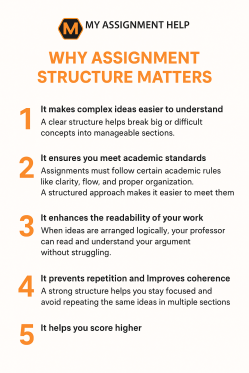
A clear structure helps break big or difficult concepts into manageable sections.
Example: If your topic is Artificial Intelligence in Education, dividing it into Benefits, Challenges, and Future Impact makes it easier for readers to follow.
Tip: Before writing, list your main points and group similar ideas together—this instantly simplifies your structure.
Assignments must follow certain academic rules like clarity, flow, and proper organisation. A structured approach makes it easier to meet them.
Example: Most rubrics have criteria like Organisation, Logic, or Presentation. A well-structured assignment naturally scores well in these sections.
Tip: Always read the marking rubric before starting. It usually reveals exactly what your professor wants.
When ideas are arranged logically, your professor can read and understand your argument without struggling.
Example: Using subheadings such as Introduction, Method, Analysis, and Conclusion makes your paper look clea and professional.
Tip: After writing a paragraph, check whether it connects smoothly to the next one. If it doesn’t, rearrange or add linking sentences.
A strong structure helps you stay focused and avoid repeating the same ideas in multiple sections.
Example:If you already explained “Causes of Poor Air Quality” in one section, your structure will remind you not to bring it up again unnecessarily.
Tip: Create a rough outline before writing. Even a simple bullet list can keep your content organised.
Teachers reward assignments that are easy to read, logically organised, and well-presented.
Example: Two students may have the same content quality, but the one who uses a clearer structure will usually get a better grade.
Tip:
Always revise your structure in the end—make sure each paragraph has one clear idea and supports your main argument.
Students often ask, “How should I structure my response to this assignment?” The answer almost always starts with using a strong, clear, academic structure.
This step gives you the exact method top students use. Whenever you wonder, “How should I structure my assignment?” — this is where the answer begins.
The very first thing you must do is read the question carefully. Many students jump straight into writing and later realise they misunderstood what the professor actually wanted. Understanding the assignment helps you avoid wrong formats, incorrect approaches, and unnecessary rewrites.
To fully understand the task, break the question into parts:
These are the verbs that tell you what to do in your assignment.
Examples of action words: evaluate, discuss, compare, justify, critique.
What it means:
Why this matters: Action words decide the tone and depth of your answer.
This tells you what your assignment is about.
Example: If the question is “Discuss the impact of online learning on student performance,”
The main topic is online learning and its effects on performance.
Why this matters: It ensures you stay focused and don’t include irrelevant information.
Different assignments use different formats:
Sometimes professors specify how many sections to include, whether you need headings, and how detailed your analysis should be.
Example: A case study might require sections like Background, Problem, Analysis, and Recommendation.
Why this matters: When you know the expected structure, writing becomes much easier and more organised.
Most students who ask, “How should I structure my response to this assignment?” are actually confused about what the question wants. When you break the question down using the steps above, the structure becomes clear automatically.
Once you fully understand the question, the next step is to start researching your topic. Good research is the backbone of strong academic assignment writing, and it directly impacts how effectively you can present your ideas.
Begin by exploring credible academic sources, such as:
Many students write confidently but still lose marks because their work lacks strong evidence or relies on weak online sources. Research allows you to build arguments that are factual, supported, and academically acceptable.
If you’re working on a research-heavy assignment, you may need to write a literature review — a section that summarises what other researchers have already said about your topic.
Tip: A good literature review is not just a summary — it shows patterns, gaps, agreements, and disagreements in existing research.
Example: If your assignment is on “The impact of social media on mental health,” your literature review should discuss existing studies, theories, and findings by psychologists and researchers.
You can explore more about how to write a literature review to learn how to summarise and evaluate existing research effectively. A literature review helps you identify gaps in knowledge, compare different studies, and build a strong foundation for your assignment. Using credible sources in this section also strengthens the overall quality and credibility of your work.
For an advanced university assignment or postgraduate work, you may have to create a research proposal before writing the full assignment. This outlines:
Tip: A strong research proposal improves clarity and helps you organise your assignment structure before writing.
Example: A research proposal on renewable energy adoption might include your research questions, methodology, and expected outcomes.
Learn more about research proposal writing to understand how to plan and present your research effectively. A research proposal outlines your objectives, methodology, and expected outcomes, providing a clear framework before you start the full assignment.
Every academic assignment needs a central argument — this is what your entire paper will revolve around. A strong thesis statement not only tells the reader what your position is but also guides how you structure your content.
A clear thesis helps you:
You can explore in more detail how to develop a strong thesis statement
Example:If your assignment is “The Impact of Social Media on Student Productivity,” your thesis could be:
“While social media can offer educational resources and networking opportunities, excessive use significantly reduces student productivity and focus.”
This thesis clearly shows your position and hints at how the assignment will be structured:
A well-planned outline makes it much easier to organise the parts of your assignment in a logical and coherent way. Think of the outline as your roadmap — it ensures you follow the correct assignment structure when writing the draft, helping you stay focused and avoid missing key points.
Example Outline
For guidance while drafting your assignment, you can refer to the first draft of assignment resource, which explains how to organise your ideas and start writing effectively.
The introduction is the first impression your assignment gives, so it needs to be clear, engaging, and structured. A strong introduction sets the tone for the rest of your work and helps the reader understand what to expect.
What the assignment is about: Briefly explain the topic and the scope of your assignment.
Example: “This assignment explores the impact of social media on student productivity, focusing on both benefits and drawbacks in academic settings.”
Why the topic matters: Explain the relevance or importance of the topic in your field.
Example: “Understanding this impact is critical for educators and students to develop strategies that maximise learning while minimising distractions.”
How the assignment is structured: Give a short roadmap of the sections that follow.
Example: “The assignment first discusses the theoretical background, followed by analysis of recent studies, and concludes with recommendations for effective use of social media in learning environments.”
The thesis statement: State your central argument or main idea clearly.
Example: While social media offers educational opportunities, excessive use negatively affects student productivity, requiring balanced usage strategies.
For students who find adapting this structure difficult for complex topics, expert assistance is available through project management assignment help online.
This is the largest part of your writing assignment.
It includes:
When learning how to structure an academic assignment, organising this section with headings and subheadings is crucial. You can also refer to the essay writing guide to understand academic paragraphing, flow, transitions, and coherence.
Your conclusion must:
This is also a good place to naturally mention “how should the assignment be structured” as a reflective phrase in your final advice.
Editing is where good assignments become great. Check for:
Finally, compare your work with your outline and question to ensure accuracy.
Our experts can help you organise, edit, and format your assignment perfectly.
Students frequently search for an assignment structure example because visualising the structure helps a lot. Below is a simple yet effective example demonstrating how to structure an assignment on “Climate Change and Global Policy.”
Title Page Climate Change and Its Impact on Global Policy
Student Name
Course
Date
Introduction Climate change is a global issue affecting ecological systems, human societies, and international politics… [introduce topic + thesis]
Body Section 1: Background and Context Define climate change, causes, and global trends…
Body Section 2: Policy Challenges Discuss political conflicts, economic limitations, etc.
Body Section 3: Possible Solutions Explain global treaties, policies, and agreements…
Conclusion Summarise findings and give a final perspective.
References APA/MLA citations
This example demonstrates the exact structure of an assignment used in many college assignments, paper assignments, and university assignment tasks.
Even if you know how to structure an assignment, poor formatting can still cost marks.
Standard assignment format includes:
Students also worry about the college assignment format, but most institutions follow similar rules unless specified otherwise.
Understanding how to answer assignment questions effectively is as important as structure.
Here’s how:
Your response must align with the writing assignment instructions and question intent.
To improve your assignment writing, follow these practical tips:
You may also explore tips to write a good assignment to improve your writing skills and understand how to present your ideas effectively. These tips can help you enhance clarity, structure, and overall quality in your assignments.
If your assignment is more specialised, such as a case study, you can refer to how to write a case study for step-by-step guidance and examples. This resource helps you structure your analysis, present evidence, and draw clear conclusions effectively.
Students often struggle with:
Avoiding these mistakes can significantly improve the overall quality of your writing assignment.
Conclusion
Now you fully understand how to structure an assignment from start to finish. By properly planning, outlining, researching, writing, and revising, you can create an academically strong paper that flows logically and impresses your instructor. Whether you are working on writing my assignment, handling complex paper assignments, or preparing college assignments, following a clear, systematic structure will make the process smoother.
Mastering assignment organisation not only improves your grades but also strengthens your overall academic assignment writing skills. Follow these steps, use a reliable assignment structure example, and keep practising—your confidence and performance will grow with every new assignment you write.
A clear assignment structure includes an introduction, main body with organised headings, and a conclusion. Some assignments may also require abstracts, references, or appendices.
Read the instructions carefully. Look for keywords like “analyse,” “compare,” “evaluate,” or “discuss,” which indicate the type of structure and approach required.
No. Essays, reports, case studies, and reflective papers all have different formats. Always match the structure to the assignment type and your professor’s guidelines.
There is no fixed rule, but the introduction is usually 10%, the main body 70–80%, and the conclusion 10%. Follow any word-count instructions given.
Include the topic, purpose, and scope of the assignment. Give a brief outline of what the reader can expect next.
Use headings, subheadings, bullet points, topic sentences, and clear transitions. These make your content easier to read and understand.
Most reports and long assignments need headings. Essays may not use headings unless allowed by your instructor.
It depends on the word count and subject. As a general rule, include at least 1–2 references per major point or paragraph.
Good structure improves clarity, flow, and readability. Teachers reward well-organised work because it shows critical thinking and understanding.
Yes. Templates help you maintain organisation and consistency, especially if you’re not confident about layout or formatting.

I am a technical academic writer specializing in IT, programming, networking, and engineering subjects. I translate complex technical concepts into clear, academically sound content for students at all levels.










 WhatsApp

