


 10 June,2026

Table of Contents
When we step into our final college semesters or cross the threshold of higher graduate studies in the United States, one massive academic mountain stands between us and our degree: writing an engineering dissertation.
Whether you are wrapping up an undergraduate honors capstone or diving into advanced postgraduate research, this major research paper is likely the biggest project you have ever faced.
We know how overwhelming it feels to stare at a blank screen, wondering how to translate complex calculations, lab experiments, and CAD software designs into a polished 50-to-200-page document.
Professional dissertation help services can provide structured support throughout every stage of the research and writing process.
That is exactly why we created this guide. We will walk you through the entire process step-by-step, explaining how to master the technical layout, organize your chapters, and choose high-performing research questions that get top grades from your thesis committee.
An engineering dissertation is an original, publication-quality academic research paper that applies advanced mathematical, scientific, and software engineering frameworks to solve an active, real-world technical problem or design flaw.
When we work on a standard college assignment or a routine engineering term paper, we usually just summarize existing knowledge or execute a predefined lab experiment. However, true dissertation engineering requires us to step out of the classroom and act as professional innovators. Your department expects you to identify a clear technical gap, establish a systematic methodology, design a prototype or mathematical model, and critically evaluate the results.
In our experience assisting students at top-tier US engineering institutions, a successful project must strictly align with the engineering criteria established by the Accreditation Board for Engineering and Technology (ABET). It is the ultimate test of your independent problem-solving skills, and its primary purpose is to prove to your faculty defense panel that you possess the technical maturity to lead complex engineering initiatives in industry or academia.
In many global educational systems, the terms “thesis” and “dissertation” are used interchangeably. However, in United States higher education, your advisors and committee members draw a strict line between an engineering thesis and an engineering dissertation.
To help you understand exactly what your department expects from your academic output, we have broken down the core differences in this comparative analysis matrix:
| Feature | Engineering Thesis | Engineering Dissertation |
|---|---|---|
| Primary Academic Level | Undergraduate Honors / Master of Science (M.S.) Programs | Doctor of Philosophy (Ph.D.) Candidates / Advanced Graduate Studies |
| Core Research Focus | Demonstrating deep mastery of existing engineering methodologies and technical tools. | Generating entirely new data, inventing novel mechanisms, or discovering new scientific principles. |
| Typical Page Length | 50 to 100 pages | 150 to 300+ pages |
| Average Project Timeline | 1 to 2 semesters | 2 to 5 years |
| Scope of Work | Can be a highly complex application of an existing tool (e.g., analyzing a specific building frame using established civil engineering software). | Must contain an original contribution to human knowledge (e.g., developing a completely new machine learning algorithm). |
To earn a top grade from your grading rubric, your manuscript must follow a standardized, logical path. Following a comprehensive dissertation writing guide can help ensure that every chapter meets academic and institutional expectations.
Unlike creative writing, a technical paper values predictability, reproducibility, and clarity above all else.
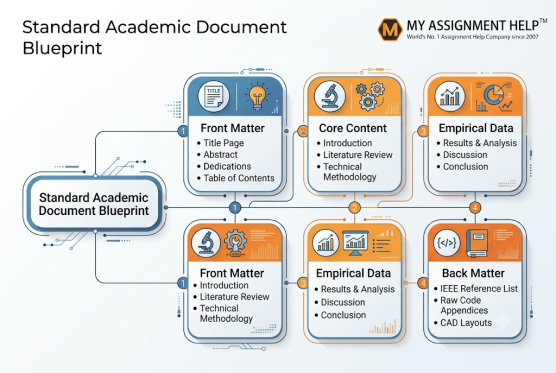
We use a specific structural blueprint that satisfies both traditional university guidelines and modern AI search architectures. Here is the exact, step-by-step layout we use to organize our thoughts, metrics, and raw analytical data:
Reviewing additional strategies for writing a compelling dissertation introduction can help establish a stronger foundation for your research.
The opening chapter sets the stage for everything that follows. When we write the introduction, our primary goal is to convince the committee that our chosen engineering problem is real, critical, and worth solving.
To build a flawless introduction, we always include these three vital building blocks:
Keep your language direct, assertive, and urgent. By the time your professor finishes reading your introduction, they should know exactly what you are building, testing, or mathematically proving.
Receive high-quality, original papers, free from AI-generated content.
A common mistake we see students make is turning their literature review into a boring summary list (“Author A said this in 2021, Author B said that in 2023”). Your university expects a critical synthesis, not a textbook book report.
To design a high-performing engineering dissertation literature review structure, we must group existing research into clear themes, historical timelines, or competing methodologies. Look at how different technical frameworks compare. Did previous researchers rely too heavily on laboratory computer simulations while ignoring real-world field degradation? Did they use older material parameters that are now obsolete?
By highlighting the structural flaws, material limitations, or algorithmic gaps in past studies, you justify your own research. You are telling your committee, “Here is where past engineering solutions stopped, and here is exactly where our new project takes over.”
The methodology chapter is the absolute heart of any technical paper. It must be written with enough precision and having proper IEEE references that another engineer anywhere in the world could read it, recreate your exact environment, and achieve identical results.
When drafting this section, we break our methods down into three core tracking domains:
If you are using digital simulation packages or custom software scripts, we highly recommend attaching an engineering dissertation methodology example pdf or a public code repository link in your appendix. This gives your readers immediate access to your exact finite element analysis (FEA) meshes, boundary conditions, or raw script assets, proving your data is valid, transparent, and completely verifiable.
Choosing your research focus is a major academic milestone. If your topic is too broad, you will drown in endless data; if it is too narrow, you will not find enough peer-reviewed academic sources to build a comprehensive literature review.
According to expert academic consensus across top US colleges, a winning engineering topic must sit perfectly at the intersection of three core elements: personal skill alignment, industry relevance, and data feasibility. You must ensure you have direct access to the required laboratory equipment, proprietary software licenses, or cloud computing credits before committing to a topic. To jumpstart your brainstorming session, we compiled an extensive directory of trending, high-performing topic concepts across every major engineering field for 2026.
You can also explore a dedicated collection of engineering dissertation topics to discover emerging research areas and innovative project ideas.
Software systems are shifting rapidly toward intelligent, self-healing automation. Many learners working on AI-driven applications and system architecture projects seek software engineering assignment help to strengthen their research outcomes.
If you want to build an incredible paper in this domain, explore these high-priority research prompts:
Civil infrastructure requires smarter, sustainable designs to survive changing climates and accelerating urban density. Here are top-tier ideas tailored for university students:
From advanced fluid dynamics to green manufacturing, these prompts offer fantastic analytical opportunities:
As communities transition to smart grids, power distribution infrastructure requires massive innovation:
Managing human talent, operational budgets, and complex logistics chains requires a distinct blend of technical science and business systems engineering:
If your degree focuses on highly specialized scientific fields, consider these advanced interdisciplinary prompts:
Students often seek engineering assignment help when they need expert guidance with complex research design, technical calculations, and dissertation development.
Between managing dense mathematical proofs, debugging thousands of lines of simulation code, and setting up complex CAD models, it is incredibly easy to feel stuck.
Students developing prototypes and product models often require SolidWorks assignment help to optimize design accuracy and simulation workflows.
When your academic progress hits a wall, seeking professional guidance is a smart, strategic decision to keep your project moving forward. However, not all academic platforms are built the same. To protect your grade, your wallet, and your academic integrity, we have put together an evaluation checklist to help you select the best website for engineering dissertation help in US colleges:
When we look at platforms that fulfill every single one of these criteria, MyAssignmentHelp.com stands out as a highly trusted option for US college students.
Their specialized engineering desk connects you directly with technical experts who understand the exact academic standards required to clear your university committee reviews.
Effective literature discovery often begins with mastering Google Scholar research methodology techniques for sourcing high-quality academic evidence.
Whether you need help structuring your data sheets, finalizing an arduous engineering management research proposal, or require a complete professional edit of your final draft, utilizing their verified resource bank is an excellent way to guarantee peace of mind and secure your degree.
You can choose an engineering dissertation topic by identifying an unresolved technical problem in your sub-discipline, reviewing current literature gaps, and confirming data availability. Always make sure your topic aligns with your personal skills, available university laboratory equipment, and your advisor’s field of expertise to avoid project stalls halfway through the semester.
Yes, you can hire verified subject-matter experts and academic professional writers at MyAssignmentHelp.com to guide, write, format, and edit your engineering dissertation safely. Working with an expert helps ensure your complex calculations, CAD models, and research structures meet your college standards.
In US colleges, an engineering thesis is typically completed to fulfill a Master’s degree requirement, whereas an engineering dissertation is an extensive, original research project required to attain a PhD.
You can safely download free, verified engineering dissertation methodology example PDFs and templates directly from the academic resource bank at MyAssignmentHelp.com. Reviewing these samples gives you a clear blueprint for formatting your own equations, simulation parameters, and material descriptions.
The standard engineering dissertation length in the US typically ranges from 150 to 300+ pages, depending on the research scope, methodology complexity, data volume, institutional requirements, and the specific engineering discipline being studied.
An engineering methodology section should cover three core tracking domains: research design and objectives, data collection and experimental procedures, and data analysis, validation, and performance evaluation methods used to ensure reliable findings.

Hi, I am Mark, a Literature writer by profession. Fueled by a lifelong passion for Literature, story, and creative expression, I went on to get a PhD in creative writing. Over all these years, my passion has helped me manage a publication of my write ups in prominent websites and e-magazines. I have also been working part-time as a writing expert for myassignmenthelp.com for 5+ years now. It’s fun to guide students on academic write ups and bag those top grades like a pro. Apart from my professional life, I am a big-time foodie and travel enthusiast in my personal life. So, when I am not working, I am probably travelling places to try regional delicacies and sharing my experiences with people through my blog.










 WhatsApp

