


 30 December,2025

Table of Contents
For generations, homework has been as much a part of school as backpacks. But in recent years, the conversation has changed. Doctors, parents, and even some lawmakers are asking a tough question: Is homework doing more harm than good?
This guide explores the evidence. We will look at how homework affects the brain, why it is often unfair, and how new laws are changing the way we think about after-school work. If you are currently struggling with a heavy workload, you can find professional support and resources at MyAssignmenthelp.com before exploring the deep-dive analysis below.
To understand the current debate, we have to look back at the origins of this educational staple. Many students often wonder who invented homework in the first place. History shows us it has not always been popular. In the early 1900s, many people actually thought it was dangerous for children’s health. In 1901, California even passed a law banning homework for students under the age of 15!
| Years | Key Event | Cultural Impact | Real-World Examples |
|---|---|---|---|
| 1901 | California Law AB 55 | Homework was abolished for students under 15 to prevent “brain fatigue.” | A 12-year-old spent evenings playing outside or helping with chores, with no books taken home. |
| 1940s | The Progressive Era | Educators viewed homework as busy work that reduced creativity and joy in learning. | Worksheets were replaced with in-class projects like model gardens or birdhouses. |
| 1957 | The Sputnik Launch | Homework became linked to national security during the Cold War. | Heavy nightly drills in math and science became common; grades were tied to patriotism. |
| 1983 | “A Nation at Risk” Report | Schools increased academic workload to combat a “rising tide of mediocrity.” | Homework loads doubled as schools added more years of English and Math. |
| 2024–25 | Healthy Homework Acts | Modern laws emphasize quality over quantity to protect student mental health. | Schools adopt no-homework weekends or the 10-minute rule by grade level. |
In the early 1900s, many medical professionals thought homework was dangerous for children’s health. The Ladies’ Home Journal led a crusade against it, claiming it caused “nervous prostration” in children. In 1901, California even passed a law banning homework for students under the age of 15! During this time, the consensus was that a child’s evening belonged to the family, not the school.
The pendulum swung violently in the 1950s. When the Soviet Union launched Sputnik, the U.S. worried that American students were falling behind in math and science. Homework was rebranded as a patriotic duty to make kids “smarter and faster.” By the 1980s, the landmark report A Nation at Risk pushed for even more work to combat a “rising tide of mediocrity.”
Since then, homework has stayed a major part of the school day, but the burden is no longer equal. Data shows that the “Homework Gap” significantly affects minority and low-income students. According to the Pew Research Center, approximately 25% of Black students and 17% of Hispanic students are unable to complete homework because they lack a reliable computer or internet connection at home, compared to just 7% of White students.
Pro Tip for History Buffs: If you want to see how much homework has changed, ask your grandparents how much they had in 3rd grade. Statistics show that in the late 1940s, the average 3rd grader had 0 to 5 minutes of homework. Today, that average has increased by over 500%.
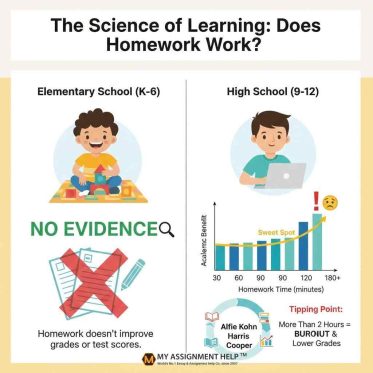
The biggest question is: Does homework actually help you get better grades? The answer depends on how old you are.
Alfie Kohn, a leading education expert, has spent years looking at studies on homework. His finding is shocking: There is no evidence that homework improves academic achievement for elementary school students. For children in grades K-6, doing an hour of homework versus zero homework makes no difference in their test scores.
In middle and high school, homework does help, but only in small amounts. Research by Harris Cooper of Duke University shows that the benefits of homework follow a “plateau” model.
When assignments exceed this threshold, students often struggle to keep up. This is why many seek specialized support to do my math homework so they can maintain their grades without risking cognitive burnout.

The most common reason people want to ban homework is because of the toll it takes on a child’s body and mind.
Don’t sacrifice your sleep for a deadline. Let our experts handle the heavy lifting while you rest.
The CDC and the American Academy of Pediatrics state that teenagers need 8 to 10 hours of sleep. However, with seven hours of school and three hours of homework (plus sports or music), most teens are only getting 6 hours.
Example: When a student stays up until 1:00 AM to finish a complex essay, their brain cannot enter “REM sleep.” Without it, you might forget the very facts you stayed up to study! In these high-pressure moments, professional history homework help can be a vital resource to ensure a student meets their deadlines without sacrificing their health.
Doctors have noted that students with heavy homework loads suffer from “adult-level” stress symptoms. These include chronic headaches, stomach ulcers, and exhaustion. Furthermore, sitting at a desk for several hours after sitting at a desk all day at school leads to poor posture and a lack of physical activity.
To minimize this physical strain, it is crucial to maximize productivity. If you know how to focus on homework effectively, you can significantly reduce the total number of hours your body is stuck in a sedentary position. Using focus techniques allows you to finish your tasks quicker, giving you more time for the physical movement and outdoor play that your body actually needs to stay healthy.
The movement to ban homework isn’t just happening in classrooms; it’s being fueled by a massive cultural shift online. Before we look at how lawmakers are responding, look at this recent discussion from the student community on Reddit. It perfectly captures the raw reality of the “homework burden” today:
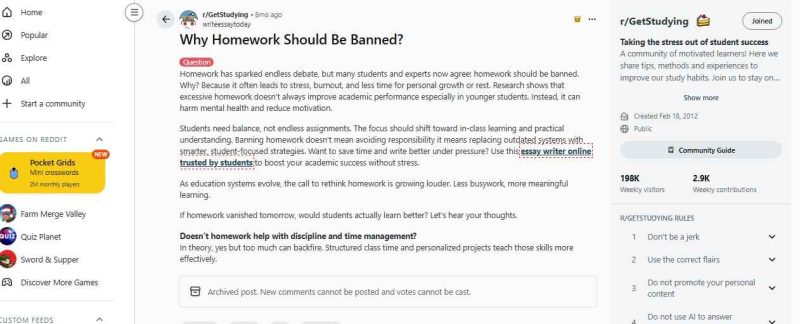
The Voice of the Student: “This isn’t just a post; it’s a reflection of a system that is pushing students toward a breaking point. When thousands of people agree on one thread, it’s time to listen.”
Because of viral conversations like the one above, we are finally seeing real legal changes, such as the Healthy Homework Act (AB 2999).

One of the strongest arguments against homework is that it is fundamentally unfair. This is known as the “Homework Gap” or the “Digital Divide.”
A student with parents who are available and educated can get help when they are stuck. Conversely, a student whose parents work late or do not speak English as a first language is left to struggle alone. Providing accessible English assignment help is one way to help bridge this gap and ensure these students don’t fall behind.
In a classroom, every student has the same teacher and the same materials. At home, the playing field is no longer level.
Pro Tip for Teachers: Instead of grading the result of homework, consider grading the effort or allowing students to do the “hard parts” in class where you can help everyone equally.
By grading homework, schools are often accidentally grading a student’s socioeconomic status rather than their actual effort or intelligence.

If you are looking for a quick list of the major arguments, here are the top ten:
To be fair, we must look at why schools still give homework. Most teachers believe it provides necessary practice. For instance, abstract concepts like the Pythagorean theorem or proofs often require geometry assignment help to master during the practice phase.
The Middle Ground: While these goals are good, critics argue they can be achieved during school hours. Responsibility can be taught through classroom projects, and practice can happen in “study halls” where teachers are present to help.
Example of the “Middle Ground”: Instead of a math worksheet, a teacher might ask students to find “geometry in the real world” by taking a photo of a triangle at the park. This connects parents to school without the stress of a timed test.

We are seeing a major shift in the law. In California, Assembly Bill 2999 (The Healthy Homework Act) has set a new standard. It requires schools to create homework policies that protect student mental and physical health. Many students are now researching if their own states have similar rules, asking the question: Is homework illegal or just highly regulated?
Finland treats children like humans who need rest. Their success proves that you do not need to work kids to death to make them smart.
We are seeing a major shift in the law. In California, Assembly Bill 2999 (The Healthy Homework Act) has set a new standard.
Other states are watching California closely, and many experts expect similar laws to pass across the country in the coming years.
Pro Tip for Parents: If your child is spending more than 3 hours on homework, check if your state has a “Healthy Homework” policy. You can use these laws to advocate for your child.
If a school does not want to ban homework entirely, they can try the Flipped Classroom model. In this model, students watch a short video of the lesson at home (which is easy and low-stress). They then do the “hard” practice problems in class where the teacher can help them. For example, a teacher might provide a video on how to write a thesis statement for homework, and then the students spend the next day actually writing their essays in class with guidance.
Endorsed by the National PTA, this rule says students should have a maximum of 10 minutes of homework per grade level.
In this model, students watch a short video of the lesson at home (which is easy and low-stress). They then do the “hard” practice problems in class where the teacher can help them.
Example: Instead of struggling with a long essay alone at night, a student can ask someone to do my assignment for me or follow a guided approach like watching a video on “how to write a hook” and then completing the essay in class with teacher feedback..
No. Research shows that in elementary and middle schools, there is no direct link between homework and test success. In high school, moderate homework helps, but “over-assigning” work actually causes scores to drop due to student burnout and fatigue.
Until the laws change, you have to manage the load. If you find yourself in a bind, sometimes a little humor is the only cure. You might enjoy reading through some of the most funny excuses for not doing homework—though we don’t recommend using them with your teacher!
It is not illegal, but it is becoming more regulated. For example, California’s AB 2999 requires school districts to create policies that prevent homework from harming a student’s mental or physical health. Some individual school districts have also voted to ban homework for elementary grades.
Absolutely. The homework debate is one of the most popular debate topics because it affects every student, teacher, and parent. Use the data in this guide to build a compelling argument about the “10-minute rule” or the “History of Homework.”
Homework often widens the “Achievement Gap.” Students from low-income families may lack high-speed internet, a quiet place to study, or parents who are available to help. This means homework often grades a student’s home resources rather than their actual ability.
If homework takes up 4 hours every night, students lose the time they need for sports, volunteering, and leadership roles. Technical subjects are often the biggest culprits; many students find themselves asking, ‘Can you do my C programming?’ just to reclaim the hours needed for the very things that help them stand out in college applications.
The evidence is clear. While the intention behind homework is good, the execution is often harmful. If we want a generation of students who are healthy, creative, and eager to learn, we must rethink the way we use their time at home. By focusing on quality over quantity and respecting the need for rest, we can create a better school system for everyone.

I am a student-focused academic writer who supports learners with essays, homework, and study skills. My approach emphasizes clarity, confidence-building, and practical academic improvement.










 WhatsApp

