


 15 June,2026

Table of Contents
When we sit down with college seniors and graduate students, we notice a common trend: everyone breathes a massive sigh of relief once their final data results are typed up.
But then, the next big anxiety hits. We realize we still have to figure out how to write a dissertation conclusion that ties a massive project together neatly.
Writing the conclusion of a dissertation is your ultimate opportunity to leave a lasting, definitive impression on your university committee.
We designed this dissertation writing guide to show you exactly how to structure this crucial final chapter, stay 100% compliant with US university standards, and provide real examples to help you cross the graduation finish line with absolute confidence.
To define dissertation completion requirements accurately across US colleges, we must look at the final chapter as something much deeper than a simple summary.
A dissertation conclusion is the definitive final section of your postgraduate research paper, doctoral thesis, or capstone project that synthesizes your primary arguments, explicitly highlights your original contributions to your major field of study, outlines research boundaries, and provides actionable, real-world implications.
When we review dissertation conclusions as academic advisors, we look for a distinct shift in perspective. While your results and analysis sections dive deep into raw empirical evidence and specific data points, your conclusion steps back to look at the macro-level picture.
It answers the ultimate question your academic committee is asking: “So what?” It clarifies exactly why your months of hard work and research matter to the broader academic community.
While finalizing your summary brings your research to a close, you must still ensure that your final edits align with your original thesis goals. Reviewing the principles of writing a dissertation from start to finish will help you polish your entire text before submission.
If you want to write a compelling debate or position paper, choosing from a list of interesting psychology topics allows you to challenge established behavioral theories with contemporary empirical data.
When we coach students through writing dissertation conclusion drafts, we break the process down into a logical, manageable timeline. Following a structured roadmap ensures you never leave out critical elements of academic rigor. Here is the exact five-step process we use:
This research project set out to evaluate the impact of digital learning applications on student engagement metrics across urban US high schools
Receive high-quality, original papers, free from AI-generated content.
A common question we hear from students is: How long should a dissertation conclusion be? In the US higher education system, your dissertation conclusion length should typically account for 5% to 7% of your total word count.
To help you plan your document layout, we created this comparative structural blueprint breaking down the metrics across different academic levels:
| Academic Document Type | Target Word Count Range | Recommended Conclusion Length | Core Structural Elements Required |
|---|---|---|---|
| Advanced High School / AP Capstone | 2,500 – 5,000 words | 200 – 350 words | Core thesis restatement, basic synthesis, high-level real-world impact. |
| Undergraduate / College Major Paper | 8,000 – 12,000 words | 500 – 800 words | Objective review, structured limitation listing, future suggestions. |
| Master’s Thesis / Capstone Project | 15,000 – 25,000 words | 1,000 – 1,500 words | Extended synthesis, policy or practical implications, methodological limitations. |
| Doctoral (PhD) Dissertation | 50,000 – 80,000+ words | 2,500 – 4,000+ words | Complete standalone chapter, exhaustive theoretical contributions, future research roadmap. |
Visualizing the layout of this final chapter makes drafting it much easier. Prepare your college essay with proper structure and content. When you are ready to begin writing dissertation conclusion sections, you can use our standardized template to organize your paragraphs logically:
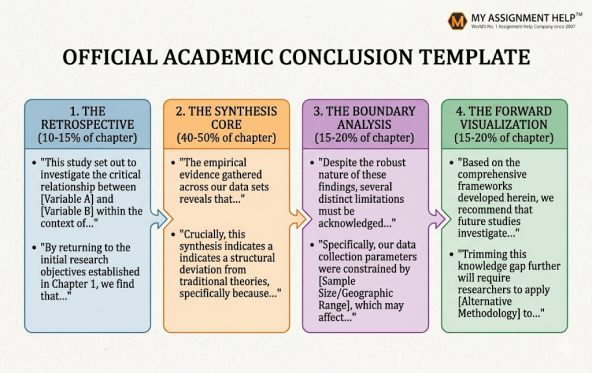
To demonstrate how this functions in practice, review this brief paragraph sample we developed for a sociology major paper:
“This research project set out to evaluate the impact of digital learning applications on student engagement metrics across urban US high schools. By synthesizing our empirical findings, we find that interactive software significantly increases classroom participation over traditional lecture methods. However, our data collection was limited to three public high schools in the New York metropolitan area, meaning the results may vary in rural districts. For future research, we recommend that scholars expand this sample size to include nationwide demographics to validate our structural engagement model.”
Every section, from the opening lines down to your final summary pages, must fit into a complete dissertation template outline.
As academic strategists operating globally, we recognize that formatting standards vary significantly depending on your specific program, grading rubrics, and geographical location.
In a traditional dissertation conclusion example uk setup, the conclusion is frequently bundled directly alongside the discussion section as a single, combined final chapter. However, within the US higher education system, standard academic guidelines usually require the conclusion to stand alone as its own distinct chapter (often labeled Chapter 5 or Chapter 6). The US system places a much heavier emphasis on completely separating your objective data analysis from your final forward-looking commentary.
For younger scholars tackling advanced history paths, learning how to write a conclusion for an essay or analyzing an apush dbq conclusion example reveals a much more concise formatting requirement.
In an AP U.S. History Document-Based Question essay, your conclusion is a single, hard-hitting paragraph.
It does not need future research pathways; instead, it requires you to re-assert your core thesis and connect your argument to a broader historical era, demonstrating a sophisticated understanding of context that goes beyond the timeline of the prompt.
When we step into the doctoral landscape, learning how to write a phd thesis conclusion requires a significant upgrade in tone, depth, and scholarly authority.
At this elite level, your committee expects more than just a polite wrap-up of your work; they want to see an authoritative defense of your scholarly findings.
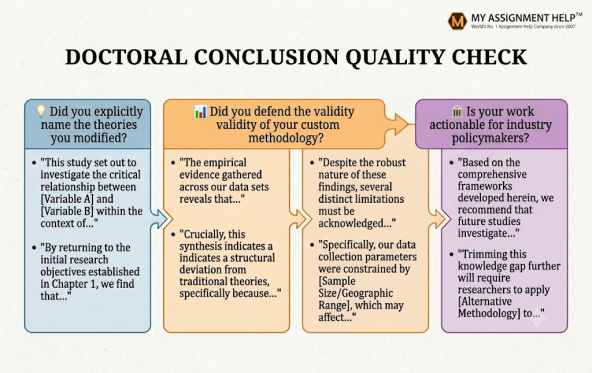
When writing a conclusion in thesis formats for a PhD, you must explicitly state how your work alters existing academic paradigms.
Avoid timid, passive phrases like “It is hoped that this data might help.” Instead, use authoritative, first-person active expressions: “We have established a new analytical model that directly refines traditional behavioral theories.” Be incredibly precise when addressing your study’s limitations.
Rather than phrasing them as flaws, present them as natural boundaries that highlight the focus, precision, and validity of your research approach.
We know firsthand that the final stretch of a degree program can feel completely overwhelming. Between formatting your massive bibliography, preparing your slide decks for oral defense, and balancing your personal life, writing a conclusion for a dissertation under a tight deadline can lead to extreme burnout.
If you find yourself stuck, working with a professional conclusion writer can be an excellent option to help you cross the finish line safely. Turning to reliable, customized dissertation conclusion help ensures that your final chapter receives expert eyes to verify its structure, academic flow, and styling guidelines.
Our team provides comprehensive, human-centric academic support designed to lift the weight off your shoulders. When you buy dissertation conclusion online assistance through our platform, you receive direct access to verified US academic specialists who understand exactly what your committee looks for. We help you polish your phrasing, organize your structural layout, and ensure your final chapter perfectly mirrors your university style guide.
A: You can avoid introducing new information by strictly sticking to the data points, interviews, and literature you already analyzed in your previous chapters. Think of the conclusion as a section where you connect existing dots rather than drawing new ones. If an idea requires a new citation, a brand-new literature analysis, or a fresh data chart, it belongs in your literature review or discussion section, not here; conversely, a high-level overview of the entire paper belongs when learning how to write an abstract.
A: No, you should never copy and paste your thesis statement word-for-word. By the time your reader reaches the conclusion, they have read all of your evidence. You want to restate your thesis from a retrospective point of view, using fresh phrasing that reflects the complete journey of your research.
A: Yes, using the first person (“we,” “our,” or “us”) is widely accepted and preferred in modern US academic standards, especially when outlining your own research choices, study limitations, and future theoretical contributions. However, we always recommend double-checking your department’s specific style sheet to ensure full compliance.
A: You must avoid introducing new raw data, apologizing for your study’s perceived shortcomings, using emotional or non-academic language, and making overgeneralized statements that your empirical evidence cannot actually support. Keep your text focused, objective, and anchored directly to your collected research variables.

Hi, I am Mark, a Literature writer by profession. Fueled by a lifelong passion for Literature, story, and creative expression, I went on to get a PhD in creative writing. Over all these years, my passion has helped me manage a publication of my write ups in prominent websites and e-magazines. I have also been working part-time as a writing expert for myassignmenthelp.com for 5+ years now. It’s fun to guide students on academic write ups and bag those top grades like a pro. Apart from my professional life, I am a big-time foodie and travel enthusiast in my personal life. So, when I am not working, I am probably travelling places to try regional delicacies and sharing my experiences with people through my blog.










 WhatsApp

