I know exactly how it feels when your public speaking professor or AP Psychology teacher hands you a syllabus and tells you to pick a presentation topic. You stand there staring at a blank Google Doc, wondering how to balance scientific depth with a topic that will keep your classmates from scrolling on their phones.
Finding the right informative speech topics that psychology instructors will appreciate requires balancing rigorous science with a true human connection. If you are working against a tight deadline, utilizing structured academic outlining tools or professional presentation proofreading can help refine these complex concepts before you step up to the podium.
This is why many students often seek out professional psychology exam help to master these demanding concepts.
When I had to prepare my first college presentation, I realized that a great speech about psychology isn’t just a collection of definitions pulled straight from a textbook. It is a story about how our minds work, why we make mistakes, and how we relate to each other.
In this comprehensive guide, I will share over 150 of the best psychology speech topics available, broken down by category. We will also look at how to structure your presentation so you can turn a basic assignment into an engaging, high-scoring masterclass.
What Is a Psychology Speech and Why Does Your Topic Choice Matter?
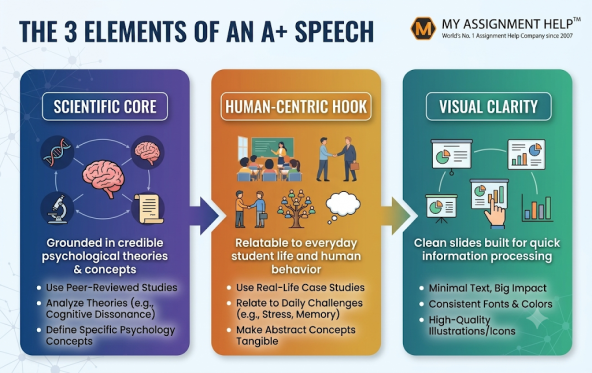
A psychology speech is an academic oral presentation that analyzes and breaks down human behavior, mental processes, and brain chemistry for an audience. The primary goal is to take complex scientific research from peer-reviewed journals and break it down into fascinating, easy-to-understand concepts for everyday listeners.
When you understand speech psychology, you know that choosing the right topic dictates your entire delivery strategy. If your topic is too broad, like trying to explain “the human brain” in seven minutes, your presentation will feel rushed and shallow. If it is too narrow, you will run out of interesting things to say by minute three. Your topic needs to hit a sweet spot: it must be narrow enough to cover deeply, but relatable enough that your audience instantly cares about the outcome.
Core Principles of Selecting Which Psychology Speech Framework to Use
Before you pick a title, you need to know which psychology speech style your grading rubric requires, and leveraging expert psychology assignment help can ensure your work meets every academic benchmark.
I see many students make the mistake of turning an informational assignment into an aggressive debate topic. Let us look at the structural differences to help you decide where psychology speech elements belong in your planning phase.
Feature / Goal
Informative Presentation
Persuasive Speech Argument
Primary Intent
Explains facts, data, and established psychological phenomena.
Evaluates opinions, shifts beliefs, and defends a specific stance.
Tone
Neutral, objective, and educational.
Passionate, analytical, and highly motivating.
Core Structure
Definition → Mechanism → Real-world case study.
Problem statement → Psychological cause → Solution.
Best Used For
AP Psychology term papers, introductory lectures, and explainer slides.
Advanced research assignments, ethics panels, and policy debates.
Understanding what psychology speech type you are building keeps your research focused. If your goal is strictly informative, you are teaching the audience something new. If your goal is persuasive, you are convincing them to change their actions or view a concept through a completely different lens.
Translating internal mental states into spoken words becomes much easier when you analyze an academic example of descriptive speech that explicitly targets human emotions and sensory perceptions.
Comprehensive List of Psychology Topics for Informative Speech Assignments
Here is a curated directory of informative essay topics about psychology and versatile topics for informative speeches. I have broken these down into logical thematic clusters so you can scan through and find a theme that perfectly fits your specific course level.
Cognitive Dissonance in Action: How our brains rationalize bad financial choices to protect our self-image.
The Zeigarnik Effect: Why your brain gets stuck on unfinished tasks and how it affects study habits.
Neuroplasticity and Language: How learning a second language physically rewires pathways in the human nervous system.
The Illusion of Multi-Tasking: What actually happens to our attention spans when shifting between app screens.
False Memories: Why our brains alter past events and how eyewitness testimonies become flawed over time.
Confirmation Bias: The psychological algorithms that keep us trapped inside online echo chambers.
The Placebo Effect: How expectations trick physical receptors in the body to trigger genuine healing.
Sensory Overload: How high-tech classroom environments alter student focus levels.
The Psychology of Flow State: How athletes and musicians turn off their inner critics to achieve peak performance by tapping into deeper levels of processing within the brain.
Cryptomnesia: When the brain accidentally mistakes an old memory for a brand-new, creative idea.
When analyzing these phenomena, ensure your bibliography references established frameworks from the American Psychological Association (APA) or peer-reviewed data from the Journal of Cognitive Neuroscience.”
Cluster 2: Social Psychology & Group Dynamics
The Bystander Effect: Why crowds fail to help in public emergencies and how to break the psychological loop.
Groupthink in Corporate Culture: How high-stakes boards make catastrophic errors to preserve social harmony, often leaving critical emotions ignored in OB settings.
Implicit Bias: How our unconscious minds make split-second assumptions without our active permission.
The Dynamics of Online Tribalism: Why internet communities divide into aggressive “us vs. them” mentalities.
Deindividuation in Online Crowds: Why otherwise kind people become aggressive under the shield of digital anonymity.
The Psychology of Cults: How charismatic leaders isolate individuals using systematic social conditioning.
The Milgram Experiment Revisited: What modern obedience studies teach us about authority figures.
The Halo Effect: How physical attractiveness alters our perception of a person’s intelligence and morality.
The Social Psychology of Empathy: Can you actively train someone to feel what another person experiences?
Environmental Psychology: How architecture and lighting secretly influence daily mood and workspace productivity.
The Scarcity Principle: How countdown timers and “limited stock” warnings trigger urgent, irrational buying behavior.
Dark Commercial Patterns: The psychological tricks websites use to make you accidentally sign up for subscriptions.
The Endowment Effect: Why we instantly overvalue objects the second we take physical or digital ownership of them.
Decoy Pricing: How businesses introduce a useless third option just to trick your brain into buying the most expensive one.
The Psychology of Unboxing: How tactile packaging design stimulates the brain’s reward centers before the product is even used.
Cluster 7: Technology, Media, & Cyberpsychology
Doomscrolling: Why the human brain is evolutionarily wired to obsessively consume negative news feeds.
Parasocial Relationships: The psychological impact of forming deep, one-sided emotional bonds with creators and influencers.
Phantom Vibration Syndrome: Why our brains misinterpret minor muscle twitches as a smartphone notification.
The Online Disinhibition Effect: The distinct psychological triggers that make people share their deepest secrets with strangers on the internet.
Gamified Dating Apps: How the “infinite swipe” mechanic transforms human matchmaking into a slot-machine addiction.
Cluster 8: Neuropsychology & Exceptional Human Experiences
Synesthesia: What happens in the brain when sensory wires cross, allowing people to taste colors or see sounds.
The Neurobiology of Dream Incorporation: How the brain weaves external bedroom sounds and smells into active dream narratives.
Aphantasia: The psychological reality of living with a completely blind mind’s eye, unable to visualize memories.
Mirror Neurons and Violence: How watching physical actions activates the exact same motor pathways in the observer’s brain.
The Neuroscience of Music Chills: Why specific chord progressions trigger sudden dopamine releases and physical goosebumps.
Cluster 9: Forensic & Legal Psychology
The Reliability of Eyewitness Memory: Why the brain’s “record” button is prone to creative editing, especially under stress.
The Psychology of False Confessions: How high-pressure interrogation tactics can break a suspect’s reality and lead them to believe they committed a crime they didn’t.
Micro-expressions in Deception: Can humans actually be trained to spot a lie, or are we just reading into our own biases?
The “CSI Effect” on Juries: How media portrayals of forensic science have raised the bar for what jurors expect from real-world evidence.
Moral Disengagement in White-Collar Crime: How professionals convince themselves that unethical behavior is actually “just business.”
Cluster 10: Cultural & Cross-Cultural Psychology
The Psychology of Acculturation Stress: The internal mental tax paid by individuals navigating life between two different cultural value systems.
Collectivist vs. Individualist Conflict: How the fundamental definition of “success” differs between cultures and the psychological friction it creates in international workplaces.
Cultural Taboos and Emotional Suppression: Why certain emotions are celebrated in some cultures but labeled as “weakness” or “dangerous” in others.
The Psychology of Rituals: Why repetitive, symbolic actions (from sports superstitions to religious rites) provide such powerful anxiety relief.
Generational Trauma in Diaspora Communities: The psychological legacy of ancestral displacement and how it manifests in the mental health of younger generations.
The Biophilia Hypothesis: Why humans have an innate psychological need to be near nature and how “green architecture” lowers cortisol.
Evolutionary Mismatch Theory: Why our Paleolithic brains struggle to cope with modern sedentary life, processed foods, and constant artificial light.
The Psychology of Space: How the geometry of a room (ceilings, lighting, and angles) influences our ability to think creatively or focus analytically.
Noise Pollution and Cognitive Load: How the constant hum of city living drains our “attention budget” by the end of the day.
The Evolution of Altruism: Why we are hardwired to help strangers, and the biological “payoff” our brain receives for acts of kindness.
Cluster 12: Advanced Behavioral Nuances
Learned Helplessness in Modern Settings: How repeated failure in one area of life can cause a psychological “shutdown” that affects unrelated areas.
The “Spotlight Effect”: Understanding the cognitive bias that makes us feel like the whole world is watching our minor social blunders.
Locus of Control: How the belief that you control your destiny (or that the world controls it for you) dictates your stress resilience.
The Psychology of Schadenfreude: Why the human brain occasionally experiences a “pleasure spike” when witnessing the misfortune of others.
The Sleeper Effect: Why persuasive messages that we initially reject can become more influential over time as our brain forgets the source but keeps the message.
Cluster 13: Psychology of Work & Organizational Behavior
The Psychological Safety Paradox: Why teams that feel free to disagree outperform “harmonious” teams in long-term innovation.
Presenteeism: The psychological phenomenon of being physically present at work but mentally checked out, and its link to burnout culture.
The Peter Principle: The psychology behind why competent employees are promoted until they reach a position of incompetence.
Workplace Incivility: How minor, persistent rude behaviors (like ignoring emails) have a larger psychological impact on health than overt bullying.
The Psychology of Office Politics: Analyzing the “social capital” currency that determines who advances in competitive environments.
Cluster 14: Social Perception & Relationship Dynamics
The Pygmalion Effect: How our expectations of others can inadvertently mold their performance and personality.
Love Languages vs. Attachment Styles: A critical look at whether “love languages” are scientifically valid tools or just simplified relationship metaphors.
The Psychology of “Ghosting”: Why digital communication makes it easier for people to bypass the social guilt of direct confrontation.
The Cheerleader Effect: Why people are perceived as more attractive when they are in a group compared to when they are standing alone.
Relational Aggression: Analyzing the psychology behind covert social bullying (rumors, exclusion) often found in high-pressure school settings.
Cluster 15: Cognitive Traps & Heuristics
Hindsight Bias: Why we convince ourselves that we “knew it all along” once an outcome has been revealed.
The Dunning-Kruger Effect: Why those with the least knowledge in a field are often the most confident in their abilities.
The Framing Effect: How the exact same information (e.g., a medical procedure with “90% success” vs. “10% failure”) changes our risk tolerance.
Availability Heuristic: Why we overestimate the danger of rare events (like plane crashes) simply because they are easy to visualize.
Sunk Cost Fallacy: Why we continue to invest time, money, and energy into failing projects just because we’ve already invested so much.
Cluster 16: Applied Psychology & Personal Growth
The Psychology of Self-Compassion: Why treating yourself with kindness after a failure leads to higher motivation than “tough love.”
Active vs. Passive Coping: Why some people reach for distractions when stressed while others seek out problem-solving.
The Psychology of Grit: Dissecting whether “passion and perseverance” is an innate trait or a skill that can be built through environmental scaffolding.
The Mere Exposure Effect: How simply being near something or someone repeatedly changes our brain’s preference for it.
The Forgetting Curve: How spacing out your study intervals (spaced repetition) hacks the brain’s natural decay of information.
Cluster 17: Personality & Individual Differences
The HEXACO Model: Moving beyond the “Big Five”—why adding “Honesty-Humility” changes how we predict unethical behavior.
The Psychology of Morningness vs. Eveningness: How your internal chronotype influences your career success and susceptibility to depression.
High Sensitivity (HSP): The evolutionary advantages and social challenges of having a highly reactive nervous system.
The “Dark Triad” in Leadership: Why narcissism, Machiavellianism, and psychopathy are often rewarded in corporate hierarchies.
The Psychology of Curiosity: Why the “information gap” drives human exploration and how it correlates with intelligence.
Cluster 18: Health & Physiological Psychology
The Psychosomatic Connection: How chronic emotional stress directly impacts the gut-brain axis and immune function.
The Psychology of Pain Management: How cognitive-behavioral techniques can actually change the neural processing of chronic pain.
Sleep Hygiene and Emotional Regulation: How even minor sleep deprivation mimics the cognitive impairment of alcohol intoxication.
The “Runner’s High”: Dissecting whether it’s endorphins or endocannabinoids that produce the psychological “glow” post-exercise.
Placebo vs. Nocebo: The fascinating power of negative expectations to create actual physical symptoms.
Cluster 19: Social Psychology & Influence
The Benjamin Franklin Effect: Why we grow to like people more after we have done them a favor.
Social Proof in the Digital Age: How influencer marketing manipulates our herd instinct to establish artificial trust.
The Door-in-the-Face Technique: The psychology behind why making a large request first makes a smaller one seem reasonable.
The Psychology of Apology: Why some apologies heal relationships while others (non-apologies) cause more damage.
Group Polarization: Why online discussion forums tend to push members toward more extreme versions of their initial views.
Cluster 20: Developmental & Lifespan Psychology
The Quarter-Life Crisis: The specific psychological stressors unique to the transition between college and professional adulthood.
Neurodiversity in the Workplace: How rethinking “disorders” like ADHD and Autism as different cognitive processing styles improves innovation.
The Psychology of Retirement: Managing the loss of identity and social structure after a lifelong career.
Reminiscence Therapy: How recalling past memories helps elderly individuals integrate their life narrative and combat depression.
The “Over-Parenting” Effect: How the “helicopter” parenting style influences the development of internal locus of control in young adults.
Cluster 21: Psycholinguistics & Communication
The Sapir-Whorf Hypothesis Today: To what extent does the language we speak dictate the limits of our thoughts and perceptions?
The Psychology of Metaphor: How our brains use concrete physical concepts (like “warmth”) to understand abstract social ones (like “friendship”).
Code-Switching: The cognitive and emotional labor involved in constantly adjusting one’s persona, dialect, and behavior to fit different social contexts.
Non-Verbal Leakage: Why our bodies often broadcast truths that our words are trying to hide, and why we are often “blind” to our own cues.
The Power of Storytelling: How narrative structures trigger mirror neurons and create empathy-driven persuasion in the listener.
Cluster 22: Perception & Human Senses
Inattentional Blindness: The “Invisible Gorilla” effect and why our brain deletes important visual information when we are hyper-focused.
The Psychology of Color: How marketing teams use hue and saturation to trigger specific mood states and hunger cues.
Multisensory Perception: How the brain integrates sound, sight, and touch to create the “reality” of an object (like the crunch of a chip).
Change Blindness: Why we fail to notice massive shifts in our environment when our attention is slightly diverted.
The “Uncanny Valley”: Why our brains experience a spike in disgust when an artificial figure (like an AI robot) looks almost—but not quite—human.
Cluster 23: Motivation & The Future of Work
The Psychology of “Deep Work”: How the modern office environment makes it neurologically difficult to enter the state of sustained, high-value concentration.
The “Fresh Start” Effect: Why human beings are psychologically more motivated to set goals at temporal landmarks (like Mondays or birthdays).
Decision Fatigue in High-Stakes Roles: Can the brain’s “executive function” be treated like a muscle that fatigues, or is it a limitless resource?
Psychological Ownership: Why people value things they helped “create” (The IKEA Effect) more than finished products of higher quality.
The Motivation of Altruistic Punishment: Why humans are willing to spend their own resources to punish those who violate social norms.
Cluster 24: Philosophy & The Mind
The Myth of the “True Self”: Is there an authentic core identity, or is the “self” just a fluid response to our current social environment?
The Psychology of Belief: What neural mechanisms allow humans to hold onto deeply ingrained beliefs even when presented with overwhelming evidence to the contrary?
The Role of Boredom: Why boredom is not just a nuisance, but an essential emotional signal for cognitive resetting and creative discovery.
The Teleology of Human Behavior: Do we act because of our past (causality) or because of our future goals (purpose)?
The Psychology of Silence: Why silence is an uncomfortable state for many, and the power it holds in negotiation and therapeutic settings.
Get Your High-Scoring Physcology Speech Now – 20% Discount for New Students!
Receive high-quality, original papers, free from AI-generated content.
Engaging Psychology Presentation Topics for Class Slides
If you are building a presentation that requires clean visual aids, slide design matters just as much as the text, which makes utilizing professional powerpoint presentation services highly beneficial.
These specific psychology presentation topics and psychology topics for presentation are perfect for adding charts, timelines, and case studies to your slide decks.
When sorting through psychological topics for presentation plans, look for ideas that contain clear data sets, which is standard practice when evaluating broad speech topics for any public speaking course.
Using topics for presentation in psychology that feature distinct visual elements will make your slide transitions smooth and engaging. Here are some interesting psychology topics for presentation slides that naturally fit a visual medium:
The Visual Architecture of Optical Illusions: Present real-time visual distortions to show how our brains construct reality out of partial sensory pieces.
The Stanford Prison Experiment Timeline: Use archival charts and daily behavioral metrics to illustrate the rapid shift in assigned group roles.
Mapping the Human Sleep Cycle: Use brainwave frequency graphs to illustrate what happens during REM sleep to lock in long-term memory.
Consumer Psychology Heatmaps: Display real eye-tracking data from grocery store layouts to prove how companies trick our brains into impulse buys.
The Phineas Gage Case Study: Use 3D skull models to track how localized physical brain damage permanently altered a human personality.
Comparative Analysis: Shifting from Informative to Persuasive Speech Topics Psychology
As you advance through high school and college public speaking classes, your instructor might ask you to switch from an informative summary to a persuasive argument.
This shift requires moving away from simply describing a topic to taking a firm stance on a controversial issue, a transition where dedicated essay help can guide you through structuring a compelling narrative.
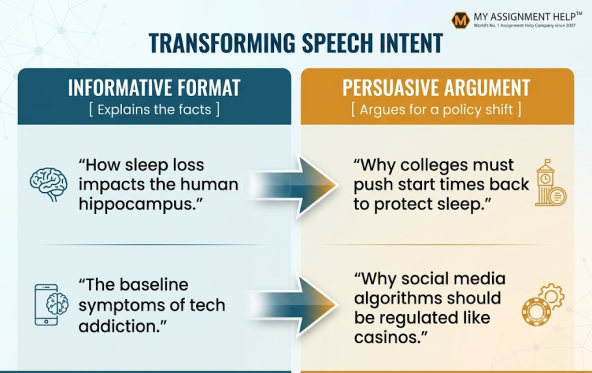
Let us look at how you can transform your informative speech topics into high-impact psychology persuasive speech topics professors will love to grade. This strategy is excellent for expanding a short presentation into a major research term paper.
The structural matrix below highlights the core differences between an informative approach and a persuasive stance:
If you need to pick persuasive speech topics about psychology, focus on areas where experts disagree, or where societal rules conflict with psychological wellness. Here is a comparative look at how to adapt these frames:
Pure Informative Angle
Persuasive Speech Topics Psychology Alternative
Explaining how classical conditioning works in modern corporate advertising campaigns.
Why child-targeted advertising using psychological conditioning should be banned globally.
Outlining the clinical symptoms and baseline metrics of social media addiction.
Why social media companies should be legally forced to disable infinite scroll features for minors.
Presenting the historical profile and data behind white-collar corporate crime.
Why violent white-collar offenders should undergo mandatory empathy training rather than simple isolation.
Tracing the cognitive benefits of mindfulness meditation practices on stress reduction.
Why public high schools should replace detention with mandatory mindfulness programs.
Versatile Psychological Speech Topics for General Presentations
If you are looking for general psychological speech topics or need to put together a straightforward speech on psychology, these ideas offer a great balance, and collaborating with a speech writing service can refine your delivery.
They work well as a psychological speech for public speaking classes where the audience might not have a strong background in science.
These psychology topics for speech options let you use simple English while still delivering an educational presentation. They are great for building a psychology speech in english that flows naturally without relying on heavy academic jargon.
Emotional Intelligence: Why empathy and self-awareness predict career promotions better than baseline IQ metrics.
The Body-Mind Link: How chronic mental anxiety physically alters our immune systems and digestive health.
The Evolution of Phobias: How our brains quickly learn to fear harmless things through ancestral memory survival triggers.
The Academic Case for Mental Health: Why an introduction to mental wellness courses should be mandatory for all university freshmen.
The Therapeutic Power of Writing: How daily journaling down-regulates activity in the brain’s fear center (the amygdala).
Introverts vs. Extroverts: The underlying chemical variations in how different personalities recharge their energy reserves.
The True Crime Phenomenon: The comforting evolutionary psychology behind why people love watching dark crime documentaries.
The Boundary Equation: How learning to say “no” protects corporate professionals from clinical burnout cycles.
Seasonal Affective Disorder: How shifting light levels throughout winter directly manipulate human serotonin production.
The Psychology of Altruism: Why performing random acts of kindness reduces the giver’s biological stress markers.
Conclusion: Finalizing Your Academic Term Paper and Presentation Goals
At the end of the day, a standout psychology presentation relies on picking a topic that genuinely interests you. When you care about the material, your delivery feels natural, your slides look sharp, and your audience stays engaged from start to finish.
I highly recommend presenting on things like the psychology of procrastination, how sleep affects memory, or practical behavioral tips like how to focus on homework or pay someone to do homework effectively. These concepts are simple to research, have plenty of everyday examples, and do not require your classmates to memorize complex neuroanatomy terms.
Once you choose a topic from this directory, make sure to back up your points with credible sources using your school’s library databases or Google Scholar.
Take your time structuring your headers, organize your bullet points clearly, and practice your speech in front of a mirror a few times. By focusing on deep research and keeping your language clear and accessible, you will easily turn your next public speaking assignment into an outstanding, high-scoring presentation. Good luck!
Frequently Asked Questions About Academic Psychology Speeches
What are good informative speech topics for beginners?
Good informative speech topics for beginners are topics that connect directly to everyday human experiences, meaning you won’t necessarily need extensive homework help to get started.
What is the easiest psychology topic to talk about?
Academic speech experts consider well-documented psychological pioneers and classic behavioral theories to be the safest choices for a high-grade presentation. If you want a reliable topic, focus on Ivan Pavlov’s classical conditioning, Abraham Maslow’s hierarchy of needs, or B.F. Skinner’s operant conditioning experiments. These areas have decades of peer-reviewed data available in every university library, making it easy to build a rock-solid bibliography.
How do you outline a 5-minute psychology speech fast?
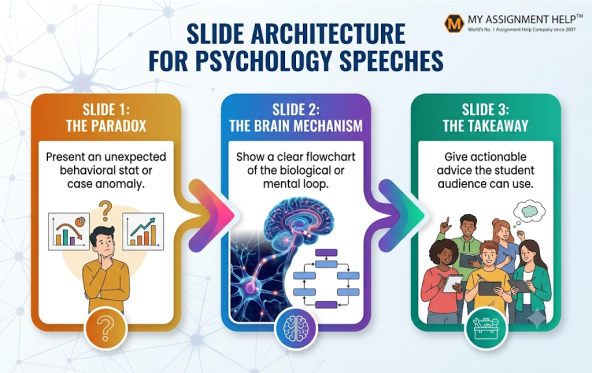
When presentation deadlines approach, you can outline quickly by breaking your speech down into three parts: a hook, three main points, and an actionable takeaway. Start your introduction with a surprising statistic or a personal story to grab attention. Next, divide your body section into three logical steps: define the psychological term, explain how it works in the brain, and provide a real-world example. Finally, wrap up your conclusion by giving the audience one helpful tip based on your research.
I am an English literature specialist with experience in critical analysis and academic writing. I support students with well-researched essays and literature-based academic assignments.


 11 June,2026












 WhatsApp

