


 31 December,2025

Table of Contents
Imagine sitting in front of your laptop, staring at a blank page, knowing that your semester grade depends on this one paper. Panic sets in. Where do you even start? What topic will earn you the best marks? How do you make your paper stand out in a sea of assignments?
Writing a term paper doesn’t have to feel like this. With the right plan, approach, and tools, you can transform this daunting task into a clear, structured, and even rewarding process. This guide will show you step by step how to choose a topic, conduct research, craft a strong thesis, organize your paper, and submit a polished final version that impresses your professor.
Whether it’s your first term paper or your last before graduation, mastering this skill will give you a significant advantage — not just in college, but in your future career.
A term paper is an extended piece of academic writing that students submit at the end of a semester or course. It evaluates your understanding of the material taught throughout the term and how you can apply theories to real-world issues.
Unlike shorter essays, a term paper is based on in-depth research and requires a clear thesis supported by evidence and analysis. It usually ranges between 10 and 20 pages but may vary depending on your professor’s instructions and subject area.
While it shares similarities with essays, term papers are longer and demand a formal academic approach. If you’re still learning the difference, you can explore this guide on how to write an essay to understand the contrast between short-form and extended academic writing.
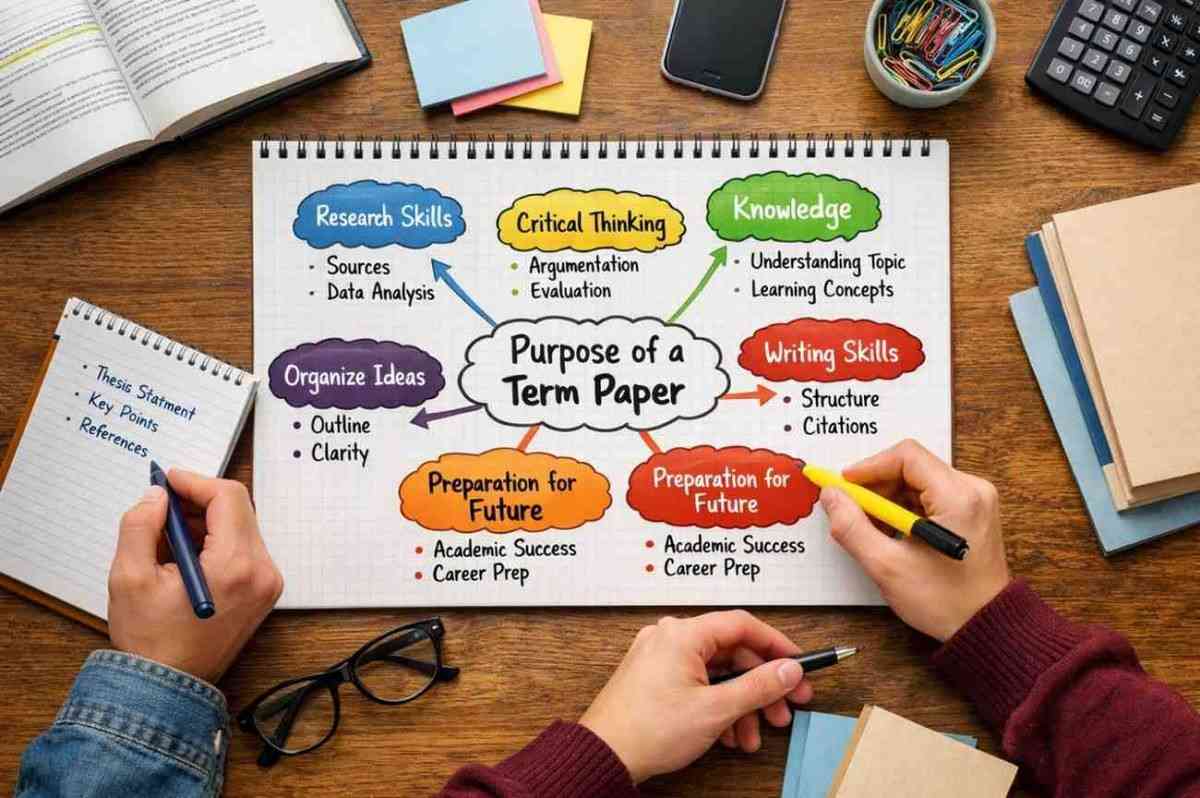
The goal of a term paper is not only to demonstrate what you’ve learned but also to show your ability to think critically and synthesize information. Professors assign term papers to evaluate your:
Ultimately, your paper should present an informed opinion or argument built upon existing research and data.
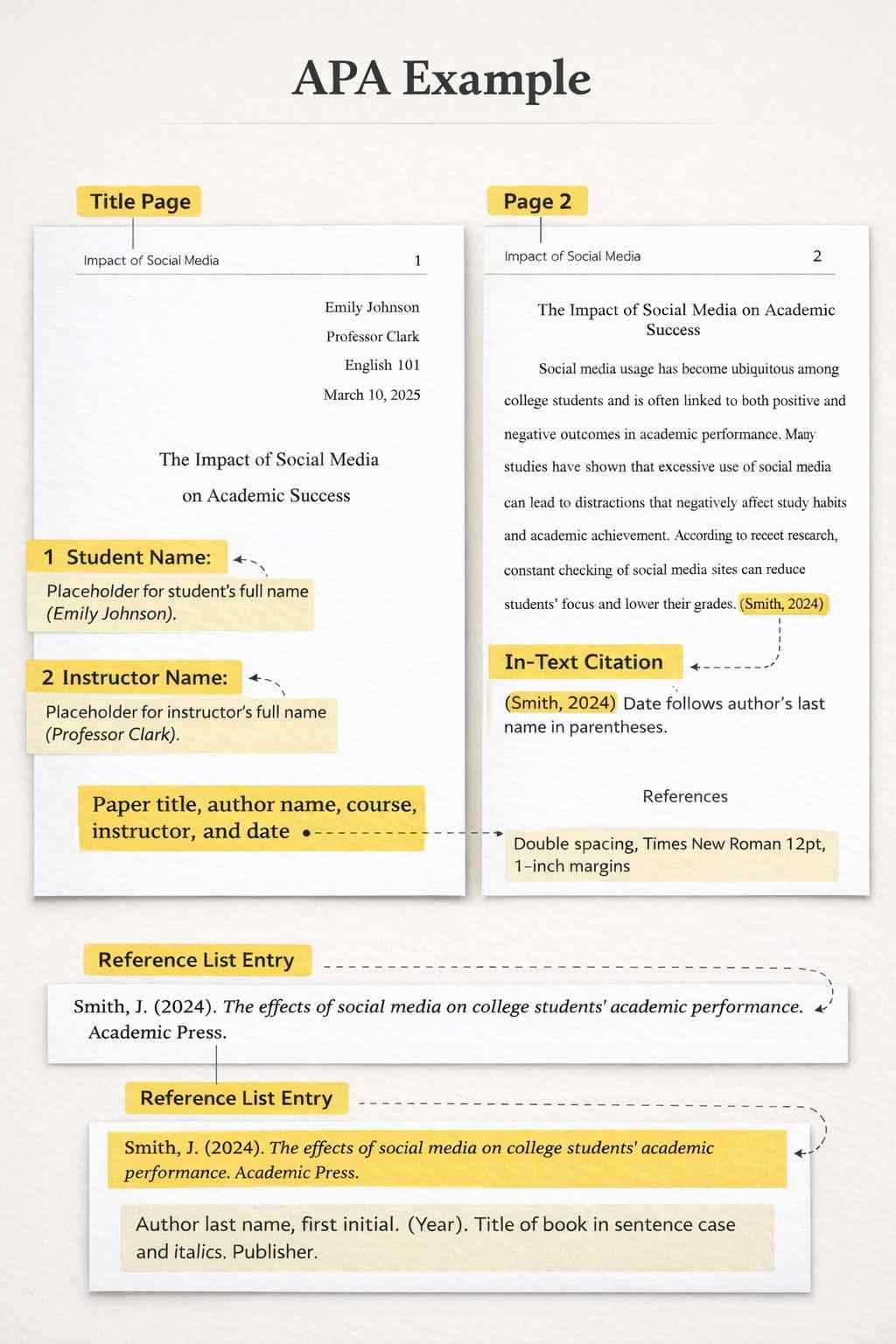
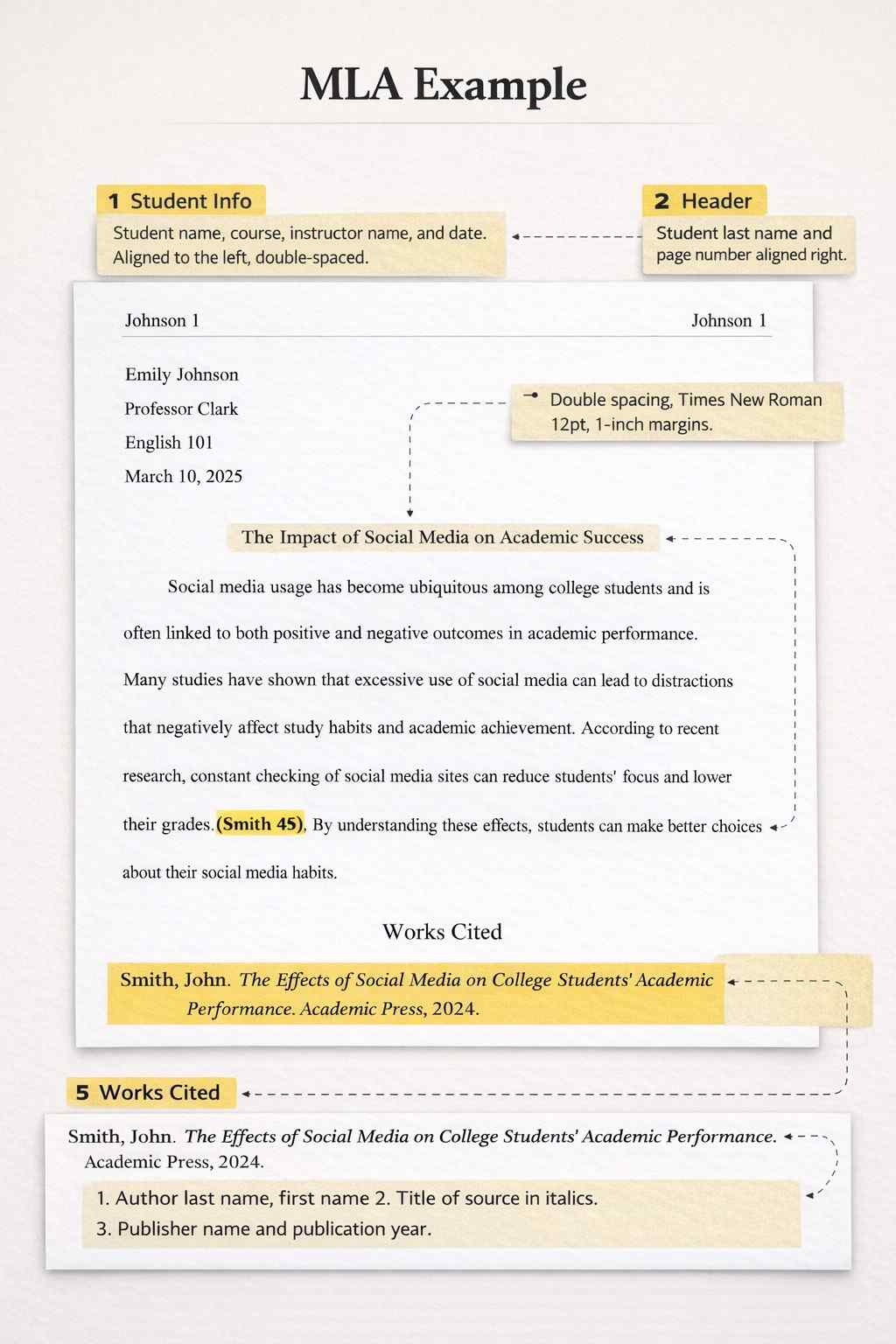
Formatting ensures your work looks professional and adheres to academic standards. Two styles are commonly used in colleges worldwide: APA (American Psychological Association) and MLA (Modern Language Association).
Used primarily in social sciences such as psychology, sociology, and business.
Example:
Excessive social media use can reduce students’ study time (Smith, 2024).
Commonly used in humanities, literature, and cultural studies.
Example:
Social media distractions often lower academic focus (Smith 45).
For a complete citation guide, see APA referencing or MLA referencing.
Pro Tip: Always double-check your instructor’s preferences—mixing up citation styles (e.g., APA in the body and MLA in the bibliography) is one of the most common student mistakes.
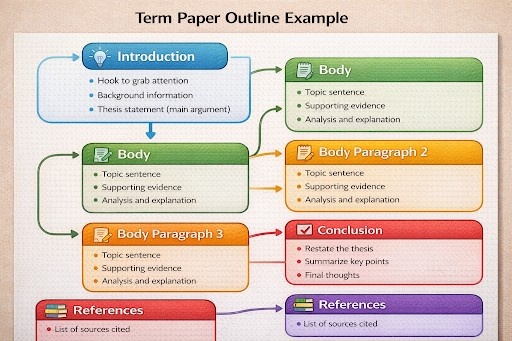
Each institution may have its own formatting requirements, but most term papers follow a standard academic layout. A good structure improves clarity and makes your paper easy to navigate.
Below is the general term paper structure followed across universities worldwide:
If you’re unfamiliar with formatting, it’s a good idea to refer to a proper APA referencing guide to understand how to cite sources accurately.
Pro Tip: When outlining, limit yourself to one main idea per paragraph. This makes transitions smoother and arguments clearer.
Depending on your subject, you may be asked to follow a specific citation format—usually APA, MLA, or Chicago. Each style has unique rules for citing books, articles, and online materials.
To learn about the differences between citation systems, you can check this article explaining the differences between MLA and APA. Mastering citation styles ensures your term paper meets academic integrity standards and avoids unintentional plagiarism.

Beginning a term paper often feels like the hardest part. But once you have a clear topic and plan, the process becomes far more manageable. Let’s break down the initial steps.
Pick a topic that interests you and aligns with your course objectives. A focused, researchable question is easier to manage than a broad, vague one. For instance, instead of writing about “Climate Change,” narrow it to “The Effects of Climate Change on Arctic Biodiversity.”
A good topic keeps you engaged throughout your research and provides a clear direction for your writing. If you struggle with brainstorming or narrowing topics, professional term paper help services can guide you in selecting and structuring your subject.
Example:
This focused topic clearly shows:
A clear topic makes research and writing much easier.
Pro Tip: Run your topic by your professor before starting. A five-minute conversation can save you hours of unnecessary rewriting.
Before drafting your paper, spend time gathering background information. Use academic databases like JSTOR, Google Scholar, and your institution’s library. Read journals, research papers, and credible online resources. You can also explore free samples from MyAssignmentHelp for additional insights, research and examples.
Take notes as you read and organize your findings under subheadings. Pay attention to contrasting viewpoints—these make your argument stronger.
If you want to understand how to plan your arguments and structure ideas effectively, this guide on how to write an outline provides a clear step-by-step explanation.
Pro Tip: Don’t rely solely on the first few Google results—look for scholarly sources published within the last five years to keep your paper current.
Your thesis statement is the foundation of your term paper. It summarizes your main argument in one concise sentence. Everything you write afterward should support or expand on that thesis.
For instance:
“Social media affects college students’ academic performance by reducing study time, increasing distractions, and changing learning habits.”
Every paragraph in your term paper will return to this idea. To learn the fundamentals of developing clear, defensible theses, explore this piece on how to write a thesis statement.
Pro Tip: A good thesis is arguable, specific, and concise. If your thesis feels like a fact rather than a claim, it’s not strong enough.
Once your research and thesis are ready, organize your ideas into a structured outline. This outline helps you stay on track and ensures a logical flow between sections.
A typical term paper outline looks like this:
If you need guidance in formatting outlines for longer academic papers, the research paper outline example can help you visualize how to structure information.
Pro Tip: Treat your outline as a living document. Update it as you research and discover new insights—your ideas will evolve naturally.
Your first draft doesn’t need to be perfect. Focus on putting your ideas down rather than worrying about grammar or sentence structure. You can refine it later.
Start with the introduction, briefly explain your topic, and clearly state your thesis. The body should contain evidence-based arguments, data, and analysis. Conclude each paragraph with a transition to maintain flow.
Example body sentence:
Many college students spend hours on social media, which reduces the time available for studying (Smith, 2024).
You can edit grammar and citations later.
For practical tips on writing initial drafts, see this article on creating your first draft of an assignment.
Pro Tip: Use “placeholders” for citations or facts you’ll verify later. This prevents losing momentum during writing.
Formatting errors and inconsistent citations can lower your grades. Always follow your institution’s style guide. For humanities, MLA is often preferred, while social sciences typically use APA.
If you’re unsure about citation mechanics, you can refer to the MLA referencing guide. It offers simple examples for in-text citations and bibliographies.
A clear and properly formatted reference list enhances your academic credibility and prevents plagiarism.
Pro Tip: Use free citation generators cautiously—always verify their output against the official style guide.
The abstract comes before your introduction but should be written last. It’s a 150–250 word summary that outlines your research purpose, key findings, and conclusions.
If you haven’t written one before, read this guide on how to write an abstract to craft a concise summary that represents your paper accurately.
Pro Tip: Keep it factual—avoid citations or in-depth analysis in your abstract. It’s a summary, not a mini-paper.
High-quality research forms the backbone of every successful term paper. Avoid random internet articles and focus on peer-reviewed journals, government reports, and academic books.
Keep track of your sources as you go. Create a simple spreadsheet or use citation tools to manage references efficiently. If you want structured help conducting research and analyzing sources, professional research writing assistance services can provide valuable support.
Pro Tip: Record full citation details (author, year, publisher, page number) as you go. You’ll save hours when compiling your bibliography later.
Even well-prepared students make errors in their term papers. Here are a few to watch for:
When in doubt, reviewing your outline against your thesis ensures every section contributes meaningfully to your argument. If you find the requirements too complex or the deadline too tight, you can choose to buy a college paper online from our expert team to ensure all academic standards are met without the stress.
Pro Tip: Read your paper aloud once before finalizing. You’ll instantly catch awkward phrasing and unclear transitions that silent reading misses.
Once you finish your draft, set it aside for a day before editing. This break allows you to review it with a fresh perspective.
Check for spelling, grammar, and sentence structure. Ensure that your arguments are clear and that the paper flows logically from one point to the next.
If you need professional help at this stage, the proofreading and editing service can help refine your language, tone, and academic formatting.
Plagiarism is one of the most serious academic offenses. It occurs when you use someone else’s words or ideas without proper credit. To maintain integrity, always cite your sources and use plagiarism detection tools.
You can use a free plagiarism checker to scan your document before submission.
Another way to reduce plagiarism is to paraphrase effectively. If you struggle to rephrase complex sentences, tools like the paraphrasing tool can help you express information in your own words.
Although often used interchangeably, term papers and research papers serve slightly different purposes. A term paper typically reviews what you’ve learned in a course, while a research paper explores new questions or ideas beyond the syllabus.
If you want to dive deeper into this distinction, read the full research paper writing guide. It explains how research papers require original data collection and hypothesis testing, unlike term papers that synthesize existing information.
Your bibliography or reference list should include every source cited in your term paper. Follow the rules of your chosen citation style consistently throughout the document.
Remember to list sources alphabetically by the author’s last name. Check capitalization, punctuation, and italicization carefully, as small errors can affect your grade.
After proofreading and formatting, perform a final review:
When you’re confident that your paper is polished, submit it before the deadline. Rushed work often contains avoidable errors, so time management is crucial.
Sometimes, even with a clear understanding of term paper writing, students struggle to manage time or handle complex topics. Consulting professional assignment writers can save time, reduce stress, and ensure your paper meets academic expectations.
Save hours of stress by ordering a 100% original, custom-written paper from academic experts who meet your deadline.
Order Your Term Paper NowWriting a term paper takes planning, research, and care. You can write a great paper by following a few simple steps. First, pick a clear topic and a strong main idea. Next, find facts from good sources. Finally, check your work one last time. This shows you know your subject and value honest work.
Keep these tips in mind:
With practice, writing papers gets easier. It is a great way to grow as a student. If you need more help, look at MyAssignmentHelp. They offer guides and expert tips to help students succeed everywhere.
A term paper shows what you learned during the semester. It tests your research and writing skills. It also shows how well you can apply classroom theories to real-world situations.
Most papers are 10 to 20 pages long. This depends on your subject and what your professor asks for. Science papers are often shorter and focus on data, while humanities papers tend to be longer.
A standard paper includes these parts:
Using styles like APA or MLA makes your work look professional and organized.
A term paper sums up what you learned in a specific course. A research paper looks for new answers or tests a new idea. While both require deep study, a research paper is more about finding new information.
Pick a topic that fits the course and interests you. Make sure there are enough books and articles to help you write. A specific question like “How AI helps college students” is better than a broad idea like “Technology.”
Your professor will tell you which style to use. Usually, you will use APA for social sciences and MLA for liberal arts. Use the same style for all your notes and your final list of sources.
Always write ideas in your own words and give credit to every source you use. Before you turn in your work, use an online tool to check for copied text. This helps keep your work honest.
Read your draft again to fix grammar and clear up confusing parts. Make sure your facts support your main idea. You can also use a proofreading service to help polish your final version.

Hi, I am Mark, a Literature writer by profession. Fueled by a lifelong passion for Literature, story, and creative expression, I went on to get a PhD in creative writing. Over all these years, my passion has helped me manage a publication of my write ups in prominent websites and e-magazines. I have also been working part-time as a writing expert for myassignmenthelp.com for 5+ years now. It’s fun to guide students on academic write ups and bag those top grades like a pro. Apart from my professional life, I am a big-time foodie and travel enthusiast in my personal life. So, when I am not working, I am probably travelling places to try regional delicacies and sharing my experiences with people through my blog.










 WhatsApp

