


 31 December,2025

Table of Contents
Persuasive communication is one of the most powerful skills you can learn—whether you are a student presenting in class, a professional pitching an idea, or a speaker influencing public opinion. A strong persuasive speech does more than share facts; it can change how people think, feel, and act.
This guide will help you understand:
Strong persuasion depends on delivery and structure. These extemporaneous speech techniques can help you present arguments more naturally and effectively.
A persuasive speech is a talk that tries to convince people to believe, feel, or act in a certain way. It uses logic, emotion, and trust to make the message strong. For example, a speaker may ask people to recycle more by sharing facts about pollution and stories about wildlife.
Core Components of Effective Persuasive Speeches:
Effective persuasion relies on a strong hook and a clear call to action. If you are practicing your delivery, try applying these examples to our recommended 5-minute speech topics to see how quickly you can sway an audience’s opinion.
Understanding the type of speech helps you organize your arguments effectively.
Example 1: Value-Based Persuasion
Topic: “Why Mental Health Should Be Treated Like Physical Health”
“Every day, millions silently struggle with anxiety, depression, or stress—but we hesitate to treat these issues as urgently as a broken bone. Mental health deserves equal care, priority, and compassion.”
Techniques Used:
Example 2: Policy Persuasion
Topic: “Schools Should Implement Mandatory Financial Literacy Classes”
“Nearly 70% of young adults struggle with basic budgeting. Yet many graduate knowing how to analyze Shakespeare but not manage debt. Mandatory financial literacy classes can change this, giving students skills for life.
Techniques Used:
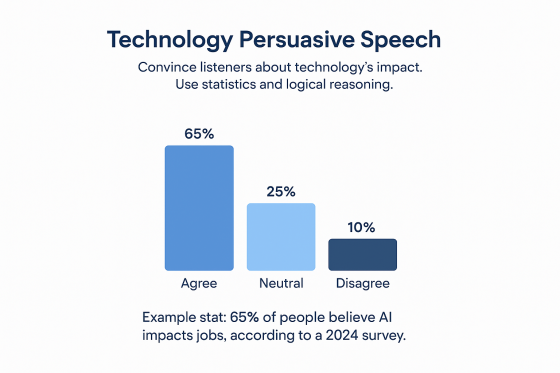
Pro Tip (Spot Logos): If a persuasive speech uses numbers, research, data, surveys, or step-by-step logic → it’s using Logos.
Pro Tip (Spot a CTA): If the speaker is urging the audience to do something—implement, change, support, vote, demand—it’s a CTA.
Pro Tip (Spot Evidence): If the speaker uses facts, surveys, or reports to support a claim, the argument is evidence-backed.
Example 3: Fact-Based Persuasion
Topic: “Social Media Negatively Impacts Sleep Quality in Teens”
“Studies show that teens who use screens heavily—especially before bed—sleep worse. Research found that adolescents using digital devices for over 9 hours a day are 60% more likely to have poor sleep than those with limited screen time. Cutting screen use at night can improve focus, health, and sleep quality.
Techniques Used:
Pro Tip (How to Recognize It):
If the argument uses data, study results, or findings from a credible source (NIH, PubMed, universities), it’s scientific evidence.
Pro Tip (How to Recognize It): If the argument uses data, study results, or findings from a credible source (NIH, ScienceDirect, PubMed, universities), it’s scientific evidence.
Pro Tip (How to Recognize It): If the main argument can be supported with data or disproven by studies, it’s a factual claim.
Practical tip: Always cite the source of your data.
Our experts guide you in building strong arguments, counterpoints, and compelling conclusions for essays and speeches.
Personal Development:
Education:
Technology:
Social Issues:
Environment:
Example: “Every minute, 3,000 tons of food are wasted while millions go hungry.”
Briefly show your credibility so listeners trust your viewpoint.
This combination helps your audience understand and accept your perspective.
Explore more perspectives here → Great Debate Speech Topics
Persuasive speeches have the power to inform, inspire, and influence. Our persuasive essay writing service, experts understand the core components—Ethos, Pathos, Logos—addressing counter-arguments, and ending with a strong call to action, you can craft speeches that leave a lasting impact. Using persuasive and value speech examples, well-researched facts, and relatable stories can further help you connect with your audience. Whether you are presenting in class, speaking professionally, or advocating for a cause, following a structured approach ensures your message is memorable and persuasive.
Ans: It aims to influence how people think, feel, or act using strong arguments, credible evidence, and emotional appeal.
Ans: Pick a topic you care about, has strong evidence, and is relevant to your audience.
Ans: Begin with a hook—a fact, story, or bold statement to grab attention immediately.
Ans: It shows understanding of other perspectives, strengthens credibility, and makes your argument balanced.
Ans: Close with a clear call to action that tells the audience exactly what you want them to do—whether it’s changing a behavior, supporting an idea, or adopting a new mindset.

I am a scientific writing expert specializing in STEM and medical research. I create technically precise, research-driven academic documents, including dissertations, lab reports, and advanced scientific assignments.










 WhatsApp

