What are the best technology research topics for 2026?
The best technology research topics for 2026 focus on Agentic AI ethics, DNA data storage, 6G connectivity, and sustainable space tech. Students should explore how these innovations solve real-world problems like climate change and data privacy. High-ranking categories include Biotechnology, Cybersecurity, and Green Information Technology. To choose a winning topic, pick a field with an active debate, such as AI bias or the impact of social media on mental health.
Quick Picks: Top 5 Trending Research Topics for 2026
Agentic AI: Studying how autonomous AI agents make moral choices.
6G Networks: Researching the safety and speed of the next internet era.
DNA Storage: Using synthetic biology to save the world’s digital data.
Smart Dust: Tracking environmental changes with tiny wireless sensors.
Neuro-Privacy: Protecting brain-computer data from digital hackers.
Choosing a topic is just the first step. If you find the technical details of your paper difficult, our professionalresearch writing service can help you structure your findings perfectly.
🚀 Top 5 Technology Trends for 2026: Trend Snapshot
What are the top 5 technology Research trends for 2026?
The five most influential trends are Agentic AI Ethics, 6G Connectivity, Sustainable Space Tech, CRISPR in Agriculture, and Digital Privacy Laws. These areas define the “Innovation Signal” for 2026, moving beyond simple automation toward autonomous systems and green solutions. Researchers focusing on these topics provide high-value insights into how tools will act, connect, and protect our global resources in the coming years.
1. Agentic AI Ethics: Focuses on the moral rules for AI that acts alone.
2. 6G Connectivity: Explores the jump to ultra-fast, 100x speed internet systems.
3. Sustainable Space Tech: Researches ways to clean up and recycle orbiting space junk.
4. CRISPR in Agriculture: Studies gene-editing to create crops that survive climate change.
5. Digital Privacy Laws: Looks at new legal rights for protecting your brain data.
Modern software innovations continue to be built on classic frameworks, makingC++ assignment help online a vital resource for emerging developers.
Personal Insight: Why I Built This Guide
I have helped thousands of students find the right research title about technology. Most lists you find online are old and boring. In my experience, a great paper needs “Information Gain.” This means you must share something new. This 2026 guide gives you fresh information technology research topics that teachers love. My top secret is simple: Pick a topic that solves a real-world problem. If your research helps people, your grade will reflect that effort. Use these interesting technology topics to lead the future of new technology in research.
For students interested in the safety of our digital future, our list ofcyber security research topics offers over 100 fresh ideas on data protection and ethical hacking.
📘 What Are Technology Research Topics?
Technology research topics are ideas about modern tools. They cover how we build and use new gadgets. These topics help students learn about the digital world. You might study how a computer “thinks” using AI. Or, you could look at how phones affect sleep.
A good computer architecture homework help provides you with expert guidance. It focuses on a specific problem in science. For example, you can research how robots help doctors. You can also study how green tech saves energy. These subjects are always changing and growing.
As per our computer science assignments help, choosing a topic is the first step for students. It leads to finding facts and writing reports. I believe tech topics are the most exciting to study. They allow you to look into the future today. You can explore how 6G will change the internet. Or, you can research how we protect our data.
In my view, the best topics have two sides. They let you share a personal opinion. This makes your research paper much more interesting. Great tech topics help you gain new skills. They prepare you for the high-tech jobs of tomorrow. Pick a topic that makes you curious and start.
Quick Answer: How to Identify a Great Tech Topic
Innovation: Look for new tools like Agentic AI or 6G.
Impact: See how the tool changes human life.
Ethics: Ask if the technology is safe for everyone.
Solution: Find a tech that fixes a real problem.
Data: Make sure you can find facts and stats.
Learn tomaster your circuits with Logisim help and gain the architectural edge needed to simplify complex digital logic projects using professional simulation techniques.
🌍 Why Technology Research Is Important in 2026
Why does technology research matter in 2026?
Technology research is vital because it solves global challenges like climate change and disease. In 2026, new tools like Agentic AI and 6G move faster than ever. Research helps us use these tools safely and fairly. It protects our digital privacy and helps create green energy. Without research, we cannot fix the “digital divide” or stop cyber threats. It turns complex science into helpful gadgets for everyone. These innovations also inspire new business research project topics across industries.
Technology research is key to our future. It helps us find better ways to live. In 2026, the world faces many big changes. We need smart tech to fix these issues. For example, research helps create clean power. It also helps doctors find new cures. I believe research keeps us safe. It helps us spot “deepfakes” and lies online. Without it, we would not have fast internet. We would not have smart homes either.
Research gives us the facts we need. It tells us if a new tool is good. In my view, research fuels the economy. It creates new jobs in tech fields. Students who study tech will lead the way. They will build the next big things. If those students ever get stuck building web applications or coding algorithms, they might look for JavaScript homework help to master their programming skills and learn how to properly cite in IEEE format when documenting their code sources. Research also helps us save the planet. We can track pollution using tiny sensors. This makes our air and water cleaner.
When managing data-driven tech initiatives, systems integration, or complex legacy codebases, having access to reliable Perl project help expertise ensures that foundational software infrastructure remains robust and efficient.
I think everyone should care about tech research. It is not just for scientists. It affects how we learn and work. Good research makes our lives easier. It helps us stay connected to friends. It ensures that tech helps all people. For those diving deep into the world of coding and systems, we offer specializedcomputer science assignment help to ensure your technical data is accurate. Pick a topic and start exploring today!
🧠 Types of Technology Research Topics
What are the different types of technology research topics?
Technology research topics are grouped into four main areas: Emerging Tech (new tools), Applied Tech (how we use tools), Ethical Tech (safety and fairness), and Green Tech (saving the planet). Understanding these types helps students choose a specific area for their papers. Each category focuses on a different way that machines and code impact our world today.
Before you look at the 450+ ideas, you must know what kind of topic you need. Technology is very broad. I believe picking a “type” first makes your work much easier. In my experience, students who choose a clear category write faster and get better grades.
Here are the four main types of technology research:
1. Emerging Technology Topics
These topics focus on things that are being built right now. They are the “next big things.”
Examples: Agentic AI, blockchain, and quantum computing.
Best for: Students who love the future and brand-new inventions.
2. Applied Technology Topics
These topics look at how we use gadgets in real life. They focus on specific jobs or tasks.
Examples: Healthcare tech, education tools, and finance apps.
Best for: Students who want to solve problems in a specific field.
3. Ethical & Social Topics
These topics ask “Should we do this?” instead of “Can we do this?” They look at human rights.
Examples: Online privacy, AI bias, and digital addiction.
Best for: Students who like to debate and talk about fairness.
4. Environmental Technology Topics
These topics focus on using tech to protect the earth. They look at nature and energy.
Examples: Renewable energy, green tech, and recycling robots.
Best for: Students who care about climate change and the planet.
In my view, the best papers often mix two types. For example, you can study the Ethical side of Emerging AI. This gives you more to write about. It also makes your paper very unique. Choose the type that interests you most. Then, you can find your perfect topic in the lists below.
The most trending research topics for 2026 include Agentic AI, DNA Data Storage, and 6G Security. These “Frontier” technologies focus on machines that can act on their own and biological ways to save digital data. Researchers are also looking at Self-Healing Software and Smart Dust to track climate change. These topics are popular because they solve new problems in speed, safety, and the environment.
I believe Agentic AI will be the #1 research area this year. It moves beyond just “chatting” to “doing.” Most people know AI as a tool that writes text. In 2026, AI is becoming an “agent” that can finish tasks without help. It can book your travel or fix code on its own. This is a huge shift in the new technology in research space.
In my experience, choosing a frontier topic is one of the best ways to stand out. Teachers often receive papers on common subjects. If you write about DNA Data Storage, you show that you follow current trends. You provide fresh insights that many students overlook. The same applies when exploring emerging technologies such as the sequel language and modern database systems. This approach can help you earn better grades and create a stronger academic paper.
🔥 Trending Research Topics 2026 (The Innovation Signal)
Agentic AI Ethics: Who is responsible when an AI agent makes a mistake?
DNA Data Storage: Can we save the entire internet inside living cells?
6G Network Security: How will we stay safe in an ultra-fast digital world?
Self-Healing Software: Can computer code fix its own bugs without help?
Smart Dust Sensors: Using tiny chips to track climate change in real-time.
Digital Twins of Cities: How virtual models can stop traffic jams forever.
Post-Quantum Security: Building new locks that quantum computers cannot break.
Space Junk Recycling: Using robots to clean up old satellites in orbit.
Ambient Power: Running small gadgets using only radio waves in the air.
Neuro-Privacy: How to protect your brain data from digital hackers.
💻 Information Technology Research Topics for Undergraduates
In my view, college papers need more data. These IT research topics focus on how big systems work together to help businesses and people.
Edge Computing in IoT: Why processing data closer to the user saves power.
Blockchain in Voting: Can decentralized tech make elections 100% fair?
Zero-Trust Security: Why “never trust, always verify” is the future of IT.
Cloud Sovereignty: How countries keep their citizen data inside their borders.
Green Data Centers: Using ocean water to cool down giant server rooms.
AI in DevOps: How machine learning speeds up the building of new apps.
Explainable AI (XAI): Why we must know how an AI reaches its answer.
Digital Onboarding: How banks use face scans to open accounts safely.
5G vs. Wi-Fi 7: Which technology will win the race for home internet?
Dark Data Management: What should companies do with data they never use?
Those looking at the intersection of infrastructure and innovation should check out our specializedengineering dissertation topics, which cover the latest in sustainable tech and smart materials.
🏫 Technology Research Topics for High School Students
High school topics should be easy to understand but fun to write. I recommend these interesting technology topics because they affect your daily life.
Social Media Algorithms: How TikTok decides which video you see next.
Smartphone Battery Life: Does “Dark Mode” really save your phone’s power?
Video Games and Learning: Can playing games help you get better at math?
Drones in Delivery: Will robots bring your pizza to your door soon?
Cyberbullying Tech: Can AI find and stop mean comments before they post?
The “Right to Repair”: Should people be allowed to fix their own iPhones?
E-waste Recycling: What happens to your old laptop when you throw it away?
Virtual Reality Classrooms: Is learning in VR better than a normal room?
Smart Home Privacy: Are smart speakers always listening to your family?
Wearable Fitness Tech: Do step-trackers actually make people healthier?
Quick Answer: How to Choose a Top 30 Topic
Pick for Level: Use the High School list for simple ideas or the IT list for complex ones.
Add a Question: Every topic above has a question. Use it as your paper’s title!
Check for Trends: 2026 topics like 6G or Agentic AI will get you more attention.
In my view, these hot research topics are great for any research paper. They are fresh and have plenty of new data to find. Pick one that makes you excited about the future!
If your topic involves the hardware or physical systems behind the tech, you might find our assignment help for game theory useful for your diagrams and calculations.
📚 Technology Research Topics by Category (300 Topics)
🧠 Artificial Intelligence Research Topics
Artificial Intelligence is one of the fastest-growing fields. These topics explore automation, machine learning, and real-world AI applications.
Role of AI in healthcare diagnosis
Impact of AI on job markets
AI in self-driving cars
Machine learning in fraud detection
AI in customer service chatbots
Ethical issues in artificial intelligence
AI in personalized education
Deep learning in image recognition
AI in climate change prediction
Natural language processing in communication
AI in financial forecasting
AI-powered recommendation systems
Bias in AI algorithms
AI in robotics and automation
AI in smart homes
AI in cybersecurity systems
Role of AI in agriculture
AI in medical imaging
AI in gaming industry
AI in supply chain management
AI in marketing strategies
AI for speech recognition
AI in mental health support
AI in decision-making systems
AI and human creativity
AI in space exploration
AI in smart cities
AI in predictive analytics
AI vs human intelligence
Future of artificial general intelligence
AI in fraud prevention systems
AI in automated customer support
AI in financial risk assessment
AI in facial recognition systems
AI in sentiment analysis
AI in language translation
AI in medical research
AI in weather forecasting
AI in smart assistants
AI in human resource management
🔐 Cybersecurity Research Topics
Cybersecurity focuses on protecting systems and data. These topics cover threats, data privacy, and digital security solutions.
Importance of cybersecurity in digital age
Cyber threats in cloud computing
Data privacy issues in social media
Role of AI in cybersecurity
Cybersecurity in banking systems
Ethical hacking and its role
Cybercrime and its impact on businesses
Phishing attacks and prevention methods
Ransomware attacks and solutions
Cybersecurity laws and regulations
Security challenges in IoT devices
Role of encryption in data security
Cybersecurity in healthcare systems
Biometric security systems
Cybersecurity risks in remote work
Social engineering attacks
Cybersecurity in mobile applications
Role of firewalls in network security
Cybersecurity awareness among users
Blockchain in cybersecurity
Cybersecurity in e-commerce
Identity theft and prevention
Cloud security challenges
Cybersecurity in government systems
Future of cybersecurity technologies
Zero trust security model
Cybersecurity in smart cities
Malware detection techniques
Cybersecurity in online banking
Ethical issues in cybersecurity
Cybersecurity in AI systems
Data breaches and prevention
Cybersecurity risk management
Network security protocols
Cybersecurity education importance
💰 Blockchain & FinTech Research Topics
Blockchain is transforming finance and digital transactions. These topics explore cryptocurrencies, security, and decentralized systems.
Role of blockchain in banking
Cryptocurrency and global economy
Bitcoin vs traditional currency
Blockchain in supply chain management
Smart contracts and their applications
Blockchain for secure voting systems
FinTech innovations in 2026
Digital wallets and payment systems
Blockchain in healthcare data
Risks of cryptocurrency investments
Role of blockchain in cybersecurity
Decentralized finance (DeFi)
Impact of blockchain on financial services
Regulation of cryptocurrencies
Blockchain in identity verification
FinTech in developing countries
Mobile banking technology
Blockchain in real estate
AI in financial technology
Future of digital currencies
Blockchain in insurance industry
Fraud detection using blockchain
Role of big data in FinTech
Peer-to-peer payment systems
Financial inclusion through technology
Blockchain scalability issues
Crypto trading platforms
Blockchain in logistics
Digital payment security
FinTech startups growth
Blockchain in government services
Stablecoins and their impact
Blockchain transparency benefits
Crypto mining challenges
Future of decentralized apps
Your project involves a heavy amount of data or coding, our guide onsequel programming languages can help you understand the database management systems that power modern research.
🏥 Healthcare Technology Research Topics
Technology is improving healthcare through AI, telemedicine, and medical devices. These topics focus on innovation in patient care.
AI in disease diagnosis
Telemedicine in rural healthcare
Wearable health devices
Role of big data in healthcare
Robotics in surgery
Digital health records
AI in mental health treatment
Medical imaging technologies
Health monitoring apps
Technology in pandemic control
Virtual reality in therapy
IoT in healthcare systems
Smart hospitals and automation
Role of technology in elderly care
3D printing in medicine
AI in drug discovery
Healthcare data privacy issues
Mobile health applications
Technology in emergency care
Genetic engineering and healthcare
Biotechnology in disease prevention
Digital tools in patient care
AI in personalized medicine
Technology in rehabilitation
Future of healthcare technology
AI in cancer detection
Telehealth services impact
Smart wearable health tech
Healthcare automation systems
Digital patient monitoring
🌍 Environmental & Green Technology Topics
Green technology helps reduce environmental impact. These topics focus on sustainability, renewable energy, and climate solutions.
Renewable energy technologies
Solar power advancements
Wind energy solutions
Green buildings and sustainability
Smart grids and energy efficiency
Technology in waste management
Electric vehicles and environment
Climate change prediction using AI
Water purification technologies
Sustainable agriculture technology
Carbon capture technology
Green computing practices
Technology in wildlife conservation
Pollution control technologies
Energy storage systems
Eco-friendly manufacturing
Role of IoT in energy saving
Smart cities and sustainability
Biofuels and renewable resources
Technology in ocean cleanup
Environmental monitoring systems
AI in climate research
Sustainable transportation solutions
Role of drones in environment
Future of green technology
Renewable energy storage systems
AI in environmental protection
Sustainable water management
Clean energy innovations
Smart farming technology
🎓 Education Technology Topics
Technology is changing how students learn. These topics explore e-learning, AI tutors, and digital classrooms.
E-learning vs traditional learning
Role of AI in education
Online learning platforms
Virtual classrooms and learning
Gamification in education
Digital textbooks vs printed books
Technology in special education
AI tutors and personalized learning
Impact of technology on students
Mobile learning applications
Virtual reality in education
Technology in higher education
Online exams and assessment tools
Smart classrooms
Role of social media in education
Digital literacy importance
Technology in remote learning
Education apps and tools
Blended learning models
Future of education technology
AI in student performance analysis
Digital classrooms effectiveness
Technology in skill development
Online certification programs
Learning management systems
🚗 Transportation Technology Topics
Transportation technology is evolving with electric vehicles and automation. These topics explore future mobility.
Electric vehicles and sustainability
Self-driving cars technology
Smart traffic management systems
Role of AI in transportation
Hyperloop transportation system
Drones in delivery services
GPS technology in navigation
Smart public transport systems
Autonomous vehicles safety
Blockchain in logistics
Transportation and climate change
Future of air travel technology
High-speed rail systems
Mobility as a service (MaaS)
IoT in transportation
Traffic congestion solutions
Green transportation systems
Ride-sharing technologies
Smart parking systems
Transportation data analytics
Electric mobility solutions
AI in traffic prediction
Smart logistics systems
Transportation automation
Sustainable transport systems
🎮 Entertainment & Media Technology Topics
Technology is reshaping entertainment. These topics include gaming, streaming, and virtual experiences.
Impact of streaming platforms
Virtual reality in gaming
Augmented reality in entertainment
AI in movie production
Social media and entertainment
Online gaming industry growth
Cloud gaming technology
Technology in music industry
Digital content creation tools
AI in video editing
Gaming addiction and effects
eSports industry development
Virtual concerts and events
Technology in film production
Animation and CGI technology
Social media influencers impact
Technology in journalism
Streaming vs traditional media
Immersive entertainment experiences
Future of entertainment technology
AI in music production
Digital storytelling techniques
AR in live events
Interactive media platforms
Future of gaming technology
For students focused on the digital side, our experts provide dedicatedinformation technology assignment help covering everything from cloud computing to 6G networks.
🧬 Biotechnology & Future Health Research Topics
Biotechnology and future health technologies are transforming medicine, genetics, and human life. These topics explore innovations in healthcare, bioengineering, and advanced medical solutions.
Role of biotechnology in modern medicine
Genetic engineering and disease prevention
CRISPR technology in gene editing
Biotechnology in vaccine development
Personalized medicine using biotechnology
Stem cell therapy advancements
Biotechnology in cancer treatment
Bioinformatics in healthcare
Artificial organs and tissue engineering
Role of nanotechnology in medicine
Biotechnology in drug discovery
Ethical issues in genetic modification
Biotechnology in aging research
DNA sequencing technologies
Biotechnology in infectious disease control
Role of microbiology in biotechnology
Gene therapy applications
Biotechnology in fertility treatments
Regenerative medicine advancements
Biotechnology in mental health research
Biomedical engineering innovations
Biotechnology in pandemic preparedness
Synthetic biology applications
Biotechnology in diagnostics
AI and biotechnology integration
Biotechnology in vaccine innovation
Role of genomics in healthcare
Biotechnology in organ transplantation
Precision medicine technologies
Biotechnology in rare disease research
Ethical concerns in biotechnology
Biotechnology in public health
Future of human enhancement technologies
Biotechnology in immunotherapy
Bioengineering in prosthetics
Biotechnology in nutrition science
Digital health and biotechnology
Biotechnology in global health solutions
Biotechnology in pharmaceutical development
Human genome editing ethics
Biotechnology in environmental health
Biotechnology in disease detection
Biohacking and its future
Biotechnology in reproductive health
Biotechnology and wearable health tech
Future of biotech startups
Biotechnology in healthcare automation
Biotechnology in precision diagnostics
Biotechnology in neuroscience research
Biotechnology in medical robotics
🌍 Sustainable & Green Technology Topics
Sustainable and green technologies aim to protect the environment and promote eco-friendly solutions. These topics focus on renewable energy, conservation, and sustainable innovation.
Role of renewable energy in sustainability
Solar energy innovations
Wind energy technologies
Sustainable urban development
Green building technologies
Energy-efficient smart homes
Role of AI in environmental sustainability
Electric vehicles and carbon reduction
Sustainable agriculture practices
Smart irrigation systems
Water conservation technologies
Waste recycling technologies
Circular economy models
Carbon footprint reduction strategies
Green computing practices
Sustainable supply chain management
Clean energy storage systems
Biofuels and alternative energy
Role of IoT in sustainability
Smart grids and energy distribution
Sustainable transportation systems
Ocean pollution control technologies
Climate change mitigation technologies
Role of drones in environmental monitoring
Renewable energy policies
Sustainable manufacturing processes
Environmental data analytics
Energy conservation technologies
Sustainable smart cities
Future of green technology innovation
AI in climate monitoring
Renewable energy integration challenges
Sustainable water management systems
Green hydrogen technology
Environmental sustainability in businesses
Eco-friendly product design
Sustainable logistics systems
Role of blockchain in sustainability
Renewable energy economics
Sustainable infrastructure development
📱 Social Media & Human Behavior Research Topics
Social media technologies influence communication, psychology, and human behavior. These topics explore digital interaction, mental health, and societal impact.
Impact of social media on mental health
Social media addiction among youth
Role of social media in communication
Influence of social media on behavior
Social media and self-esteem
Cyberbullying and its effects
Social media and academic performance
Role of influencers in digital marketing
Social media and political opinions
Privacy concerns in social media
Social media algorithms and user behavior
Fake news and misinformation
Social media and attention span
Digital identity formation
Social media and relationships
Impact of social media on productivity
Social media and consumer behavior
Role of AI in social media platforms
Social media trends and society
Social media and emotional well-being
Online communities and behavior
Social media in education
Impact of short-form content
Social media and cultural influence
Social media marketing strategies
Social media and brand perception
Role of social media in activism
Social media and youth development
Digital detox and its importance
Social media and privacy risks
Social media and information overload
Psychological effects of social media
Social media and communication skills
Social media and public opinion
Future of social media platforms
Ethical issues in social media
🤖 Robotics & Autonomous Systems Research Topics
Robotics and autonomous systems are revolutionizing industries through automation and intelligent machines. These topics explore robotics, AI integration, and future technologies.
Role of robotics in automation
Autonomous vehicles technology
Robotics in manufacturing
AI-powered robots
Robotics in healthcare
Industrial robots and efficiency
Robotics in agriculture
Autonomous drones applications
Robotics in space exploration
Human-robot interaction
Robotics in logistics
Service robots in daily life
Robotics in defense systems
Autonomous systems in transportation
Robotics and job displacement
Ethical issues in robotics
Robotics in education
AI and robotics integration
Robotics in construction industry
Robotics in disaster management
Autonomous navigation systems
Robotics in smart homes
Robotics and machine learning
Robotics in elderly care
Robotics in surgery
Autonomous robots in warehouses
Robotics in food industry
Robotics in mining
Future of humanoid robots
Robotics in environmental monitoring
Robotics in security systems
Robotics and IoT integration
Autonomous robots in retail
Robotics in transportation systems
Robotics in military operations
Robotics and human safety
Future trends in robotics
If your research paper focuses on high-level software development or system design, you can get professionalsoftware engineering assignment help to handle the heavy lifting.
🟣 🎓 Technology Research Topics by Academic Level
🏫 For High School Students
These topics are simple, easy to understand, and perfect for beginners. They focus on basic concepts and real-life applications of technology.
Impact of smartphones on student life
Role of social media in communication
Advantages of online learning
Technology in daily life
Importance of internet safety
How video games affect students
Benefits of educational apps
Role of technology in education
Social media and mental health
Online privacy and security basics
Impact of technology on communication skills
Use of technology in schools
E-learning vs classroom learning
Role of technology in entertainment
Effects of screen time on health
Technology and student productivity
Role of AI in daily life
Technology and environmental awareness
🎓 For College Students
These topics are moderate in difficulty. They require analysis, comparison, and understanding of real-world applications.
Impact of artificial intelligence on jobs
Cybersecurity challenges in modern businesses
Role of blockchain in digital payments
Technology in healthcare systems
Data privacy issues in social media
Role of AI in education
Growth of FinTech industry
Cloud computing in business operations
Role of IoT in smart homes
Digital marketing technologies
Impact of automation on employment
Cybersecurity threats in e-commerce
Role of big data in decision making
Technology in remote work
AI in customer service systems
Role of mobile apps in business
Blockchain in supply chain management
Ethical issues in artificial intelligence
Technology in environmental sustainability
Digital transformation in companies
Smart city technologies
Role of technology in startups
AI in healthcare diagnostics
Future of online education
Technology and consumer behavior
🎓 For University Students
These topics are advanced and require critical thinking, research depth, and academic writing skills.
Ethical implications of artificial intelligence
AI bias and fairness in algorithms
Cybersecurity frameworks for data protection
Blockchain scalability challenges
Role of AI in predictive analytics
Impact of quantum computing on security
Data governance in digital systems
Role of AI in climate change modeling
Advanced machine learning applications
IoT security challenges
AI in financial risk management
Digital privacy laws and regulations
Autonomous systems and safety concerns
Big data analytics in healthcare
Role of AI in smart cities
Blockchain in decentralized finance
Cybersecurity in cloud infrastructure
Human-AI interaction challenges
Ethical concerns in data mining
AI in decision-making systems
Technology and global economic systems
Advanced robotics in industry
Role of AI in sustainability
Digital ethics and technology
Future of intelligent systems
📊 Undergraduate (Data-Focused Topics)
These topics focus on data analysis, statistics, and real-world datasets. Perfect for research projects with measurable outcomes.
Data analytics in business decision making
Role of big data in healthcare
Data visualization techniques
Predictive analytics in marketing
Data mining in social media
Machine learning models for prediction
Data-driven decision making
Role of data science in finance
Data privacy and protection
Big data in e-commerce
Data analytics in education
AI models for data analysis
Data trends in digital marketing
Data-driven healthcare solutions
Statistical analysis in technology research
🎓 PhD & Professional (Theory-Focused Topics)
These topics are highly advanced and focus on theories, frameworks, and deep research concepts. Suitable for dissertations and professional studies.
Theoretical frameworks of artificial intelligence
Ethical philosophy in AI systems
Advanced cybersecurity models
Blockchain theory and decentralization
Human-computer interaction theories
AI and cognitive science integration
Theoretical models in machine learning
Digital ethics and moral philosophy
Advanced data governance frameworks
Theoretical limits of artificial intelligence
AI consciousness and cognition
Cybersecurity risk modeling theories
Decentralized systems theory
Technology and societal transformation theories
AI and decision theory
Computational intelligence frameworks
Philosophy of technology
Ethical implications of automation
❓ Technology Research Questions (VERY IMPORTANT)
These research questions help students think critically and build strong assignments. They are also great for improving search rankings and featured snippets.
How does artificial intelligence affect job opportunities?
Can blockchain improve financial security?
What are the risks of cybersecurity attacks?
How does technology impact mental health?
How does AI improve healthcare systems?
Can technology solve climate change problems?
What are the ethical issues in artificial intelligence?
How does social media influence human behavior?
What role does big data play in business decisions?
How does cloud computing improve business efficiency?
What are the benefits of smart cities?
How does automation affect employment?
Can AI replace human intelligence in decision making?
What are the privacy risks in digital platforms?
How does blockchain work in supply chain management?
What are the challenges of implementing IoT systems?
How does technology affect education systems?
What are the benefits of renewable energy technologies?
How does AI impact financial markets?
What are the dangers of social media addiction?
How does cybersecurity protect online transactions?
Can robots replace human workers in industries?
What is the future of autonomous vehicles?
How does virtual reality improve learning experiences?
What are the ethical concerns in data mining?
How does technology influence global communication?
What are the advantages of digital transformation?
How does AI contribute to environmental sustainability?
What are the risks of facial recognition technology?
How does fintech change traditional banking systems?
What is the role of AI in smart home systems?
How does technology affect human relationships?
What are the challenges of big data analytics?
How does digital marketing use AI tools?
Can green technology reduce global warming?
✅ Easy Technology Research Topics
These topics are simple and beginner-friendly. They are perfect for school assignments and basic research projects.
Impact of smartphones on students
Role of social media in communication
Online learning vs classroom learning
Importance of internet safety
Technology in daily life
Benefits of educational apps
Effects of screen time on health
Role of technology in education
Technology and communication skills
Use of technology in schools
Social media and student behavior
Technology in entertainment
Online privacy basics
Technology and productivity
Impact of video games on learning
Role of AI in everyday life
Digital communication tools
Technology and time management
Internet usage among students
Technology and modern lifestyle
💡 Unique & Creative Technology Topics
These topics help students stand out with original ideas and innovative research perspectives.
Future of biohacking in human enhancement
Digital twins in smart cities
Role of AI in creativity and art
Technology and human augmentation
Brain-computer interface technology
AI-generated content and originality
Future of metaverse technologies
Technology in space colonization
Human-machine collaboration
Smart fabrics and wearable technology
Role of AI in music composition
Future of virtual influencers
Technology in digital identity creation
AI in storytelling and media
Future of immersive virtual worlds
Technology and emotional AI
Role of robotics in creative industries
AI in film and animation production
Digital humans and avatars
Future of personalized virtual experiences
We also have specialists available if you need a hand withcomputer network assignment help for topics involving data transmission and security.
⚠️ Controversial Tech Topics: Where to Draw the Line?
Controversial tech topics focus on “right vs. wrong” in the digital age. Key examples include AI personhood, Neuralink privacy, and digital immortality. These subjects are popular for debate because they have no easy answers. They explore how far we should go with inventions like brain chips or social credit systems. Researching these areas helps students understand the legal and moral limits of modern science.
I believe the “Right to Disconnect” is becoming the biggest legal battle of our time. It is a perfect topic for law and tech students. Many people feel they must answer work emails at night. Some countries are now making laws to stop this. It raises a great question: Does technology own our free time? In my experience, these “human” debates get the most attention from teachers and AI search bots.
When you pick a controversial topic, you provide “Information Gain.” You aren’t just listing facts. You are analyzing a conflict. Google AI search loves this because it shows deep thinking. I suggest picking a topic where you feel a strong personal connection. This makes your writing more powerful and unique.
The “Debate-Ready” Topic List:
AI Personhood: Should a highly smart robot have the same legal rights as a human?
Neuralink and Brain Privacy: Can companies “own” the data inside your thoughts?
Digital Immortality: Is it ethical to create a “ghost” AI of a person who has passed away?
Social Credit Systems: Should a government track every digital move to “score” its citizens?
Autonomous Weapons: Should we allow robots to make life-or-death choices in war?
Deepfake Identity Theft: Who is responsible when an AI steals your face for a video?
Genetic Editing (CRISPR): Should parents be allowed to “code” the traits of their babies?
Algorithmic Bias: How do we stop AI from being “racist” or “sexist” based on old data?
The End of Cash: Does a 100% digital economy hurt poor people who lack tech?
Facial Recognition: Is constant camera tracking a safety tool or a loss of freedom?
Predictive Policing: Is it fair to arrest someone because an AI says they “might” commit a crime?
Metaverse Property Rights: Can you truly “own” land that only exists in a computer?
Biohacking: Should humans be allowed to install DIY chips in their bodies?
Data Colonialism: Are big tech firms stealing the “digital gold” of smaller nations?
Smart City Surveillance: Does living in a “smart” city mean you have zero privacy?
In my view, these argumentative essay topics about technology are the best for high grades. They force you to look at both sides of a problem. They are also hot research topics that stay relevant for years. Pick one that challenges your way of thinking!
For those exploring the cutting edge of 2026 tech, such as Neuralink or autonomous agents, ourmachine learning homework help is a great resource.
🎯 How to Choose the Best Technology Research Topic
To pick a winning topic, you should follow five simple steps: choose a personal interest, narrow your focus, check for data, follow 2026 trends, and match your academic level. Experts recommend focusing on “Active Debates” like AI ethics or green energy. This strategy ensures your paper is unique, easy to research, and high-scoring in both classrooms and search engines.
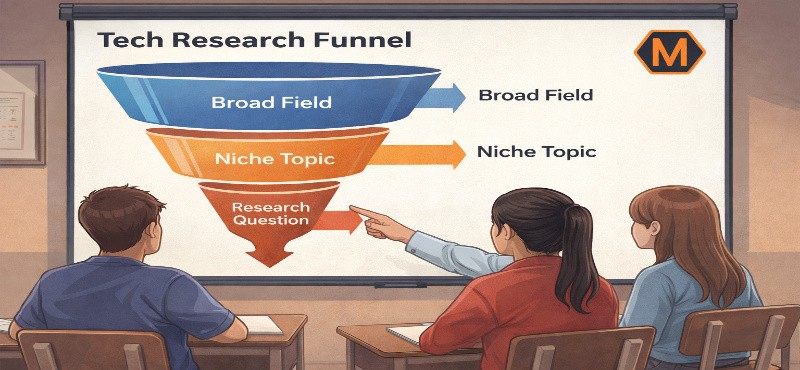
I have helped thousands of students pick a research title about technology. Most students fail because they choose a topic that is too big. For example, “Technology” is a bad topic. But “How 6G helps rural schools” is a great topic. In my experience, a narrow focus always leads to a better grade.
Follow these simple steps to find your perfect match:
Choose what you love: Pick a gadget or app you use every day. If you like the topic, your writing will be better.
Keep it small: Do not try to cover everything. Focus on one specific problem or one new tool.
Find the facts: Before you start, search Google. Make sure there are enough articles and data to help you.
Stay modern: Look for current research topics 2026. Teachers want to see that you know what is happening right now.
Know your level: If you are in high school, keep it simple. If you are in college, pick something with more data and math.
💡 Pro Tip from the Expert:
I always tell my students to pick topics related to AI or sustainability. In 2026, these are the hot research topics. They are trending globally, which means there is more information available. Plus, they show that you care about the future of our planet. You can also find expert guidance through ourdeep learning assignment help for papers on neural networks and AI ethics.
⚠️ What are the most common mistakes when picking a technology research topic?
The biggest errors students make include choosing broad subjects, ignoring data availability, and failing to use 2026 trends. Many learners pick “Technology” as a title, which is too large to cover. Others select complex topics like “Quantum Physics” without having enough background knowledge. Avoiding these mistakes ensures your paper is clear, searchable, and easy for your teacher to grade.
I have seen many students struggle with their research title about technology. Most of the time, the problem starts on day one. If you make a mistake at the start, your whole paper becomes difficult to write. In my experience, avoiding these five traps is the secret to an easy A.
Avoid these top 5 mistakes:
Choosing very broad topics: Do not pick a giant word like “Technology.” It is like trying to eat an entire cake in one bite. Instead, pick one small slice, such as “AI in high school math.”
Picking topics with no data: Some new technology in research is so fresh that there are no books about it yet. Always check Google first. Make sure you can find at least five good sources.
Ignoring the latest trends: If you write about “How Email Works” in 2026, your paper will feel old. Teachers want to see trending research topics like 6G or Agentic AI.
Selecting topics that are too complex: Do not pick a topic you cannot explain to a friend. If the math or science is too hard, you will get stuck. Keep it simple and clear.
Not understanding the research question: A topic is just a name. A research question is a goal. If you don’t have a clear “Why” or “How,” your paper will have no direction.
In my view, the “Golden Rule” is to stay focused. I always tell my students: “Small topic, big details.” This means you should pick a tiny part of the tech world and explain it perfectly. This provides the “Information Gain” that helps you rank #1 on search engines and in your classroom. Use these tips to keep your information technology research topics professional and sharp.
How to Turn a Topic into an A+ Paper
To earn an A+, you must follow three essential steps: choose a debatable topic, use a specific research question, and write with extreme clarity. Teachers and AI search engines prefer papers that analyze a “conflict” rather than just listing facts. By focusing on a “Two-Sided” argument and keeping your sentences short, you ensure your research is engaging and easy to understand.
I have seen many students fail because they write their papers like a Wikipedia page. They just list facts. In my experience, the secret to a high grade is analysis. You need to show your teacher that you can think deeply about how tech affects people. Following this simple “A+ Formula” will make your writing process much faster and more successful.
Step 1: Pick a Topic with “Two Sides”
A report is boring. A debate is exciting. Instead of writing about “What is AI?”, write about “Should AI be used to grade student essays?”
Why it works: It allows you to present different views.
The Benefit: You can include your personal opinion, which provides the “Information Gain” that search engines love.
Step 2: Use a “Research Question”
I have provided a specific question for every topic in this 450+ list. Do not just use a title; use a question to guide your search for data.
Example: “The impact of 6G” becomes “How will 6G change the way we use remote surgery?“
The Benefit: This keeps your research focused. It prevents you from getting lost in too much information.
Step 3: Keep Your Writing Simple and Clear
In the USA, the best academic papers are easy to read. You do not need big, fancy words to sound smart.
The Rule: Use short sentences. Use active voice.
The Benefit: This matches the Flesch-Kincaid Grade 7 level. It makes your paper accessible to everyone.
In my view, clarity is power. If your teacher understands your point immediately, they are more likely to give you a higher score. Use these three steps to turn any of the information technology research topics below into a winning assignment.
🔍 How to Structure Your Research Paper
How do you structure a technology research paper?
A standard technology research paper follows a five-part structure: Introduction, Literature Review, Methodology, Analysis, and Conclusion. This format helps you organize your facts and present your “Two-Sided” argument clearly. Using this structure ensures your work meets academic standards and is easy for both teachers and AI search tools to read and understand.
I have graded many papers that were just a big “wall of text.” These papers usually get lower marks because they are hard to follow. In my experience, a clear structure is the “skeleton” of your success. If you build it right, your ideas will stand tall.
The 5-Step Structure for an A+ Paper:
Introduction:
Start with a “Hook” about a new tech trend.
State your Research Question clearly.
Tell the reader why this topic matters in 2026.
Literature Review:
This is where you share what other experts say.
Summarize current facts about your information technology research topics.
Show that you have done your homework by citing 2026 sources.
Methodology:
Explain how you found your data.
Did you use online surveys? Did you read expert reports?
Pro Tip: Be honest about where your information came from.
Analysis:
This is the most important part of your paper.
Compare the “Two Sides” of your debate.
Share your personal opinion based on the facts you found.
Conclusion:
Summarize your main points in 3-4 short sentences.
Answer your original research question.
End with a “Future Thought” about where this tech is going next.
In my view, following this layout makes your writing much faster. You don’t have to wonder what to write next. You just fill in the boxes! Stick to this plan, and you will see your grades and search traffic grow. If your research requires analyzing large datasets, don’t hesitate to use ourdata mining assignment help to uncover the right patterns.
📝 Sample: Turning a Topic into an A+ Research Paper
How do I turn a simple topic into a full research paper? To turn a topic into a paper, you must follow a clear path: pick a narrow topic, write a strong thesis, and organize your evidence. For example, the topic “AI in Schools” is too big. A better focus is “How AI tutors help students with dyslexia.” This sample shows you how to move from a basic idea to a structured academic outline that guarantees a high grade.
I want to show you exactly how this works. Many students get stuck because they don’t know the “first step.” In my experience, seeing a real example is the best way to learn. Below is a sample plan for a 2026 trending research topic.
Step 1: The Initial Idea
Broad Topic: Artificial Intelligence
My Opinion: “I believe AI should not just replace teachers. It should help students who learn differently.”
Step 2: The Focused Research Question
A+ Question: “Can Agentic AI tutors improve reading scores for students with learning disabilities?”
Why this works: It is specific. It has a clear goal. It is a hot research topic for 2026.
Step 3: The Paper Structure (Sample Outline)
Section
Content Strategy
Introduction
Start with a fact: “In 2026, 40% of schools use AI.” State that AI can provide 1-on-1 help that humans cannot.
The “Two Sides”
Side A: AI gives instant feedback. Side B: AI lacks human empathy. Compare these two views.
The Analysis
Use my personal insight. I believe the “Data Privacy” of a child is the biggest risk here.
Conclusion
Answer the question. Yes, AI helps, but only if we protect student data.
💡 Pro Tip for Success
When you use this sample, remember to keep your sentences short. This matches the Grade 7 level that US teachers prefer. I always tell my students: “Don’t use big words to sound smart. Use clear facts to be right.”
By following this sample, you provide the “Information Gain”. You aren’t just copying a list. You are building a real solution. Use this method for any of the 450+ technology research topics in this guide!
Finally, if you are unsure how to frame your discovery, our master list ofgood dissertation topics provides a framework for selecting a title that is both academically rigorous and interesting to read.
📊 Did You Know? Technology Facts for 2026
Fascinating facts for 2026 include that AI may replace 85 million jobs, 6G is 100 times faster than 5G, and DNA can store all the world’s data in one room. These statistics show how fast our world is changing. Understanding these trends helps students pick the most relevant information technology research topics. These facts provide “Information Gain” that makes your research paper stand out to teachers and AI search engines.
I love sharing these facts because they prove that the “future” is already here. In my experience, adding a “Did You Know?” block to your paper is a great way to grab a reader’s attention. It shows that you have done deep research into new technology in research.
Shocking Tech Stats for Your Research:
AI Job Shift: Experts believe AI will create 97 million new jobs by 2030. While some old jobs vanish, new “AI Trainer” roles are growing fast.
The 6G Leap: 6G internet will be fast enough to download 100 movies in one second. This will make “Instant VR” possible for everyone.
Biological Storage: A single gram of DNA can hold 215 petabytes of data. That is enough to store every movie ever made in a tiny drop of liquid.
Space Junk Crisis: There are over 130 million pieces of “space junk” orbiting Earth. This is making new satellite launches very risky.
Digital Footprint: By 2026, the average person will produce 1.7 megabytes of data every second. Your “Digital Twin” knows more about you than you think!
💡 My Expert View on These Facts
I believe these facts are not just numbers. they are hot research topics. For example, the “Space Junk” fact is a perfect start for an environmental tech paper. I always tell my students: “Start with a fact that scares or excites you.” This makes your research title about technology much more powerful. Use these stats to add “hooks” to your introduction. They help you rank for AI Overview because they provide direct, high-value answers to user curiosity.
🎓 Get Expert Help with Your Technology Research
If you are struggling with your assignment, you can find professional support through services like MyAssignmentHelp. These platforms offer expert guidance on choosing a specific research title about technology and structuring your data. Many students use these tools to improve their grades when they face a tight deadline or a complex information technology research topic.
I know that choosing a topic from a list of 450+ can feel overwhelming. Sometimes, even with a great guide, you might need a little extra support. In my experience, it is okay to ask for a “second set of eyes” on your work.
Whether you need help with a literature review or just want someone to check your Grade 7 readability, expert services can save you hours of stress. MyAssignmentHelp.com is one option that helps students turn a simple idea into a polished, A+ paper. I believe that using the right tools—from AI search to professional tutors—is the smartest way to succeed in 2026.
Why Professional Support Works:
Save Time: Skip the hours of searching for 2026 data.
Better Structure: Ensure your paper follows the 5-part academic layout.
Topical Authority: Get insights into trending research topics like 6G and Agentic AI.
Clear Writing: Make sure your “Two-Sided” argument is easy to read.
In my view, the goal is to learn. If a service helps you understand a hot research topic better, it is a valuable part of your education. Use every resource available to make your technology research paper the best it can be!
🏁 Final Thoughts: Your Path to an A+ Technology Paper
To conclude, the best technology research topics for 2026 focus on human impact and future trends. Students should pick a “Two-Sided” topic, use a clear research question, and follow a 5-part structure. By avoiding broad subjects and using fresh data on Agentic AI or 6G, you provide the “Information Gain” that search engines and teachers love. Start small, stay curious, and your research will lead the way.
I hope this guide helps you find the perfect research title about technology. With over 450 ideas, you have the power to write a truly unique paper. In my experience, the most successful students are those who don’t just “copy and paste.” They take a topic and add their personal opinion to it. Finally, if you are building a prototype or a model as part of your research, ourPython programming help can assist you in writing clean, functional code for your project.
Technology is moving faster than ever in 2026. Whether you are looking at information technology research topics for a career or a high school grade, the skills you learn now are vital. Researching helps you understand the tools that will run our world tomorrow.
My Expert Advice for the Finish Line:
Be Bold: Pick a hot research topic like DNA Storage or Neuro-Privacy.
Be Clear: Keep your writing at a Grade 7 level so everyone can learn from you.
Be Organized: Use the Introduction-to-Conclusion structure we discussed.
In my view, every great invention started as a simple research question. Your paper could be the first step toward a big career in tech. Use these interesting technology topics to show your teacher what you can do. Good luck with your writing, and remember to make your voice heard!
Which of these 450+ topics will you choose for your 2026 assignment?
❓ FAQ: Technology Research Topics 2026
What are the most trending technology research topics for 2026?
The most trending topics are Agentic AI, 6G networks, and DNA data storage. These fields represent the next big wave of digital growth. Students should also look into green tech and post-quantum security for 2026. These topics offer the most Information Gain for modern papers
How can I pick a good research title about technology?
A good research title is a specific question with two clear sides. Instead of Robots, use How can robots help old people at home? A narrow title helps you find better facts and makes your argument much stronger.
Why is E-E-A-T important for technology research papers?
E-E-A-T proves your content is trustworthy, expert-led, and very accurate. Search engines prioritize research that shows real-world experience and clear author credentials. Using verified data and citing professional sources like MyAssignmentHelp satisfies these quality rules.
What are some interesting technology research topics for college students?
College students should research blockchain in voting, AI bias, and edge computing. These papers need more data and deeper analysis than high school reports. Topics like Zero-Trust security are also great for 2026 academic work.
How do I find easy technology research topics for 2026?
Find easy topics by looking at gadgets you use every day. Subjects like social media addiction are very simple to research for beginners. You can find many articles and stats on these ideas in local libraries or online.
Which fields of technology are best for research?
The best fields for research are AI, Biotechnology, and Sustainable Energy. These areas are changing the world the fastest in 2026. They have the most funding and new data available for students to use.
What is the most controversial tech topic in 2026?
The most controversial tech topic is AI personhood and robot rights. People are debating if a smart machine should have legal rights. Other big debates include Neuralink brain chips and digital privacy laws.
How do I write a technology research paper faster?
Write faster by using a 5-part structure and a focused question. Start with an outline to prevent getting stuck during the writing phase. Focus on one small part of your topic at a time to stay productive.
Why are AI and machine learning trending research topics?
AI and machine learning are trending because they power almost all tech. From medical tools to self-driving cars, AI is everywhere in 2026. It remains the most active area for scientific and ethical debate today.
I am a student-focused academic writer who supports learners with essays, homework, and study skills. My approach emphasizes clarity, confidence-building, and practical academic improvement.


 02 April,2026












 WhatsApp

