I truly believe that in 2026, sports will have moved far beyond the scoreboard. We’re living in an era where biometric AI and the NIL legal revolution have turned every athlete into a walking startup. However, I recognize a major pain point for students across the US: topic paralysis.
It’s that sinking feeling of wanting to impress your professor while realizing the ‘standard’ sports topics—like the history of the Super Bowl—have been done to death. You don’t just need a topic; you need an edge to cut through the noise of a crowded classroom. Rather than searching for someone to do my assignment or help with the heavy lifting, you can use the themes like ‘sports research paper topics‘ and I’ve identified below that hit the sweet spot of innovation and engagement.
Sometimes, the hardest part is translating these complex tech-legal shifts into a cohesive 5-minute script. If you’re feeling the pressure, seeking professional speech writing service to refine your thesis or structure your arguments can be the difference between a mid-range grade and a standing ovation. Let’s turn that academic anxiety into a championship-level presentation.
What is an Informative Speech about Sports?
An informative speech about sports is an academic presentation designed to educate an audience on a specific athletic subject without attempting to persuade them to take a side. Unlike persuasive speeches, the goal here is to provide a comprehensive, data-driven overview of a sports-related phenomenon, such as biomechanics, the history of the Olympic Games, or the economic impact of the 2026 FIFA World Cup. If you are struggling with broader academic requirements, you can also explore various communication research topics to find a related angle.
How to Choose a Sports Topic that Captivates Your Audience?
To navigate the athletic landscape of 2026, I don’t just look at what works—I look at what is predictive. Here is how I balance timeless grit with 2026’s tech-heavy reality to choose a winning topic:
Assess Audience Interest: High schoolers might care more about “The Rise of eSports,” while a college seminar may prefer “The Geopolitics of International Sports Hosting.” Check out these engaging debate topics for more inspiration on what captures interest.
Verify Data Availability: Ensure there is enough peer-reviewed research or credible journalism to support your claims. For more academic ideas, look at these detailed sports research topics.
Identify the “New Angle”: Instead of a general history of baseball, focus on “How Sabermetrics and AI Changed MLB Scouting in the 2020s.”
Check for Visual Potential: Choose a topic that allows for engaging slides. If you need help creating them, consider PowerPoint presentation services.
Core Principles: The 5 Pillars of a Great Sports Speech
To align with the highest academic standards, your speech should be built on these five functional pillars:
Objective Accuracy: Presenting facts based on expert consensus.
Clarity of Concept: Breaking down complex terms like “VO2 Max” or “Salary Caps.”
Relevance: Connecting the topic to current 2026 events.
Structured Narrative: A clear Introduction, Body, and Conclusion. Learning how to write an outline is essential for this.
Ethical Consideration: Addressing the human element, such as an athlete’s mental health or fair play.
Top 5 Sports Trends for 2026
The sports landscape in 2026 is no longer just about the game on the field; it is a sophisticated intersection of advanced technology, evolving athlete rights, and radical environmental responsibility. As we look at the year ahead, these five trends are redefining the industry for athletes, fans, and executives alike.
1. Biometric AI in Injury Prevention
The “best ability is availability,” and in 2026, AI is ensuring athletes stay on the pitch longer. Teams are now utilizing Digital Twins—virtual replicas of athletes powered by real-time biometric data. By analyzing workload, sleep quality, and mechanical stress, AI agents can predict potential soft-tissue injuries before they happen, allowing coaches to adjust training loads with surgical precision. This shift moves sports medicine from reactive treatment to proactive preservation.
2. The NIL Economy’s Impact on College Sports
The Name, Image, and Likeness (NIL) era has matured into a full-scale NIL Economy. In 2026, top college rosters are valued at over $20 million, with athletes functioning as independent brands. The focus has shifted toward financial literacy and long-term equity, as “revenue sharing” becomes a standardized reality in Division I athletics. This trend is effectively blurring the line between collegiate and professional sports management.
3. eSports as an Olympic Discipline
After years of debate, 2026 marks a pivotal “pause and reflect” period for the Olympic Esports Games. While structural tensions between private game publishers and the IOC persist, the inclusion of titles like League of Legends in regional games (like the CAC Games) proves that the digital-physical divide is closing. The focus is now on creating a sustainable “Future Readiness” framework that aligns gaming with Olympic ethics.
4. Mental Health Ethics in Professional Leagues
Mental health has moved from a “hot topic” to a core institutional mandate. In 2026, professional leagues are implementing Ecological Frameworks that address mental well-being at the micro (athlete), meso (team), and macro (organizational) levels. The conversation has shifted toward the ethics of data: ensuring that biometric and psychological tracking isn’t used against players in contract negotiations, but rather as a tool for holistic support.
5. Sustainable Stadium Architecture
The 2026 sports venue is a “living” structure. Modern architecture now prioritizes Adaptive Reuse—renovating existing structures rather than building new ones to cut carbon footprints. New builds feature “breathable” façades and AI-managed energy systems that reduce cooling costs by up to 35%. Stadiums are no longer just event spaces; they are carbon-neutral anchors of urban sustainability.
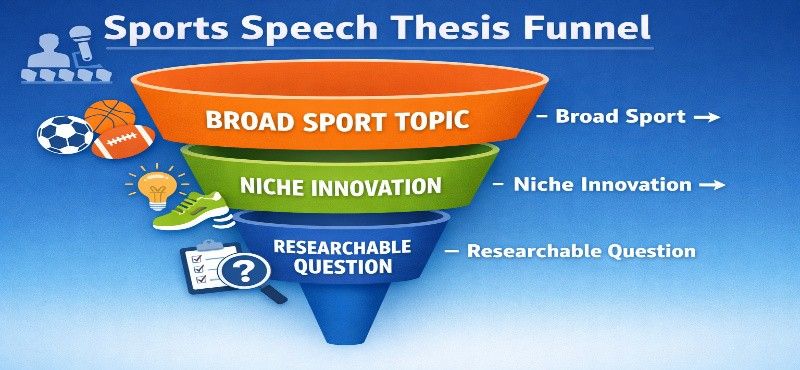
The Winning Strategy: Using the Thesis Funnel
To deliver a sports speech that actually sticks, you need more than just “passion.” You need a hook that doesn’t get lost in the stadium noise. Think of your thesis as a funnel: you start with the massive world of athletics and narrow it down until you’ve found a sharp, debatable point.
Here is how you build a “Sports Speech Thesis Funnel” to keep your audience from checking their phones.
Phase 1: Broad Sport (The Foundation)
Every great speech starts with a relatable foundation. This is where you pick your “playing field.” Whether it’s the global reach of soccer or the high-stakes world of Formula 1, your goal here is to establish the context.
Example: “Modern Professional Basketball.”
Phase 2: Niche Innovation (The Pivot)
Now, tighten the focus. You can’t talk about everything in one go, so you need to identify a specific disruption or innovation within that sport. This could be a technological advancement, a shift in player psychology, or a change in how the game is managed. This is where you move from “general interest” to “expert insight.”
Example: “The rise of 3-point shooting and ‘positionless’ basketball.”
Phase 3: Researchable Question (The Hook)
This is the “bottom of the funnel” and the heart of your speech. Turn your niche into a specific, researchable question that challenges the status quo. A good thesis isn’t a fact; it’s an argument that requires evidence to prove.
The Final Thesis Question: “Has the NBA’s obsession with 3-point efficiency prioritized statistical optimization at the expense of traditional mid-range artistry and defensive variety?”
The Intersection of Science and Sport: Biomechanics & Tech
In 2026, the “Comparative Analysis” of technology versus tradition is a top-tier informative angle. For instance, analyzing a specific brand’s strategy, like an Adidas case study SWOT analysis, can provide a professional business perspective.
Feature
Traditional Training (Pre-2020)
AI-Driven Training (2026 Standard)
Data Collection
Manual stopwatch and coaching notes.
Wearable tech, IoT sensors, and Neuralink-lite feedback.
Recovery
Standard rest and basic physiotherapy.
Cryotherapy and AI-predicted injury prevention models.
Strategy
Game film review and intuition.
Real-time predictive modeling and “Digital Twin” simulations.
Performance
Focus on physical grit.
Optimization of Sports Psychology and neuro-efficiency.
The economic impact of the 2026 FIFA World Cup on North American infrastructure.
How NIL rights transformed the NCAA from amateurism to a professional model.
The emergence of “Green Stadiums”: Sustainability in modern NFL arenas.
eSports in the Olympics: The journey to official recognition.
The role of AI officiating: Will human referees become obsolete?
The rise of the WNBA: Factors behind the 2024–2026 viewership explosion.
Virtual Reality (VR) fan experiences: Watching games from the “best seat” at home.
The “Saudi Pro League” effect: How massive investment shifted global soccer power.
Smart Fabrics: How jerseys now track player vitals in real-time.
The ethics of “Neuro-priming” in professional training.
2. Science, Health, and Biomechanics
The physics of a curveball: How aerodynamics dictates the game.
Concussion protocols: The evolution of brain safety in the NFL.
The science of hydration: Beyond the history of Gatorade.
How CRISPR and genetic mapping could theoretically impact “super-athletes.”
The psychology of “The Clutch”: What happens to the brain under pressure?
Fast-twitch vs. slow-twitch muscle fibres: The biology of sprinting.
The evolution of prosthetic technology in the Paralympic Movement.
Nutrition for elite performance: The shift toward plant-based diets in the NBA.
Sleep hygiene and its direct correlation to athletic recovery.
The biomechanics of the “Perfect Swish” in basketball.
3. Sports Business and Management
The “Moneyball” legacy: How data analytics runs the front office.
How sports betting integration changed the fan experience and league revenue.
The history and future of the Super Bowl Halftime Show as a marketing tool.
Dynamic Ticket Pricing: The math behind why your seat costs more today.
The rise of athlete-owned media companies.
Sports as a tool for “Soft Power” in international diplomacy.
The collapse of Regional Sports Networks (RSNs) and the move to streaming.
Managing a “Salary Cap”: The complex accounting of the NFL.
The impact of Title IX on the commercialization of women’s sports.
How Formula 1 used Drive to Survive to conquer the US market.
4. Historical Milestones & Legends
The 1936 Berlin Olympics: Sports as a political stage.
Jackie Robinson and the integration of Major League Baseball.
The “Miracle on Ice”: More than just a hockey game.
The history of the International Olympic Committee (IOC).
How the 1972 Munich Massacre changed sports security forever.
The origin of the Tour de France.
Jesse Owens: Defying myths through athletic excellence.
The evolution of the FIFA World Cup trophy and tournament format.
The history of the Negro Leagues and their eventual recognition by MLB.
Billie Jean King and the “Battle of the Sexes.”
5. Social Impact and Diversity
The role of sports in the Civil Rights Movement.
Transgender athletes in elite competition: The current scientific consensus.
The growth of the Special Olympics and its impact on social inclusion.
Sports as a vehicle for community development in urban areas.
The “Rooney Rule”: Successes and failures in coaching diversity.
How the 2023–2026 expansion of the WNBA impacted gender pay gap discussions.
Native American mascots: The history of the name-change movement.
Athlete activism: From Muhammad Ali to the modern era.
The impact of sports on mental health awareness.
Breaking barriers: The first female coaches in the NFL and NBA.
This is a comprehensive expansion of your sports landscape, categorized to match your existing structure while adding 150 new, forward-looking, and historically significant topics.
Trending Topics: The 2026 Landscape (Modern & Future)
Direct-to-Consumer (DTC) Revolution: Why leagues are ditching cable for their own streaming apps.
Private Equity in College Sports: The impact of billion-dollar injections into the ACC and Big Ten.
The “Kings League” Phenomenon: How creator-led sports (Pique, Ibai) are stealing Gen Z viewership.
Stadiums as 365-Day Districts: The shift from venues to “live-work-play” commercial hubs.
Micro-Betting in Real-Time: The ethics of betting on every single pitch or free throw.
The Rise of Cricket in the USA: Analyzing the success of Major League Cricket (MLC).
Gamified Broadcasting: Watching games through “Nickelodeon-style” AR filters for kids.
The “Post-Messi” MLS: Assessing the long-term footprint of the 2023–2025 Miami era.
Subscription-Based Fandom: Premium “Inner Circle” memberships for exclusive athlete access.
The Decline of the Traditional RSN: What happens to local fans when regional networks go dark?
Athlete-Owned Investment Funds: Why stars are becoming VCs before they retire.
The “Caitlin Clark” Effect: A case study in individual brand power vs. league marketing.
Digital Collectibles 2.0: How NFTs evolved into functional “Utility Passes” for fans.
In-Stadium 5G/6G Latency: How instant connectivity changes the live fan experience.
The Ethics of Fan Token Governance: Should fans vote on jersey designs or roster moves?
Carbon-Neutral Team Travel: The logistics of “Green Charters” in pro leagues.
The Surge of Flag Football: Its journey to the 2028 Olympic stage.
AI-Generated Commentary: Localization of broadcasts into 50+ languages in real-time.
Smart Balls: The impact of embedded chips on officiating in the 2026 World Cup.
Vertical Video Sports: Why leagues are filming games specifically for TikTok/Reels formats.
The “Baller League” Model: How 3-on-3 and 7-on-7 formats are challenging traditional durations.
Stadium Agriculture: Using arena rooftops for local food production.
The Rise of Hybrid Events: Blending physical racing with digital “sim” components.
Neuro-Marketing in Sports: How teams use brain-tracking to design merchandise and ads.
The Evolution of the “Super-App”: One app for tickets, betting, food, and replays.
Decentralized Sports Leagues: Could a DAO (Decentralized Autonomous Organization) own a pro team?
The Future of Sports News: AI-written recaps vs. the decline of traditional beat reporting.
Crowd-Sourced Scouting: Fans using apps to “tag” prospects for pro teams.
The “Netflix-ification” of Sports Documentary: Why every niche sport now has a docuseries.
Holographic Fan Attendance: Bringing “virtual fans” into the stadium from across the globe.
2. Science, Health, and Biomechanics
The Gut-Brain Axis in Athletics: How microbiome health affects performance under pressure.
Biological Age vs. Chronological Age: Why “aging” stars like LeBron James stay elite.
The Biomechanics of ACL Injury: Why female athletes are at higher risk (and the 2026 solutions).
Blue Light and Performance: Managing digital eye strain in professional eSports.
The Evolution of “Super Shoes”: The physics of carbon-plated running footwear.
Smart Mouthguards: Real-time monitoring of sub-concussive G-force impacts.
Cold Thermogenesis: The science of ice baths vs. cryotherapy chambers.
Genetic Screening for Injury Prone-ness: Should teams see your DNA before signing you?
The “Flow State”: Neurological triggers of “the zone” in high-stakes competition.
Vagus Nerve Stimulation: Using electronics to lower heart rates during high-pressure moments.
Padel vs. Tennis: Biomechanical differences in repetitive motion injuries.
The Physics of the “3-Point Revolution”: Optimizing launch angles for maximum efficiency.
The Impact of Extreme Heat: How the 2026 World Cup will manage 40°C temperatures.
Overtraining Syndrome (OTS): The biomarkers of burnout in youth sports.
Prosthetic Symmetry: Balancing technology and human effort in blade running.
Cognitive Drills: Training the brain to “see” the field 0.5 seconds faster.
The Science of Stretching: Static vs. Dynamic—what does the 2026 data say?
High-Altitude Training 2.0: Portable hypoxic chambers and their effect on red blood cells.
The Biomechanics of the Golf Swing: Using AI to prevent lower back degeneration.
Caffeine as a Ergogenic Aid: The fine line between “supplement” and “performance enhancer.”
Sleep Staging for Recovery: How deep sleep impacts muscle protein synthesis.
The “Yips” in Sports: A neurological look at the sudden loss of motor skills.
Hydration Bio-Sensors: Skin patches that signal exactly when you need electrolytes.
The Physics of Swimming Tech: Why “sharkskin” suits were banned and what replaced them.
Neuro-Plasticity in Rehabilitation: Re-wiring the brain to trust a repaired limb.
Breathwork and CO2 Tolerance: The secret weapon of elite endurance athletes.
The Impact of Micro-plastics on Athletes: Emerging research on synthetic turf health.
Bone Density in Non-Impact Sports: The unique health challenges of pro cyclists.
Virtual Reality Physical Therapy: Making “boring” rehab exercises gamified and effective.
3. Sports Business and Management
The Death of the “Off-Season”: The business of year-round fan engagement.
Dynamic Broadcast Pricing: Paying less to watch only the 4th quarter of a game.
The Rise of “Sports-Washing”: Analyzing the ethics of nation-state ownership.
Supply Chain Logistics of Global Tours: Moving F1 or the NFL across continents.
The Return on Investment (ROI) of Jersey Patches: Does the math actually work?
Crisis Management in the Social Media Age: How PR teams handle “viral” athlete scandals.
The Business of Youth “Travel Sports”: The $20 billion industry of elite kids’ leagues.
Naming Rights 3.0: From stadiums to “Official Training Partners” and “Official Sleep Partners.”
Tax Implications of the “Jock Tax”: How athletes pay taxes in every city they play in.
The Collapse of Traditional Golf: Managing the PGA vs. LIV commercial divide.
Inclusive Stadium Design: The business case for sensory-friendly rooms and accessibility.
Secondary Market Ticket Ethics: The battle between Ticketmaster and “The Bots.”
The Rise of the “General Manager-AI”: Using algorithms to predict trade value.
Sports Tourism: How mid-sized cities are using tournaments to drive GDP.
The Ethics of Betting Partnerships: Should leagues own shares in gambling companies?
Labor Strikes and Lockouts: The history of collective bargaining in pro sports.
The Business of the Olympics: Why cities are now fighting not to host.
Merchandise Sustainability: The shift toward recycled polyester in fan gear.
Celebrity Owners: The “Ryan Reynolds/Wrexham” effect on lower-tier clubs.
The Luxury Tax: How the NBA and MLB punish (and reward) big spenders.
Franchise Relocation: Why teams leave their “home” (The Oakland/Vegas Case).
The “Long Tail” of Sports: Monetizing niche sports (cornhole, darts, pickleball) via streaming.
Agent Influence: The power of “Super-Agents” (like Klutch Sports) on league parity.
Brand Endorsement Clauses: The “Morality Clause” in the age of cancel culture.
College Coaching Salaries: Is a $100M contract sustainable for a university?
The Business of Stadium Food: From $20 hot dogs to Michelin-star dining.
In-Game Micro-transactions: Paying for “real-time” data stats or alternative camera angles.
The Growth of the African Basketball League (BAL): The NBA’s first major venture abroad.
Sports Philanthropy: Does athlete charity work actually drive brand value?
The History of the Trading Card Market: From the T206 Wagner to the $7M Mickey Mantle.
4. Historical Milestones & Legends
The 1968 “Black Power” Salute: The iconic protest of Tommie Smith and John Carlos.
The Death of Ayrton Senna: How one tragedy revolutionized F1 safety.
The 1980 “Boycott” Olympics: When politics pulled the US out of Moscow.
The Rise and Fall of the ABA: The league that gave us the 3-pointer and the slam dunk.
The “Ping Pong Diplomacy”: How table tennis opened the US-China relationship.
The Munich 1972 Basketball Final: The most controversial 3 seconds in sports history.
The T20 Revolution: How a shorter format saved the sport of Cricket.
The Legend of Jim Thorpe: Reclaiming the legacy of the “World’s Greatest Athlete.”
The Heisman Trophy: Its origin and evolution as a cultural icon.
The 1992 Dream Team: How the NBA colonized the global basketball market.
The Bosman Ruling: The court case that gave soccer players “Free Agency.”
The 1924 Chamonix Games: The birth of the Winter Olympics.
The “Rumble in the Jungle”: Muhammad Ali, George Foreman, and Zaire.
The History of the Marathon: From the legend of Pheidippides to the 2-hour barrier.
The 1999 Women’s World Cup: The “99ers” and the explosion of US women’s soccer.
The Origin of the “Yellow Jersey”: Why the Tour de France leader wears yellow.
The Great Baseball Strike of 1994: The year without a World Series.
The First Modern Olympic Games (1896): Reviving the spirit of Athens.
The “Bodyline” Series: When cricket almost caused a diplomatic rift.
The Dawn of the X Games: How “alternative” sports became mainstream.
The History of the Stanley Cup: From a $50 punch bowl to the most famous trophy.
The “Tuck Rule” Game: How a snowy night birthed the Brady/Belichick dynasty.
The Munich Air Disaster: The tragedy that defined Manchester United.
The Rise of Tiger Woods: How one golfer changed the demographics of the sport.
The First Televised Sporting Event: The 1936 Berlin Olympics via “closed circuit.”
The Legend of Pelé: The man who made soccer “The Beautiful Game.”
The 1966 World Cup Final: “Did the ball cross the line?”—Soccer’s oldest debate.
The History of the Ironman Triathlon: From a barroom bet to a global brand.
The Integration of the NFL: The “forgotten” story of Kenny Washington and Woody Strode.
The 1954 “Miracle of Bern”: How a soccer match helped rebuild a nation’s identity.
5. Social Impact and Diversity
The “Disability Divide”: Bridging the gap between the Olympics and Paralympics.
LGBTQ+ Representation in Men’s Pro Sports: Why are there so few active “out” players?
Sports as Refugee Integration: How soccer clubs help displaced people find community.
The “Pink-Washing” Debate: Evaluating breast cancer awareness campaigns in sports.
Body Positivity in Athletics: Challenging the “ideal” athlete physique.
The Role of Sports in South African Apartheid: The International Boycott.
Religious Inclusion in Sports: The battle for hijabs and religious headwear in competition.
Climate Justice and Sports: Why low-income communities lose parks first.
The Gender Pay Gap in Coaching: Why male coaches of women’s teams often earn more.
Mental Health vs. “Grind Culture”: The impact of Simone Biles and Naomi Osaka.
Sports for Development: Using basketball to reduce gang violence in urban centres.
The “Digital Divide”: How the cost of streaming creates a barrier for low-income fans.
Neurodiversity in Sports: Coaching athletes with Autism or ADHD.
The History of Women’s Boxing: From “illegal” to Olympic headliner.
Sports and Language Preservation: The use of indigenous languages in sports broadcasts.
Anti-Doping and Fair Play: Is the WADA system inherently biased?
The Impact of Fatherhood on Pro Athletes: Changing the “absentee” stereotype.
Sports Infrastructure as Gentrification: When new stadiums push out locals.
The Rise of Blind Football (5-a-side): Engineering sound-based sports.
Athlete Literacy Programs: Using the power of stars to drive education.
The “Glass Ceiling” for Front Office Executives: Diversity in the C-suite.
Sustainability in “Fast Fashion” Team Gear: The environmental cost of a $150 jersey.
Sports and Post-War Reconciliation: The “Balkans Cup” as a tool for peace.
The Ethics of “Naturizing” Athletes: Changing citizenship to play for a different country.
Cyberbullying in Sports: The mental toll of “social media vitriol” on young stars.
The Growth of “HBCU” Sports Brands: The commercial resurgence of historically Black colleges.
Water Scarcity and Golf: The ethics of desert courses in 2026.
The “Second Career” Problem: Why 60% of pro athletes go broke (and the solutions).
Women in Sports Media: Breaking the “sideline reporter” stereotype into lead commentary.
The Future of the “National Anthem” in Sports: Tradition vs. Platform for Protest.
Expert Consensus: Why Sports Communication is a Rising Academic Discipline
By 2026, Sports Communication will have moved from a simple elective to a vital field of study. Top universities now see it as a key mix of business, sociology, and health. To succeed, students must learn how to turn hard data into stories that everyone can understand.
A great example is soccer’s Expected Goals (xG). This stat uses math to show how likely a shot is to score based on distance and angle. Instead of just showing numbers, a good speaker explains what the data means for the game.
Why This Skill Matters Today
In the current job market, being able to explain complex ideas is a “soft skill” that employers love. This is true for many different career paths:
Media: Building better stories for fans.
Marketing: Using stats to sell a brand.
Data Analysis: Making tech data clear for bosses.
By mastering this, you show you can handle both logic and human emotion. This makes you a much stronger candidate in fields like marketing and news.
Final Thoughts: From Data to Delivery
In 2026, a great sports speech is defined by its ability to bridge the gap between athletic grit and technical innovation. Whether you are discussing the microscopic details of biomechanics or the macro-economic shifts of the FIFA World Cup, your goal is to provide clarity in a world of complex data.
Remember, your audience doesn’t just want a list of stats; they want to understand the human story behind the algorithm. The best presentations are those that use the “New Angle” approach—taking a familiar sport and showing it through a lens the audience has never seen before, such as neuro-athletics or green stadium infrastructure.
Navigating the transition from a great idea to a polished, “A-grade” presentation can be a daunting task. This is where MyAssignmentHelp steps in as your academic head coach. We specialize in helping students overcome “topic paralysis” and the stress of research marathons through:
Custom Thesis Development: We don’t just give you a topic; we help you craft a unique, debatable, and researchable thesis statement that captures your professor’s attention.
Data-Driven Research: Our experts have access to peer-reviewed journals and 2026 industry reports to ensure your speech is backed by objective accuracy and the latest statistics.
Structural Refinement: We apply the PEEL method (Point, Evidence, Explanation, Link) to ensure your speech flows logically and fits perfectly within your 5-to-7-minute time limit.
Visual Aid Integration: We can help you design the “biomechanical heat maps” or “economic charts” mentioned in this guide, ensuring your presentation has the high-level visual potential required for a standing ovation.
FAQ for Sports Speeches
Q: What is the most popular sports speech topic for college students in 2026?
A: Currently, the impact of NIL (Name, Image, Likeness) on college athletes’ mental health and academic performance is the most researched and presented topic.
Q: What are some good persuasive sports topics that aren’t overdone?
A: Skip the tired “should college athletes be paid” debate. Instead, look at the ethics of genetic editing in sports (gene doping), whether public taxes should be used to fund private professional stadiums, or how rising climate unpredictability is forcing a complete overhaul of winter sporting schedules.
Q: How do I make a technical sports topic interesting to a non-athletic audience?
A: Connect the technical to the relatable. If you are breaking down advanced analytics or biomechanics, use human-interest hooks. For example, frame a speech on wearable tracking technology around how it is actively preventing career-ending injuries rather than just showing data points.
Q: Are there any “trap” topics I should avoid in a college public speaking class?
A: Be wary of picking pure fan debates like “Who is the GOAT: LeBron or Jordan?” These often turn into biased rants. Unless you are analyzing the marketing machinery or psychological impact behind their legacies, keep the focus on a researchable thesis.
Q: Can I use props or visual aids in a sports speech?
A: Absolutely! For a 2026 collegiate or competitive speech, visual aids are standard. Bringing in specialized gear to show a safety flaw or using digital slides for data can boost your engagement scores. Just make sure the prop helps your explanation and does not distract the audience.
Q: How long should an informative sports speech be?
A: Most academic standards require 5 to 7 minutes. You should also support your claims with at least 3 to 5 credible sources.
Q: Can I talk about eSports in a traditional sports speech?
A: Yes. In 2026, eSports is widely accepted as a legitimate discipline. You can focus on the biomechanics of reaction time or the economics of global streaming.
Q: How do I choose a sports speech topic that isn’t boring?
To find a compelling sports speech topic, look beyond stats. Focus on untold human stories, ethical dilemmas (like AI in officiating), or psychological resilience. Avoid “How to Play” clichés; instead, argue a controversial take or explore a sport’s cultural impact. Relatable, high-stakes narratives always keep an audience engaged.
Q: What are the best informative sports topics for college students?
College students appreciate topics blending athletics with modern complexity. Consider the evolution of NIL (Name, Image, Likeness) rights, the impact of data analytics on strategy, or mental health advocacy in elite sports. Alternatively, explore the sustainability of mega-events like the Olympics or the rise of professional eSports.
Q: How many sources do I need for a 5-minute sports speech?
You generally need 3 to 5 credible sources for a 5-minute speech. This provides enough variety to build authority without overwhelming your narrow timeframe. Aim for a mix, such as a peer-reviewed study on sports science, a reputable news article, and expert testimony or statistical data from official leagues.
I am a programming and systems expert with practical technical experience. I deliver accurate, application-focused academic support for programming, databases, and IT-related assignments.


 04 April,2026












 WhatsApp

