


 10 June,2026

Table of Contents
When I first stood in your shoes, staring down my very first collegiate business term paper assignment, I felt completely overwhelmed. I remember staring at a blank document, wondering how I was supposed to transform raw corporate statistics, financial statements, and abstract management theories into a cohesive, high-scoring study.
If you are a university undergraduate navigating your program’s rigorous research rubrics, or an advanced student preparing for graduate-level empirical coursework, I want to assure you that you are not alone.
Writing an authoritative business paper does not have to be an exhausting chore. I have built this comprehensive guide to act as your strategic roadmap, taking you through the key 6 steps to write your first business research paper from an empty screen to a polished, publishable final draft.
An academic business research paper is a formal piece of empirical writing that requires a researcher to systematically investigate a specific corporate problem, industry trend, or organizational phenomenon using verified data and established economic frameworks.
When you work on a research paper about business, you are doing much more than sharing personal opinions or writing marketing dissertation questions. Instead, you are acting as an objective analyst collecting qualitative or quantitative evidence to test a hypothesis, evaluate market dynamics, and defend a centralized, data-driven thesis statement.
Defining your own family life style is the first step toward reducing student burnout.
If your research paper focuses on brand identity mechanics or corporate equity development, exploring the role of a trademark in business will provide crucial strategic value to your thesis.
I often see college students lose critical grading points because they mistake an academic assignment for an operational summary.
\This confusion can also affect students who use business management dissertation examples as research references. While business papers and business reports may cover similar topics, they serve different purposes in both academic and professional settings.
To ensure you secure top marks and avoid formatting penalties on your next college assignment, I have mapped out their core structural and contextual differences in the side-by-side comparison below:
| Feature | Academic Business Research Paper | Professional Business Research Report |
|---|---|---|
| Primary Audience | Faculty panels, academic scholars, and departmental reviewers. | Corporate executives, team managers, investors, or company stakeholders. |
| Core Objective | To expand academic theory, fill research gaps, and demonstrate rigorous conceptual knowledge. | To solve an immediate operational problem and provide practical, real-world action items. |
| Tone & Style | Analytical, deeply theoretical, and heavily reliant on peer-reviewed citations. | Action-oriented, direct, highly concise, and focused on immediate operational metrics. |
| Key Components | Abstract, formal literature review, methodology chapter, theoretical framework. | Executive summaries, key performance indicators (KPIs), structural implementation plans. |
| Data Sources | Peer-reviewed journals, historical textbooks, and controlled case research. | Internal financial ledgers, real-time market surveys, industry benchmarks, and CRM data. |
You might find yourself asking: “Why do my instructors keep assigning these rigorous empirical studies in the first place?” The truth is, understanding the importance of business research essay assignments goes far beyond earning a high GPA.
When you master the art of investigating academic management challenges or seeking professional business development assignment help, you are building the exact data-literacy skills that top-tier companies look for when hiring new grads.
When I analyze complex corporate situations for class assignments, I am practicing how to:
While shorter essays allow you to write spontaneously, writing an introduction to a dissertation requires a systematic, inverse pyramid structure that starts with broad contextual data.
If your structural layout is disorganized, even the most brilliant analytical insights will get lost. When I format a corporate or academic assignment, knowing the structural foundations of how to write a term paper ensures my layout satisfies the exact style sheet required by the university’s rubric.
In the United States, the vast majority of business schools require you to use the APA 7th Edition style guide, though some advanced economics or international commerce courses may ask for the Chicago Manual of Style (CMS) or Harvard formatting.
For a standard university level presentation, your business research paper format for students should follow this exact sequence:
Learning how to write an outline as a preliminary framework for your research paper is essential to organize your source arguments, group key metrics, and map out the logical progression of your thesis before drafting.
I use a preliminary outline to arrange my initial thoughts and catalog my data points before writing the actual draft. Building this early skeleton prevents you from getting writer’s block because it ensures you always know what paragraph comes next.
To make things easy for you, I have put together a foundational business research paper outline that you can copy and adapt for almost any collegiate business assignment.
This structure works well for many business topics, including case studies, market research projects, and analyses such as an Amazon PESTEL Analysis. It provides a clear framework for organizing information and presenting your findings logically.
Here is how you should distribute your content, along with a formal outline example for research paper submissions:
| Section | Target Word Count % | Core Editorial Objective |
|---|---|---|
| Introduction | 10% – 15% | Introduce your target company or industry problem, state your main thesis, and establish your paper’s scope. |
| Literature Review | 20% – 25% | Analyze past academic papers on your topic. Identify gaps in their research that your paper will fill. |
| Methodology | 10% – 15% | Explain exactly how you conducted your research so that another student could replicate your steps. |
| Results & Analysis | 25% – 30% | Break down your data, charts, or case study findings objectively. This is the meat of your paper. |
| Discussion & CTAs | 15% | Interpret what your results mean for real-world business owners and managers. Provide strategic advice. |
| Conclusion | 5% – 10% | Restate your thesis in a new light, summarize your main points, and leave the reader with a final thought. |
Writing a high-scoring business assignment is much easier when you break it down into manageable steps. Whenever I tackle a new project, I follow the traditional 6 stages of business research process workflow. This structured methodology keeps me organized and saves me hours of wasted effort.
For instance, if you are analyzing a global brand using a framework like a PESTLE Nike case study, applying this systematic workflow ensures you cover everything from political shifts to environmental impacts without getting overwhelmed.
Moving from brief essays to massive final papers requires a huge shift in your research strategy. Moving forward, selecting defined research topics for HR dissertations gives you a solid foundation for deeper data analysis.
Stage 1: Topic & Proposal ➔ Stage 2: Introduction ➔ Stage 3: Lit Review (Ch. 2) ➔ Stage 4: Methodology ➔ Stage 5: Data Analysis ➔ Stage 6: Edit & Refine
The very first milestone in your business research steps is exploring broad business research article topics and choosing a focused area that you want to write about. I always recommend picking a specific, narrow topic rather than something too broad.
For instance, instead of writing about “Social Media Marketing,” you should narrow your focus to “The Impact of TikTok Influencer Marketing on Generation Z Purchasing Decisions in the US Fashion Industry.”
If your professor requires a formal check-in before you write the main draft, you will need to organize your ideas into a standard research topic proposal format. If you need support with this planning stage, you can connect with expert mentors for research proposal help to construct a clear proposal structure outlining your core research questions, source materials, and development timeline.
Once your topic gets approved, it is time to write your business research introduction. I like to start my introductions with a strong, data-driven hook such as a shocking industry statistic or a major corporate event to pull the reader in right away.
From there, you provide a brief historical background of the problem, clearly state who is affected, and close out the very first page with a razor-sharp statement, following proven rules on how to write a thesis statement that summarizes your main argument perfectly.
Next, you will tackle the structure of chapter 2 in research, which is almost always dedicated to building your literature review. Your goal here is to show your professor that you have actually read existing academic research on your topic.
Do not just summarize one article after another. Instead, group your sources into common themes. If you are writing about entrepreneurship, look at what different authors say about funding challenges, market competition, and founder psychology, and synthesize those ideas together.
Your proposal should use a clear research proposal format template—modeled after academic standards found in a professional marketing project proposal—that highlights your core research questions, a brief overview of your proposed source materials, and a clear research proposal structure outlining your timeline
In this section, you answer a simple question: How did you find your answers? Knowing how to write a methodology section for a research paper is crucial for maintaining academic integrity.
You must clearly state whether your approach is qualitative (relying on interviews, open-ended focus groups, and textual case studies) or quantitative (relying on corporate balance sheets, regression analyses, and numbers-based surveys). Mention the specific databases you used, such as Google Scholar, EBSCOhost, IBISWorld, or ProQuest.
Developing strong communication strategies within a business requires a grasp of how people acquire language skills, an area thoroughly examined in case studies on behaviourism and suggestopedia.
Receive high-quality, original papers, free from AI-generated content.
One of the fastest ways to understand how to structure your own work is to look at a high-quality business research paper example. Seeing how an experienced researcher formats their tables, crafts their thesis, and weaves quotes into their paragraphs can give you an immediate competitive edge.
You can find excellent corporate examples to evaluate in your thesis by examining specific corporate branding case studies.
As you look over an undergraduate research paper example or a company research paper sample from your university library, pay close attention to how the author handles transitions between sections.
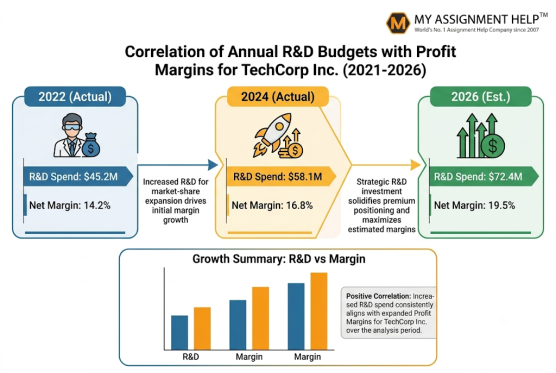
Notice how a professional business research report format example always uses clean tables to present complex data clearly:
Let’s be completely honest: balancing multiple college courses, part-time jobs, and personal responsibilities can leave you feeling completely burned out. When deadlines start crashing down on you all at once, it is completely natural to seek professional business assignment help to help guide you through a complex academic project or improve your draft writing.
If you find yourself stuck on a tricky business research proposal assignment or struggling to make sense of a statistical analysis section, seeking out professional help is a smart, strategic move. Utilizing trustworthy business research assignment help resources or leaning on external business research paper help expertise can save you a massive amount of time.
Working with an experienced academic mentor or structural editor allows you to see exactly how to fix formatting errors, polish your academic tone, and clean up your bibliography. It is an amazing way to learn the ropes, reduce your stress levels, and discover how to write a business paper that stands out in your department. Whether you are aiming to submit your final draft to prestigious entrepreneurship research journals or simply trying to ace a tough final assignment, getting a second pair of professional eyes on your work is always a wise investment.
The first step in developing research-based documents (or working with custom report writing help professionals) is identifying the core business problem or specific market decision context you need to address. Before you look up any data or write a single paragraph, you must clearly define the operational challenge, financial vulnerability, or strategic opportunity that your report is trying to solve for the target company.
The most reliable databases for uncovering high-tier business studies include ABI/INFORM Collection, Business Source Premier (EBSCO), JSTOR, and ProQuest. For those searching for detailed corporate financial records, valuation metrics, or executive summaries, utilizing resources like Statista, Mergent Online, and archived Bloomberg Terminal data yields the strongest academic evidence.
For a standard 2,000-word university term paper, your introduction should typically be about 200 to 300 words (roughly 1 to 1.5 pages double-spaced). It needs to be just long enough to introduce your industry problem, establish your paper’s real-world relevance, and deliver your thesis statement cleanly.
Yes, under modern guidelines for APA in-text citation and formatting, using active first-person pronouns (like “In this study, I analyze…”) is entirely acceptable to explain your analytical steps. However, because some traditional business faculties still prefer a passive, detached tone (such as “This paper analyzes…”), you should always double-check your course syllabus first.

Hi, I am Mark, a Literature writer by profession. Fueled by a lifelong passion for Literature, story, and creative expression, I went on to get a PhD in creative writing. Over all these years, my passion has helped me manage a publication of my write ups in prominent websites and e-magazines. I have also been working part-time as a writing expert for myassignmenthelp.com for 5+ years now. It’s fun to guide students on academic write ups and bag those top grades like a pro. Apart from my professional life, I am a big-time foodie and travel enthusiast in my personal life. So, when I am not working, I am probably travelling places to try regional delicacies and sharing my experiences with people through my blog.










 WhatsApp

