Get Instant Help From 5000+ Experts For
question

Writing Get your essay and assignment written from scratch by PhD expert

Rewriting: Paraphrase or rewrite your friend's essay with similar meaning at reduced cost

Editing:Proofread your work by experts and improve grade at Lowest cost

And Improve Your Grades
myassignmenthelp.com
loader
Phone no. Missing!

Enter phone no. to receive critical updates and urgent messages !

Add File

Error goes here

Files Missing!

Please upload all relevant files for quick & complete assistance.

Guaranteed Higher Grade!
Plagiarism checker
Verify originality of an essay
essay
Get ideas for your paper
Plagiarism checker
Cite sources with ease

Persuasive Speech Examples, Topics & Outline Guide (2026)

Persuasive-Speech-Examples.

Persuasive communication is one of the most powerful skills you can learn—whether you are a student presenting in class, a professional pitching an idea, or a speaker influencing public opinion. A strong persuasive speech does more than share facts; it can change how people think, feel, and act.

This guide will help you understand:

  • What a persuasive speech is
  • Explore the different types of persuasive speeches
  • Discover real examples along with the techniques used
  • Find strong and engaging topics you can use
  • Follow a clear, step-by-step outline to create impactful and memorable speeches

What Is a Persuasive Speech?

A persuasive speech is a talk that tries to convince people to believe, feel, or act in a certain way. It uses logic, emotion, and trust to make the message strong. For example, a speaker may ask people to recycle more by sharing facts about pollution and stories about wildlife.

Core Components of Effective Persuasive Speeches:

  1. Ethos: Shows the speaker is credible and trustworthy. Audiences relate better to someone they respect.
  2. Pathos: Appeals to emotions, values, and personal experiences. This makes arguments more relatable.
  3. Logos: Uses facts, logic, and evidence to support claims. Logical reasoning strengthens your speech.
  4. Addressing Counter-Arguments: Acknowledging and refuting opposing viewpoints shows that you have done complete research. This builds trust and makes your argument stronger.
  5. Call to Action: A clear instruction at the end telling the audience exactly what you want them to do—such as changing a habit, supporting an idea, or taking a specific step.

Types of Persuasive Speeches

Understanding the type of speech helps you organize your arguments effectively.
  • Short Persuasive Speech : Short speeches (around 2 minutes) need a strong attention grabber. Then, outline your main points clearly. Use logic, facts, and clear presentation. Irrefutable logic, powerful rhetoric, striking facts, and intelligent presentation are essentials.
    Read more: 2-Minute Speech Topics for Students
  • Motivational Persuasive Speech : Motivational speeches inspire listeners to act. You must appeal to positive emotions, but first establish your credibility.
  • Advocacy Speech: Attention, relevance, need, satisfaction, visualization, and action are the main parts of advocacy speeches. Compare one scenario with another to make your point.
  • Academic Persuasive Speech : These speeches require logic, credible evidence, rhetoric, and sometimes visual aids to persuade an academic audience.
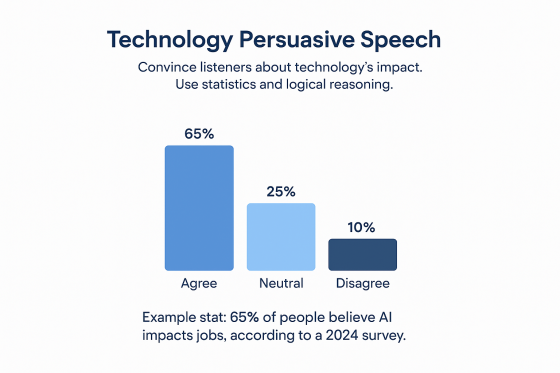
  • Technology Persuasive Speech : Convince listeners about technology’s impact. Use statistics and logical reasoning.
    Example stat: 65% of people believe AI impacts jobs, according to a 2024 survey.

    Practical tip: Use visuals, charts, or numbers to make your argument memorable.

Examples of Effective Persuasive Speeches

Example 1: Value-Based Persuasion

Topic: “Why Mental Health Should Be Treated Like Physical Health”

“Every day, millions silently struggle with anxiety, depression, or stress—but we hesitate to treat these issues as urgently as a broken bone. Mental health deserves equal care, priority, and compassion.”

Techniques Used:

  • Pathos (Emotional Appeal): The speech connects with the audience by highlighting the suffering of millions.
    Pro Tip: Use relatable stories or scenarios that evoke empathy.
  • Clear Value Judgment: It stresses the importance of treating mental health as seriously as physical health.
    Pro Tip: State your stance clearly and confidently so your audience understands your position.
  • Relatable Storytelling: The example paints a real-life scenario that everyone can imagine.
    Pro Tip: Include simple, vivid examples that your audience can connect to immediately.

Example 2: Policy Persuasion

Topic: “Schools Should Implement Mandatory Financial Literacy Classes”

“Nearly 70% of young adults struggle with basic budgeting. Yet many graduate knowing how to analyze Shakespeare but not manage debt. Mandatory financial literacy classes can change this, giving students skills for life.

Techniques Used:

  • Logos

Pro Tip (Spot Logos): If a persuasive speech uses numbers, research, data, surveys, or step-by-step logic → it’s using Logos.

  • Strong call to action

Pro Tip (Spot a CTA): If the speaker is urging the audience to do something—implement, change, support, vote, demand—it’s a CTA.

  • Evidence-backed argument

Pro Tip (Spot Evidence): If the speaker uses facts, surveys, or reports to support a claim, the argument is evidence-backed.

Example 3: Fact-Based Persuasion

Topic: “Social Media Negatively Impacts Sleep Quality in Teens”

“Studies show that teens who use screens heavily—especially before bed—sleep worse. Research found that adolescents using digital devices for over 9 hours a day are 60% more likely to have poor sleep than those with limited screen time. Cutting screen use at night can improve focus, health, and sleep quality.


Techniques Used:

  • Scientific evidence: The claim is supported by real research, including a study showing a 60% higher prevalence of poor sleep among heavy screen-use teens.

Pro Tip (How to Recognize It):
If the argument uses data, study results, or findings from a credible source (NIH, PubMed, universities), it’s scientific evidence.

  • Logical reasoning: The claim is supported by real research, including a study showing a 60% higher prevalence of poor sleep among heavy screen-use teens.

Pro Tip (How to Recognize It): If the argument uses data, study results, or findings from a credible source (NIH, ScienceDirect, PubMed, universities), it’s scientific evidence.

  • Clear factual claim: The core statement — “Social media negatively impacts teen sleep” — can be measured, tested, and verified with research.

Pro Tip (How to Recognize It):  If the main argument can be supported with data or disproven by studies, it’s a factual claim.
Practical tip: Always cite the source of your data.

List of Strong Persuasive Speech Topics

Personal Development:

  • Why everyone should practice mindfulness
  • The importance of work–life balance
  • Why self-discipline matters more than motivation

Education:

  • Should schools eliminate homework?
  • Should college education be free?

Technology:

  • AI will create more jobs than it eliminates
  • Should social media companies verify all users?

Social Issues:

  • Is universal healthcare a human right?
  • Should voting be mandatory?

Environment:

  • Why reusable energy must replace fossil fuels
  • Should plastic bags be banned everywhere?

Persuasive Speech Outline (Short & Clear Guide)

  1. Start with a Strong Opening : Your introduction sets the tone. Use a hook—a surprising fact, an emotional statement, or a relatable story.

Example: “Every minute, 3,000 tons of food are wasted while millions go hungry.”

Briefly show your credibility so listeners trust your viewpoint.

  1. Present Your Key Arguments : Choose 2–4 main points. Make them clear and connected.
    Support each point with:
  • Research
  • Facts or statistics
  • Real stories or examples

This combination helps your audience understand and accept your perspective.

  1. Address Counter-Arguments :A persuasive speech feels stronger wed thinkhen you acknowledge the other side. Describe opposing views fairly—as someone who believes them would—then explain why your argument is stronger. This builds trust and shows balance. For students who want help structuring logical claims and counterclaims, our argumentative essay help service can be beneficial.


Explore more perspectives here → Great Debate Speech Topics

  1. End with Impact Finish with a clear call to action. Tell your audience exactly what you want them to do—sign up, change a habit, rethink an issue, or take a stand.

Conclusion

Persuasive speeches have the power to inform, inspire, and influence. By understanding the core components—Ethos, Pathos, Logos—addressing counter-arguments, and ending with a strong call to action, you can craft speeches that leave a lasting impact. Use clear examples, well-researched facts, and relatable stories to connect with your audience. Whether you are presenting in class, speaking professionally, or advocating for a cause, following a structured approach ensures your message is memorable and persuasive.

FAQs on Persuasive Speeches

Q.1.What is the main purpose of a persuasive speech?

Ans: It aims to influence how people think, feel, or act using strong arguments, credible evidence, and emotional appeal.

Q.2.How do I choose the right topic?

Ans: Pick a topic you care about, has strong evidence, and is relevant to your audience.

Q.3.How should I start a persuasive speech?

Ans: Begin with a hook—a fact, story, or bold statement to grab attention immediately.

Q.4.Why include counterarguments?

Ans: It shows understanding of other perspectives, strengthens credibility, and makes your argument balanced.

Q.5.How do I end a speech effectively?

Ans: Close with a clear call to action that tells the audience exactly what you want them to do—whether it’s changing a behavior, supporting an idea, or adopting a new mindset.

Jack Williams

Hi, I’m Jack Williams, a professional Biochemist with over 8 years of academic and writing experience. My passion for writing took root during my university years while working on complex Bio dissertations. That creative spark led me into the world of English Essay Writing, Academic Assistance, Scientific Research Papers, and Dissertation Support. At MyAssignmentHelp.com, I blend scientific precision with narrative clarity to help students succeed in their writing tasks. When I'm not in the lab or writing blogs, you’ll find me playing soccer or capturing moments on canvas with a paintbrush.

Related Post

Join our 150К of happy users

Get original papers written according to your instructions and save time for what matters most.

Order Now
Plagiarism checker
Verify originality of an essay
essay
Get ideas for your paper
Plagiarism checker
Cite sources with ease
WhatsApp Order/Chat on whatsapp
support
close