


 20 December,2025

Table of Contents
It happens more often than students admit — one night left, a long essay due, and no clear idea where to start. A 10-page essay sounds manageable until you realize how much planning, research, and structure it actually requires. At that point, stress replaces productivity.
Most students don’t fail at long essays because they can’t write. They struggle because they don’t know how to pace arguments across ten pages, expand ideas without repetition, or follow a clear academic structure—areas where reliable essay help resources can clarify expectations and planning.
Writing a 10-page essay doesn’t have to feel chaotic. This guide shows you exactly how to do that — step by step — with practical examples you can follow.
Understanding length expectations helps you plan effectively.
Each body paragraph typically contains 120–180 words, meaning your essay must develop ideas thoroughly rather than briefly. If your essay seems too short, these tips on how to make an essay longer can help you expand your arguments effectively.
Formatting plays a crucial role in how your 10-page essay is evaluated. Even strong content can lose marks if formatting guidelines are ignored. Always follow the style specified by your instructor.
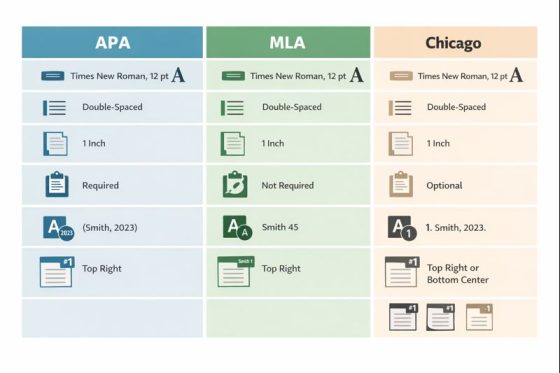
Pro Tip: Stick to one style from start to finish. For example, don’t combine APA in-text citations with MLA references.
Before you write a single sentence, plan your time. A 10-page essay cannot be written effectively without structure.
Break your work into stages:
Even if you’re short on time, a simple timeline prevents last-minute chaos.
If your instructor allows topic selection, choose one that:
A focused topic makes writing a long essay much easier and more coherent.
Strong research is the backbone of a successful 10-page essay.
Use credible sources such as:
As you research:
This will save hours during the writing stage. Before moving to drafting, it’s also important to ensure your work remains original—using a plagiarism checker helps verify that your sources are cited correctly and your content is unique.
An outline acts as a roadmap for your essay.
A standard 10-page essay outline includes:
Writing a 10-page essay in one day—or even overnight—is possible, but it comes with clear limitations. This approach works best when you already understand the topic, have access to reliable sources, and can maintain focused writing for several hours.
The same idea applies to a 15 page essay. While it can be completed in a short time, the challenge becomes much greater as the length increases. More pages mean more research, stronger arguments, and better organization.
However, writing under extreme time pressure increases the risk of weak arguments, poor organization, and citation errors. If you attempt a one-day timeline, outlining becomes non-negotiable.
This method is not recommended for research-heavy topics or unfamiliar subjects. In such cases, starting early or breaking the work into stages produces far better results.
Time pressure requires focus and discipline. If time is tight, you can also consider do my assignment services to get professional help while learning the structure.
A clear outline helps you manage length and maintain logical flow throughout your essay.
Standard 10 Page Essay Outline:
This outline ensures balanced coverage and prevents under- or overwriting.
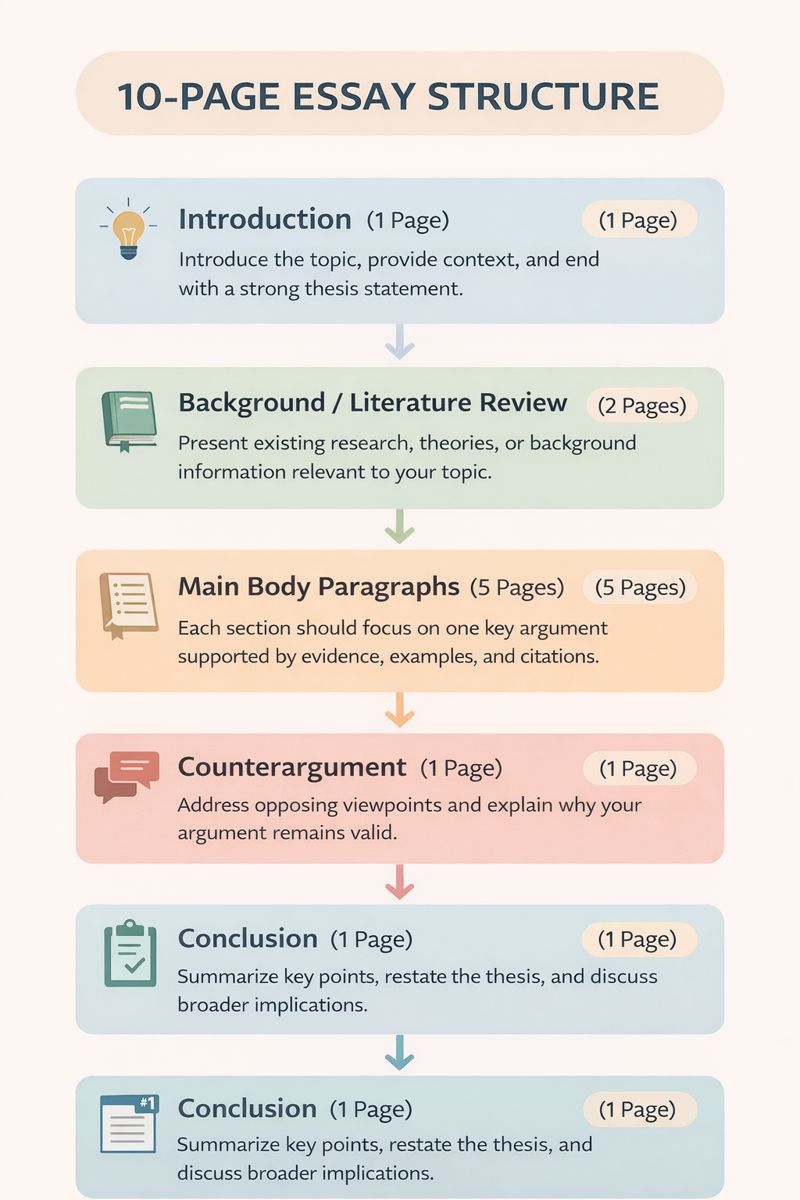
Your introduction should:
A strong introduction sets expectations and guides the reader.
The body is the core of your 10-page essay.
Each section should:
Use transitions between paragraphs to maintain flow and coherence.
Including opposing viewpoints:
Pro Tip: Conclude your counterargument with a brief, specific example that illustrates why your position is stronger.
Briefly present the counterargument, then explain why your position is stronger.
Your conclusion should:
Avoid introducing new information here. A clear plan is essential. Understanding the essay structure will help you break your essay into manageable sections.
AI tools can support the writing process when used responsibly. They are best used for brainstorming ideas, clarifying assignment prompts, organizing outlines, or improving sentence clarity after drafting.
AI should never replace your own writing or be used to generate full sections of the essay. Submitting AI-generated content as original work can violate academic integrity policies. Always verify facts, read sources, and follow your institution’s guidelines regarding AI usage.
The time required depends on experience and the level of preparation.
On average:
| Writing Stage | Estimated Time |
| Research | 4–6 hours |
| Outlining | 1–2 hours |
| Writing Draft | 8–12 hours |
| Editing & Formatting | 2–3 hours |
| Total Time | 15–25 hours |
This reinforces realism and improves trust.
Examples help you understand how theory translates into actual writing. Below are concise, original samples for guidance.
“This essay argues that social media significantly affects academic performance by influencing student focus, time management, and learning behavior.”
In recent years, social media has become an integral part of students’ daily lives. While these platforms offer opportunities for communication and learning, their impact on academic performance remains controversial. This 10-page essay examines how social media affects student focus, productivity, and overall educational outcomes.
One major way social media affects academic performance is through constant distraction. Studies show that frequent notifications interrupt concentration and reduce deep learning. As a result, students often multitask during study sessions, which negatively affects information retention (Johnson, 2022).
In conclusion, social media plays a complex role in modern education. While it offers collaborative benefits, excessive use can harm concentration and academic success. By managing usage responsibly, students can minimize negative effects while maximizing learning potential.
Maintaining academic integrity is essential in a long-form essay. To avoid plagiarism:
Even unintentional citation errors can impact grades, so reviewing originality before submission is critical.
Editing and proofreading are critical stages in writing a high-quality 10-page essay. No matter how strong your research or arguments are, unedited work can weaken your overall impact and reduce your grade. These final steps help transform a rough draft into a clear, professional, and well-structured academic paper.
Editing focuses on the quality of ideas and organization, not just surface-level errors. During this stage, review your essay carefully to ensure that every section supports your main argument.
When editing your 10-page essay, focus on the following:
Proofreading is the final step, focusing on language accuracy and formatting. At this stage, your ideas should already be solid.
When proofreading, pay attention to:
Proper editing and proofreading can significantly elevate the quality of your 10-page essay. Many grading deductions come from avoidable errors, so investing time in these final steps can make the difference between an average paper and an excellent one.
Pro Tips: To improve clarity and correctness, check out our guide on editing and proofreading before submission.
High-quality sources strengthen credibility and depth. Commonly accepted sources include:
Avoid unreliable blogs, opinion-only sources, or uncited online material when developing arguments.
Before submission, confirm:
Formatting errors can cost marks even if the content is strong.
Avoiding these mistakes improves both quality and credibility.
From outlining to final revisions, professional essay help can support research, structure, and clarity—without compromising originality.
Writing a 10-page essay may seem intimidating, but it becomes manageable when approached strategically. With proper planning, a clear outline, focused research, and careful editing, you can produce a strong academic paper that meets both content and formatting expectations.
Start early when possible, work in stages, and remember that quality matters more than rushing to fill pages. A well-structured 10-page essay is not just longer—it’s deeper, clearer, and more persuasive.
Ans: A double-spaced 10-page essay typically ranges from 2,500 to 3,000 words, depending on font and spacing.
Ans: Most 10-page essays have around 20–30 paragraphs, with each paragraph usually containing 120–180 words.
Ans: Writing a 10-page essay can take 15–25 hours on average, including research, outlining, drafting, and editing.
Ans: While possible, it’s not recommended. Planning, outlining, and focused writing are crucial to maintain quality.
Ans: A research paper emphasizes data and sources, while a 10-page essay focuses more on analysis, argument, and structured writing.










 WhatsApp

