


 19 June,2026

Table of Contents
I know exactly how it feels. You are staring at your screen late at night, your eyes are heavy, and you just finished typing what you think is a solid final paragraph. You check the bottom corner of your document, hoping to see a specific number, but your heart sinks. Your term paper is still 500 words short of the minimum requirement.
When I find myself stuck in this position during my own college writing sessions, my first instinct used to be panic. I would wonder, “How can I make my essay longer without looking like I’m desperate?” or “How do I make my essay look longer so my professor doesn’t immediately dock my grade?”
If you are asking yourself how do I make my essay longer or ” How can I make my essay longer right now, take a deep breath. I have been there, and I have helped dozens of my peers navigate this exact high school and college hurdle during writing workshops.
Writing long essays is a skill, and you do not need to pull your hair out to master it. In this guide, I will share the exact strategies I use to naturally expand an essay, help make my essay longer, and make your paper longer while actually improving its academic value.
When I review my early drafts or look over essays during peer review sessions, I notice a common trend: we usually run out of words because we treat our main ideas like a checklist instead of an exploration.
The Best Ways to Safely Make an Essay Longer:
If you are staring at your draft, asking yourself, “How do I make my essay longer?” or “How can I make my essay longer?”, it usually comes down to one of these common bottlenecks:
To help you get past this roadblock, I have put together a checklist of the core components your paper should have. If any of these are missing from your current draft, you have found your starting point for expansion.
[ ] Detailed Context: Did you introduce the historical or social background of your topic in the introduction paragraph?
[ ] Textual Blueprint: Did you provide a roadmap for the reader showing how you plan to prove your thesis?
[ ] The “Why” Behind Evidence: For every quote you used, did you write at least two sentences explaining its deeper meaning?
[ ] The Alternative Perspective: Did you dedicate a section to addressing what critics or opposing scholars say about your argument?
[ ] The “So What?” Factor: Does your conclusion explain why your topic matters to the broader world or your grade point average (GPA)?
Before I show you how to lengthen your paper, we need to talk about what not to do. When you are stressed about a deadline, it is incredibly tempting to figure out how to fluff up an essay. We have all tried things like using five words when one would do, or searching for what to add to an essay to make it longer by pasting in empty adjectives.
However, modern college professors and high school teachers can spot empty fluff from a mile away. It hurts your semantic depth, ruins your critical thinking score, and can severely damage your grade point average (GPA). Our goal is to focus on analytical elaboration—adding genuine value, substance, and analytical weight to your writing.
To make sure we are on the same page, let’s look at the difference between lazy fluff and high-scoring academic elaboration:
| Technique | Lazy Fluff (Avoid This) | Academic Elaboration (Do This) |
|---|---|---|
| Handling Quotes | Repeating the quote in your own words just to make the paragraph take up more physical space on the page. | Unpacking the quote’s hidden assumptions and showing how it explicitly proves your core thesis statement. |
| Vocabulary Choice | Swapping out simple words for long, complicated synonyms that make your sentences sound confusing. | Utilizing precise transition words and phrases that clarify the complex relationships between your main points. |
| Addressing Core Arguments | Writing an extra paragraph that restates what you already said in the previous section without adding new ideas. | Introducing a compelling counterargument or looking at an alternative perspective to show your structural expansion. |
| Using Examples | Listing three or four identical examples in a row without explaining any of them in detail. | Taking a single, powerful example and breaking down its real-world implications step-by-step for your reader. |
I put together these 11 field-tested, highly reliable strategies to help you scale up your paragraphs naturally. These will guide you through how to make essay longer with words, how to make your essay longer with words, and how to make essays longer with words without setting off any red flags on your professor’s grading rubric.
One of the easiest ways to make an essay longer with words is to use explicit, sophisticated transitions to link your ideas together. Instead of jumping abruptly from one sentence to the next, use phrases to make your essay longer that also clarify your thoughts.
For example, instead of just starting a sentence with “Also,” try using phrases to make your essay longer like:
Using essay longer phrases and phrases to make essays longer not only builds your word count naturally, but it also gives your writing a professional, fluid rhythm that keeps your reader engaged.
If you want to know how to make sentences longer for an essay, stop looking for longer individual words and start looking at the space between your sentences. When I pull a piece of evidence into a paragraph, I never let it stand alone. I use a simple three-step rule for every single quote or statistic:
If you need to know how to write a longer essay or how to extend an essay, look at the other side of the fence. Every strong thesis has an opposing viewpoint. By dedicated a paragraph to a counterargument, you can easily add 150 to 200 words to your draft.
I like to introduce this by saying: “Critics of this position often argue that…” or “An alternative perspective worth considering is…” Once you state the counterargument, you spend the rest of the paragraph showing why your original point still stands. This shows immense critical thinking and makes your paper incredibly robust.
If your writing feels a bit abstract, look for ways to lengthen an essay by grounding your ideas in reality. If you are writing about an economic theory, bring in a historical case study. If you are analyzing a novel, quote a specific scene. Giving a step-by-step breakdown of an event or case study is an excellent way to guide your reader while meeting your target length.
When we write essays, we often use big words or specific concepts assuming our audience completely understands them. I have found that taking a brief moment to define your core terms is highly beneficial.
If your paper is about “sustainable infrastructure,” spend three sentences explaining exactly what that looks like in the context of your research. This provides fantastic semantic depth for search engines and readers alike, while expanding your writing organically.
While fixing passive voice sometimes shortens a sentence, doing it while adding proper context is a masterclass in how to make your essay longer words sound sharp.
Go through your paper and look for generic words like “this,” “that,” “it,” or “they.” Whenever I see these words, I try to replace them with specific descriptions. Instead of writing, “This caused a major problem,” I change it to, “This sudden drop in international trade revenue caused a major financial problem for small business owners.” This is one of the most natural words to make an essay longer strategies you can use.
If you include a statistic or a piece of data, do not just leave it as numbers on a page. Unpack the human element behind it. If you mention that 45% of students struggle with writing long essays, add a sentence discussing the psychological stress and academic pressure that these individuals experience on a daily basis.
If you find yourself summarizing a multi-step process in a single sentence, unpack it. If you are explaining how a law gets passed or how an ecosystem changes, break it down chronologically. Dedicate a sentence or two to each individual phase. This ensures your readers can follow your logic without getting lost in a dense wall of text.
Instead of just saying, “Researchers believe that green energy is vital,” try identifying the specific fields of study involved. I like to write: “Environmental scientists, urban planners, and local policymakers collectively agree that green energy systems are vital for future city growth.” This uses excellent words to make your essay longer and words to make essays longer by adding legitimate scope to your claim.
The biggest secret to writing long essays is continuously asking yourself “so what?” every time you make a claim. If you state a fact, explain its long-term consequences. Why does this matter for the future? What will happen if we ignore this issue? Exploring the ripple effects of your topic will give you an endless stream of meaningful content to write about.
Receive high-quality, original papers, free from AI-generated content.
When I review student papers during peer review sessions, the introduction paragraph is usually where things look bare. It is very common to see an intro that is only three sentences long: a generic hook, a brief mention of the topic, and a thesis statement.
If you want to know how to make an introduction longer or how to make an introduction paragraph longer, you need to build a comprehensive intellectual runway for your paper.
I always structure my college essay introductions using a reliable, four-step framework that fills space beautifully while captivating the reader:
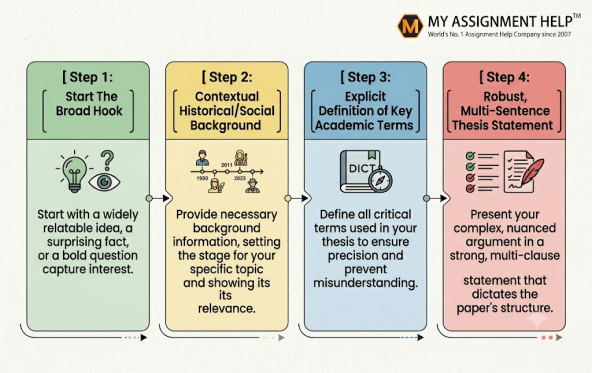
Instead of jumping straight to your main argument, use this step-by-step approach to flesh out your thoughts:
By expanding your introduction this way, you establish absolute authority right from the start, and you will easily hit your length goals before you even touch your body paragraphs.
If you are writing a major college research paper, a comprehensive term paper, or working on ways to lengthen an essay for higher studies, standard word adjustments will not cut it. Your formatting guidelines, whether you are using MLA format, APA style, or the Chicago Manual of Style, require high structural integrity.
When I need to know how to make papers longer, make paper longer, or how to lengthen a paper, I focus entirely on deep structural expansion. Here is my personal playbook for taking a research paper to the next level:
If your paper involves research or data collection, explain exactly how you gathered your information. What search databases did you use? What keywords did you look up? Why did you trust certain academic journals over others? Walking the reader through your research process adds exceptional value and length.
I like to look at how different sources talk to one another. Instead of just summarizing Source A and Source B separately, write a paragraph comparing them. Do they agree? Do they contradict each other? Pointing out these scholarly dialogues is a phenomenal way to demonstrate master-level critical thinking while naturally building up your word count.
Every piece of research has boundaries. Spend a section discussing what your paper couldn’t cover due to time constraints, word count limits, or lack of data. Explain what future researchers should look into next. This shows incredible academic maturity and adds a clean, professional section to your final pages.
Let’s be totally transparent: sometimes you are down to the wire, you have polished your words as much as possible, and you just need a microscopic visual boost without changing your actual text. If you want to know how to make your essay look longer or how to make an essay look longer, there are a few safe adjustments you can make within your style guidelines.
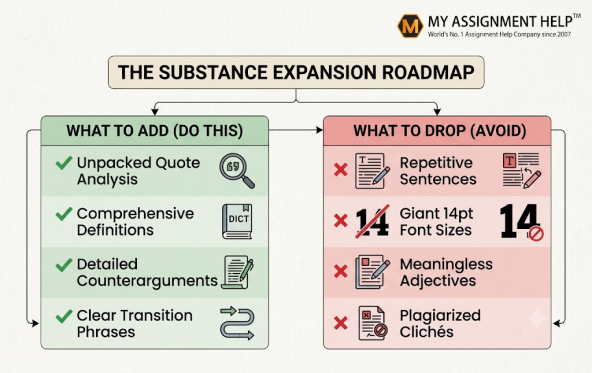
A Note on Style Guidelines: Never make massive, obvious layout changes. Professors instantly notice things like 14-point fonts or massive margins, and it can seriously harm your academic reputation. Keep your changes subtle and fully within standard style rules.
My final piece of advice for you is to focus on quality, depth, and structural clarity over sheer size. When you learn how to lengthen an essay, how to lengthen essays, how to extend an essay, or how to extend essays, you are learning how to become a more thorough, analytical thinker.
By focusing on deep evidence analysis, introducing solid counterarguments, and structuring your introductions beautifully, you will never have to worry about meeting your baseline goals again.
Take a look at this quick reference guide to keep these core expansion strategies fresh in your mind for your next writing session:
The fastest, most effective way to lengthen an essay right before your deadline is to go through your body paragraphs and find your “hit-and-run” quotes. For every single quote where you haven’t explicitly explained its connection to your thesis statement, write two sentences detailing why that piece of evidence matters. This instantly adds meaningful length and significantly boosts your overall analysis score.
You can increase your essay word count without changing your thesis by introducing a dedicated counterargument paragraph. Simply present a common objection to your main point, and then write three to four sentences explaining why that objection is incorrect or limited. This leaves your thesis completely intact while expanding your paper’s scope and proving you understand the full scale of the academic debate.
No, it is generally unsafe and highly discouraged to expand an essay by simply swapping out short words for longer synonyms. This approach usually creates clunky, unnatural phrasing that disrupts your writing flow and raises immediate red flags for professors and automated grading systems. Instead, focus on expanding your ideas by adding transition phrases, clarifying generic pronouns, and fully defining your key terms.
Yes, modern LMS platforms like Canvas and Turnitin normalize formatting instantly, making textual expansion the only safe route

Hi, I am Mark, a Literature writer by profession. Fueled by a lifelong passion for Literature, story, and creative expression, I went on to get a PhD in creative writing. Over all these years, my passion has helped me manage a publication of my write ups in prominent websites and e-magazines. I have also been working part-time as a writing expert for myassignmenthelp.com for 5+ years now. It’s fun to guide students on academic write ups and bag those top grades like a pro. Apart from my professional life, I am a big-time foodie and travel enthusiast in my personal life. So, when I am not working, I am probably travelling places to try regional delicacies and sharing my experiences with people through my blog.










 WhatsApp

