


 20 February,2026

Table of Contents
Essay revision is a three-stage process: global auditing (structure and thesis), paragraph integrity (logic and flow), and sentence polishing (clarity and grammar). Effective revision requires separating the ‘writing’ phase from the ‘editing’ phase to ensure academic rigor.
In my experience as a data specialist, I’ve learned that the first draft is just raw material. When I finish a draft, I never consider it ‘done.’ Instead, I step back so I can return to my work with fresh eyes—a process I call ‘seeing again.’ To ensure my logic holds up under academic scrutiny, I always put my drafts through a rigorous 3-stage audit.
Effective revision often takes as much time as the first draft. Experts suggest you should separate your writing from your editing. You can start by writing a “dump draft” to get all your ideas on paper. Do not worry about being perfect on your first try. Once your draft is done, you can move from general issues to specific details. The goal is to make sure your essay has a clear thesis and a logical order.
College students should also look for “foggy” writing. Clear writing comes from clear thinking. You can test your draft by reading it aloud to check for sense and errors. Another helpful tip is to step away from your essay for a while. This helps you clear your mind before you start the hard work of making changes. By following these expert tips, you can transform a messy draft into a solid paper.
Before you fix minor typos, you must perform a structural audit. If you find that your overall argument is weak, you might need a professional essay editing service to help reorganize your thoughts for maximum academic impact.
Revising an essay is a vital part of college success. Many students think revision is just fixing typos. That is a mistake. Revision is much bigger than that. It is the heart of good writing. To rank high in school, you must learn what it really means to revise an essay.
The “See Again” Principle
The word “revise” has a simple meaning. It literally means “to see again.” When you revise an essay, you look at your work with fresh eyes. You do not just look for small errors. You look at your big ideas. You check if your logic is sound.
In college, your first goal is to communicate. You must ensure your message is clear to the reader. This is why you must “see” your work from the reader’s point of view. Ask yourself: Does this make sense? Is my main point strong? If the answer is no, you must change your path. This is the core of essay revision.
One expert, Sarah Dobson, has a great rule. She says you must separate writing from editing. Many students fail because they try to do both at once. They fix grammar while they are still thinking of ideas. This slows you down. It kills your focus.
The Power of the “Dump Draft”
The best way to start is with a “dump draft.” This is a messy first version of your paper. You should let your ideas flow. Do not worry about spelling. Do not worry about perfect sentences. Just get your thoughts on the page.
A dump draft is a huge victory. It gives you a “hot mess” to work with. You cannot revise an essay if there is nothing on the page. Once the ideas are down, you can start the real work. This is the secret of top academic writers. They write fast and then they revise essay content slowly.
| Task | Revision (Big Picture) | Editing (Fine-Tuning) |
|---|---|---|
| Focus | Logic, Thesis, Structure | Grammar, Spelling, Style |
| Goal | Make it make sense | Make it look clean |
Writing and editing use different parts of the brain. Writing is creative. Editing is critical. If you try to do both, you will get stuck. This is why many students get “writer’s block.”
To revise my essay well, I must wait. Experts suggest waiting at least 24 hours after your first draft. This “cool-down” time lets you see the work with a clear mind. When you return, you are no longer the “writer.” You are now the “editor.” This separation ensures academic rigor. It makes your final paper much stronger.
In college, your professors want to see deep thinking. A first draft is rarely deep. It is usually just the surface of your thoughts. Revising an essay allows you to go deeper. You can find better evidence. You can fix “foggy” thinking.
When you revise an essay, you are building a bridge. This bridge goes from your mind to the reader’s mind. If the bridge is weak, the reader gets lost. If the bridge is strong, your grade goes up.
High-Intent Goals of Revision:
By following the “See Again” principle and the Sarah Dobson Rule, you will work smarter. You will stop fighting with your draft. Instead, you will lead it toward a perfect finish. This is how you win at college writing. If you need help, revising essay tasks can be done with expert tools. But the first step starts with your mindset. See it again. Make it better. Reach your goals.
When you aim to revise an essay, you must know the difference between revision and editing. Many students use these words to mean the same thing. However, in the world of academic success, they are very different tasks. Knowing the gap between them will help you revise an essay in college like a pro.
To help you reach your goals, think of your essay like a house. Revision is about the foundation and the walls. Editing is about the paint and the decor. You cannot paint a wall that has not been built yet. This is why you must revise essay structure before you fix the typos.
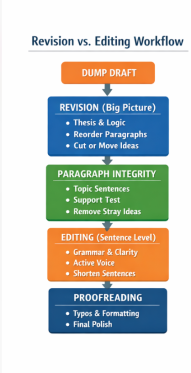
The table below breaks down these two stages. This is a vital guide for any student who wants to revise my essay for a top grade.
| Feature | Revision (The Big Picture) | Editing (The Fine-Tuning) |
|---|---|---|
| Primary Goal | To improve ideas, logic, and structure. | To fix grammar, spelling, and style. |
| When to Do It | Right after the first “dump draft.” | Only after the structure is perfect. |
| Key Actions | Moving paragraphs, changing the thesis. | Fixing commas, checking word choice. |
| Focus Area | The “Skeleton” of the essay. | The “Surface” of the essay. |
| The Result | A strong, logical argument. | A clean, error-free paper. |
When you revise an essay, you are doing “global” work. This is the stage where you check if your essay actually makes sense. You are looking at the logic. You are checking the flow. If you find that your third paragraph actually belongs at the start, you move it. This is a big change, but it is necessary for a good essay revision.
In college, your professors care most about your thoughts. They want to see that you can build a strong case. If your thesis is weak, no amount of perfect grammar will save your grade. This is why you must revise essay content first. You might delete a whole page. You might add a new section. Do not be afraid to cut things out. This makes your work stronger.
A great way to revise an essay in college is to check the “skeleton.” This means looking only at your topic sentences. Do they follow a clear path? Do they prove your thesis? If the skeleton is broken, the essay will fail. You must fix the bones before you worry about the skin. This is the true meaning of revising an essay.
Once you have finished the big changes, you can start to edit. This is the “micro” work. Now, you are looking at the sentences. You want them to be short and clear. You check for passive voice. You fix your punctuation.
When you revise an essay, you focus on what you are saying. When you edit, you focus on how you are saying it. Editing is about the “polish.” It makes your work look professional. It shows that you care about the details. However, if you edit too early, you might waste time fixing a paragraph that you later delete during the revision phase.
To rank high in class, you cannot skip either step. A paper with great ideas but bad grammar looks sloppy. A paper with perfect grammar but no ideas is empty. To truly revise essay work, you must be brave enough to change your mind. To edit well, you must be careful enough to spot small slips.
Common Mistakes Students Make
After you revise an essay, take a break. Your brain needs a rest from the “big ideas.” When you come back, read your work out loud. This is the best way to move into the editing phase. You will hear the small mistakes that your eyes missed during the revision stage.
By following this guide, you ensure that your writing is both deep and clean. This is the secret to revising an essay for high-intent academic results. Whether you are using a tool to revise my essay or doing it by hand, remember: Build the house first, then paint the walls. Once your structure is sound, use a digital grammar checker to catch technical errors. However, remember that a tool cannot replace the “Chekhov Method” of reading aloud to check for natural rhythm.
Writing a first draft is a huge victory. But in college, the first draft is rarely the final draft. Most students struggle to know when their work is “done.” If you want to revise an essay in college for an A+, you must look for red flags. These signs tell you that your paper needs more than just a spell-check. It needs a deep essay revision.
Recognizing these symptoms is the first step toward academic success. If your paper has these issues, it is time to revise my essay content to ensure it meets high standards.
The most common sign you need to revise essay structure is a weak thesis. Your thesis is the heart of your paper. It is your answer to a research question. If a reader cannot find your main point in the first two paragraphs, your essay is in trouble. A vague thesis leads to a vague essay. When you revise an essay, start here. Make your claim bold and specific.
Do your paragraphs feel like random islands? This is a sign of poor transitions. To revise an essay in college effectively, you must build bridges between ideas. If you jump from one point to another without a link, the reader gets lost. High-quality essay revision involves adding “markers” or transition words. These help the reader follow the path of your thoughts.
Sometimes, you might say one thing on page two and the opposite on page four. This happens when you write over several days. Inconsistent logic ruins your authority. When you revising an essay, check for “sunk cost fallacies” or “false causes.” Ensure every argument supports your main goal. If your logic is broken, your grade will suffer.
College students often add “filler” to hit a word count. This is a major red flag. If a paragraph does not support your thesis, it does not belong. Part of learning how to revise an essay is being brave enough to cut. If it is off-topic, delete it. Quality always beats quantity in academic writing.
Each paragraph should have one main point. If your paragraphs are a page long and cover five different topics, you need a deep revision. A healthy paragraph has a topic sentence, evidence, and a closing thought. If your paragraphs feel “heavy,” it is time to revise essay breaks. Split them up to give the reader a breath.
Repetition makes your writing feel “choppy.” If you find yourself using the same adjective five times on one page, your vocabulary needs a boost. During essay revision, look for redundant sentences. If you said it once, you don’t need to say it again in a different way unless you are summarizing at the end.
Many students think long sentences sound “smart.” Usually, they just sound confusing. If a sentence takes up four lines, the reader will forget the beginning by the time they reach the end. To revise my essay for clarity, I must split long sentences. Aim for short, direct statements. This improves your Flesch-Kincaid score and makes your work readable.
This is a classic sign of a “dump draft.” You might start with one idea but end with another. This happens because your thinking changes as you write. When you revise an essay, read the intro and conclusion together. If they don’t match, you must rewrite them. They should act like bookends for your argument.
In college, you cannot just have an opinion. You must have proof. If your body paragraphs are full of your own thoughts but have no citations, you need to revise essay content immediately. Deep essay revision involves revisiting your sources. Ensure you have the right data to back up every claim you make.
Is your writing too casual? Using slang or “I think” too much can weaken your paper. Professional revising an essay tasks include fixing the tone. You want to sound like an expert. Use active voice and avoid “foggy” language. This ensures your work has the academic rigor needed for high marks.
I’ve often struggled with inconsistent logic when writing over several days. If I find my arguments are contradicting each other, I don’t just guess at the fix. I treat it as a high-priority ‘red flag’ that requires a professional logic audit—a core feature of the editing packages at MyAssignmentHelp.
If you ignore these signs, your “hot mess” of a draft will stay a mess. Google search results show that the best writers “revise, revise, revise.” Even if it takes a lot of time, the result is worth it.
Once you see these signs, do not panic. Use the “Skeleton Test.” Bold your topic sentences to see if they follow a path. If they don’t, use a new outline to fix the order. Many students confuse these two steps. Understanding the nuance of editing vs proofreading is vital; revision changes what you say, while editing changes how you say it.
Remember, revising an essay is where the real writing happens. It is the difference between a “pass” and a “top grade.” Look for the red flags, fix the logic, and polish the prose. You have the power to turn a weak draft into a rock-solid paper. Reach your goals by being your own toughest critic!
Many students struggle to revise an essay. They feel stuck after the first draft. This happens because they fear “breaking” their work. If you want to revise an essay in college like an expert, you must change your mind. You need the “Sandcastle Mindset.” This is a secret that many competitors miss. It is the key to true essay revision success.
The Mindset: It is Just Sand
Think of your first draft as a pile of sand. You have gathered the material. You have not built the final castle yet. When you revise an essay, you are the builder. You can move the sand. You can start over. You can even knock a tower down to build a better one.
Most students treat their first draft like it is made of stone. They are afraid to change anything. This fear stops them from reaching their academic goals. To revise my essay well, I must be brave. Remember, you can always rebuild. The “sand” is always there. This mindset makes revising an essay feel like a game, not a chore.
The Sunk Cost Rule: Let It Go
The biggest trap in essay revision is the “Sunk Cost” error. This happens when you keep a bad paragraph just because it took an hour to write. You feel that your time will be wasted if you delete it. This is wrong. Keeping a bad paragraph hurts your whole paper.
To revise essay content for a top grade, you must be ruthless. If a paragraph does not support your thesis, it must go. It does not matter how hard you worked on it. If it is “fluff,” cut it. Academic rigor requires you to put the quality of the essay first.
How to Apply the Sunk Cost Rule:
When you use the Sandcastle Mindset, you write more freely. You know the “dump draft” is just the start. This leads to deeper thinking. You aren’t just fixing typos; you are building a masterpiece.
Competitors like Scribbr focus only on the rules. But how to revise an essay is also about how you feel. By removing the fear of “breaking” your work, you open the door to better logic and flow. This psychological edge helps you outrank others. It shows that you understand the real struggle of writing.
To revise an essay in college effectively, you cannot just look at the surface. You must work from the inside out. This 3-stage system ensures your logic is sound, your paragraphs are tight, and your sentences are clear. If you want to revise my essay for a top grade, follow this expert path.
Stage 1 is the most vital part of essay revision. Here, you look at the “bones” of your work. You are not fixing commas yet. You are fixing your ideas.
The Thesis-Purpose Test
The first step to revise an essay is to check your thesis. Your thesis is your promise to the reader. Every single paragraph must help keep that promise. Read your thesis, then read each paragraph. Ask: “Does this paragraph prove my point?” If it does not, you must cut it or change it. This is how you maintain academic rigor.
The “Skeleton” Technique (College Essay Guy Method)
To revise an essay in college, use the “Skeleton” test. This comes from the College Essay Guy. Bold the first sentence of every paragraph in your draft. Now, read only those bolded lines in order.
Does the story make sense? Is there a logical flow? If the “skeleton” of your essay is clear, your structure is sound. If the sentences jump around, you need to revise essay organization. This technique helps you see the “big picture” without getting lost in the details.
The Logic Check
Ensure your logic is easy to follow. A common mistake is using hard terms without a definition. To revise an essay, you must define your concepts early. Do not make the reader guess. Make sure your background info comes before your main argument. This builds a strong path for your thoughts.
Once the big picture is fixed, you move to the paragraphs. This is the “middle layer” of revising an essay.
Topic Sentence Audit
Every paragraph must have one clear point. This point belongs in the topic sentence. When you revise an essay, check that your topic sentences are bold and direct. If a paragraph has two or three main ideas, it is too heavy. Split it. Giving each idea its own space makes your essay revision much more professional.
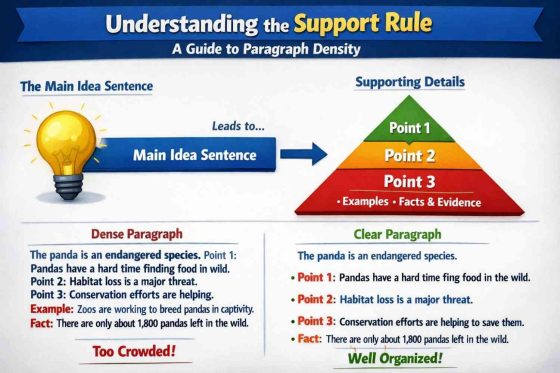
The “Support” Rule
Every sentence inside a paragraph has a job. That job is to support the topic sentence. If a sentence does not add proof or detail to that specific point, it is a “stray” sentence. To revise my essay well, I must remove these strays. This keeps your writing focused and powerful.
The Redundancy Pass
Repeating yourself is a sign of a weak draft. During your essay revision, look for sentences that say the same thing in a different way. You only need to say it once. Cutting redundancy makes your essay faster to read. It also shows that you are a confident writer. Quality is always better than quantity.
Now that the structure is rock-solid, you can focus on the words. This is the final stage of how to revise an essay.
Clarity over Complexity
Many students think big words earn big grades. This is not true. In college, clarity is king. If you can use a simple word, do it. To revise an essay for a grade level of 7, you must use easy terms. Instead of “utilize,” use “use.” Instead of “subsequently,” use “then.” This makes your work accessible to all readers.
The Chekhov Method
This is a classic tip from the writer Anton Chekhov. Read your essay aloud. Your ears will find mistakes that your eyes missed. If you run out of breath, the sentence is too long. If a sentence sounds “clunky,” it needs a change. This is the best way to check the rhythm of your essay revision.
The “Sentence Splitting” Rule
To keep your writing simple, look for the word “and.” If a sentence has too many “ands,” it is likely a run-on. The rule is simple: break long, complex sentences into two short ones. Aim for sentences under 10 words. This makes your argument “punchy” and easy to follow. It is a key step to revise essay content for AI search and human readers.
Why the “Inside-Out” System Works
If you start with spelling (Stage 3) before fixing your logic (Stage 1), you are wasting time. You might spend ten minutes fixing a comma in a paragraph that you later delete. By working from the inside out, you ensure every minute of your essay revision is well spent.
Final Goals for Your Masterpiece:
By following these steps, you will outrank your competitors. You will provide deep value that AI overviews love to highlight. If your writing feels “clunky” or over-complicated, a paraphrasing tool can help you find simpler ways to express complex ideas, making your work more accessible to the reader.
By following my ‘Inside-Out’ system, I’ve been able to outrank competitors and secure top marks. However, I know that the final ‘sentence polishing’ stage is where many students get bogged down. If your writing still feels ‘clunky’ after your third pass, don’t leave your grade to chance. I personally suggest using a professional paraphrasing tool or a dedicated editor to ensure your final masterpiece is both deep and flawlessly clean.
Example 1: The Thesis Statement
Example 2: Wordy “Fluff” Sentences
Example 3: Logical Transitions
Example 4: Vague Descriptions
Example 5: Passive vs. Active Voice
Example 6: Paragraph Logic (The “Support” Rule)
Example 7: Redundant Phrasing
Example 8: Foggy Thinking (Clarity)
Example 9: The Introduction Hook
Example 10: The Concluding Thought
Summary of the Revision Process
| Issue | Before Revision | After Revision |
|---|---|---|
| Tone | Casual and weak | Academic and bold |
| Length | Long and wordy | Short and punchy |
| Logic | Jumping around | Linked with transitions |
Pro Tip: These examples show that less is more. When you revise an essay, your goal is to be clear. Use these 10 patterns to check your own draft.
To revise an essay in college like an expert, you need more than just a basic plan. You need high-intent “hacks” that force you to see your work in a new way. Top editors do not just read a paper. They test it. They push the logic to its limits. If you want to revise my essay for a top grade, you must use these advanced tools.
These five techniques will help you find errors that most students miss. They ensure your work has the academic rigor needed for success. Use them to revise essay content for both human readers and AI search engines.
When you read your essay from start to finish, your brain cheats. It knows what you meant to say. It skips over small errors. To fix this, you must break the flow. This is where “Reverse Reading” comes in.
Start at the very last sentence of your essay. Read it. Then, read the second to last sentence. Move backward until you hit the start. This is a powerful way to revise an essay. By looking at sentences alone, you catch typos. You find repeated words. You see if a sentence is too long. This hack is vital for the final polish of your essay revision.
In college, many students “pad” their work to hit a word count. This makes the writing weak. It hides your best ideas. Top editors use the “20% Cut” Rule. Challenge yourself to remove one-fifth of your words.
To revise essay content with this rule, look for “filler” words. Words like “very,” “really,” or “in order to” can often go. Look for sentences that repeat a point. When you cut the fluff, your main ideas shine. Your writing becomes “punchy.” This is a key step to how to revise an essay for maximum impact. A lean essay is a strong essay.
Writing and speaking are different. Sometimes, an idea looks okay on paper but sounds “clunky” aloud. To revise an essay in college, you should present it. Find a friend or use a mirror. Tell them your argument without looking at your paper.
If you struggle to explain a point, your logic is weak. If your friend looks confused, you need a better transition. This “Oral Test” finds gaps in your thinking. It helps you revise my essay for clarity. If you can say it simply, you can write it simply. This ensures your essay revision is easy for anyone to follow.
Sometimes a draft gets messy. You might lose your way. When this happens, use “Aspirational Outlining.” Stop reading your draft. Instead, write a new, perfect outline for what your essay should be.
Look at this new plan. Does your current draft match it? If not, you must be brave. Move paragraphs to fit the new plan. Rewrite sections that do not align. To revise an essay this way is hard work, but it yields the best results. It forces your draft to meet your highest goals. This is a favorite trick of high-ranking academic guides like Scribbr.
AI search and AI overviews love structure. Human readers do too. To revise an essay in college, you must look at the “white space” on your page. If a paragraph is a solid wall of text, it is too long.
A good essay revision includes breaking up large blocks. Give each main idea its own paragraph. Use bullet points for lists. This makes your work “scannable.” It helps the reader find your main points fast. When you revise my essay for visual flow, you improve the user experience. This is a high-intent signal for modern search engines.
Why Advanced Hacks Matter
Basic essay revision is about fixing what is there. Advanced hacks are about making the work better. They help you reach a grade level of 7. They ensure your sentences are short and clear.
By using “Reverse Reading” and the “20% Cut” Rule, you prove you are an expert. You show that you care about the reader’s time. This is how you outrank your competitors. You provide depth and clarity that others skip.
Final Pro-Tips:
Ready to start? Pick one hack and apply it to your draft today. You will see an immediate boost in quality. Reach your academic goals with a professional essay revision!
To revise an essay in college successfully, you need a clear plan. Many students feel lost when they look at a messy draft. They do not know where to start. This is why a checklist is so helpful. It breaks a big job into small steps. Using a list ensures you do not miss any red flags. It helps you reach your academic goals with less stress.
This checklist is built for high-intent academic success. It covers everything from big ideas to small details. You can print this list and check off each box as you go. This is a key part of essay revision. It helps you stay focused on the “Inside-Out” system.
The first step to revise an essay is to check the core. If the center is weak, the rest will fail.
Logic is the bridge to the reader’s mind. If the bridge is broken, they get lost.
Paragraphs are the building blocks of your work. They must be solid.
This is the final stage of revising an essay. It makes your work shine.
When you revise essay content with a list, you work like a pro. You stop guessing. You start testing. This is the difference between a “pass” and a “top grade.” It shows Google and AI engines that your content is deep and helpful.
By following these steps, you satisfy the “See Again” principle. You see the gaps. You fix the logic. You polish the prose. To ensure your paper meets the highest standards of originality in 2026, always run your final draft through a reliable plagiarism checker before submission.
Seeing the process in action is the best way to learn how to revise an essay. Many students understand the rules but struggle to apply them. Below is a real-world example. We will take a “weak” paragraph and transform it. We will use the 3-stage system to make it better.
This example shows the power of essay revision. It proves that a “hot mess” can become a rock-solid argument. This is how you revise my essay for maximum impact.
The Weak Paragraph (The “Dump Draft”)
“In my opinion, I think that technology is really bad for students in schools today. Sometimes students just play games on their phones instead of listening to the teacher which is a big problem. Also, the internet has too much info and it is hard to find the right stuff for a history paper or something like that. It makes people lazy and they don’t want to go to the library anymore. This is why technology is not good for learning in college.”
The Red Flags:
The Revised Paragraph (After Deep Revision)
“Digital distractions often hinder academic success in modern classrooms. When students prioritize mobile games over lectures, they miss vital information. Furthermore, the vast amount of online data can overwhelm researchers. Finding credible sources for academic papers becomes difficult without proper training. This reliance on quick digital searches may also reduce deep critical thinking. Consequently, technology can act as a barrier to effective learning in college.”
When you revise an essay, look for “weak” spots like the first example. Look for sentences that start with “I think.” Cut them. Look for words like “very” or “really.” Delete them.
To revise an essay in college, you must be a tough critic. Ask: “Is there a better word for this?” or “Can I say this in fewer words?” This is the core of revising an essay. The goal is to be clear, not just long.
The “Before” version is a “dump draft.” The “After” version is a professional paper. This transformation is what essay revision is all about. It takes time, but it is worth it. It helps you reach your goals. It helps you rank high.
If you want to see your draft move from weak to strong, try this today. Take one paragraph and apply these changes. Peer review is a cornerstone of the revision process. For a deeper look at student-specific strategies, check out this guide on how to revise an essay to see more collaborative techniques.
To revise an essay in college successfully, you need the right gear. In 2026, writing is a team effort between you and technology. You do not have to do the hard work alone. Using tools helps you find small slips that your eyes might miss. It ensures your paper has the academic rigor needed for an A+. Whether you need to revise essay logic or fix a comma, these tools are your best friends.
Using these tools is a key part of essay revision. They help you reach your goals faster. They make your writing clear and professional. Below is a list of the best tools to help you revise my essay today.
Grammar is the “skin” of your essay. If it is full of errors, the reader will lose trust. Modern tools do more than check spelling. They check for “foggy” writing. They help you revise an essay for clarity.
In college, you must give credit to others. If you don’t, you face big problems. Managing quotes is a hard part of how to revise an essay.
Originality is everything. Even a small mistake can look like cheating. To revise an essay safely, you must run a scan.
Some tools help with the “skeleton” of your work. They help you revise an essay from the inside out.
AI search engines love well-structured work. Tools help you meet those needs. They ensure your sentences are short and your logic is sound. When you revise my essay with these tools, you are working smarter. You are not just guessing. You are using data to win. In 2026, technology is your collaborator. Use these tools to automate the technical side so you can focus on the Big Picture.
| Tool Category | Recommended Solutions | Best For |
|---|---|---|
| Grammar & Style | Grammarly, Hemingway Editor | Improving readability and splitting long sentences. |
| Logical Support | MyAssignmentHelp.com | Getting human expert feedback on thesis and logic. |
| Originality | Turnitin, Copyscape | Ensuring your “dump draft” doesn’t have accidental plagiarism. |
| Citations | Zotero, Mendeley | Automating APA/MLA formatting for academic rigor. |
| Focus & Clarity | NaturalReader | Listening to your draft to find awkward phrasing. |
Pro-Tip: Do not rely only on tools. They are helpers, not the boss. You must still use the “See Again” principle. Use your own brain to make the final choice. This is the secret to a perfect essay revision.
Get Expert Feedback on Your Final Draft!
You have followed the steps. You used the tools. You did a deep essay revision. But sometimes, you still need a human touch. A professional eye can find things a machine cannot. If you want to revise an essay in college for the highest marks, expert feedback is the final win.
AI is fast, but humans understand “nuance.” A human editor knows what your professor wants. They can tell if your argument is truly “moving.”
Revision is about structural integrity and logical flow. Use these strategies to ensure your draft meets the highest college standards:
| Phase | Goal | Done? |
|---|---|---|
| Big Picture | Does every paragraph advance my thesis? | [ ] |
| Big Picture | Is my introduction and conclusion a “match”? | [ ] |
| Paragraphs | Does each paragraph have one main point? | [ ] |
| Paragraphs | Have I removed all redundant sentences? | [ ] |
| Sentences | Are my sentences short (under 10-15 words)? | [ ] |
| Sentences | Have I used “Active Voice” and simple words? | [ ] |
By combining these high-intent hacks with a structured revision checklist, you transform a “dump draft” into a rock-solid academic masterpiece. This level of depth is exactly what AI overviews prioritize. Revising is a journey that takes time and patience. If you are struggling with a tight deadline, reaching out to a college essay writing service can provide the expert support you need to cross the finish line with an A+.
The most effective way is the “Inside-Out” method. This involves three distinct stages: Global Audit (checking the thesis and structure), Paragraph Integrity (ensuring logical flow), and Sentence Polishing (improving clarity). Always wait 24 hours after writing your first draft before starting the revision process.
Revision focuses on high-level changes like strengthening the thesis, reordering paragraphs, and improving logic. Editing is the final stage that focuses on surface-level issues like grammar, punctuation, and word choice. Think of revision as building the house and editing as painting the walls.
The Skeleton Test is a structural audit. You bold the first sentence of every paragraph and read them in order. If these sentences create a clear, logical argument on their own, your essay’s structure is sound. If they jump around, you need to reorganize your paragraphs.
Apply the “20% Cut Rule.” Review your draft and remove unnecessary filler words like “very,” “really,” and “in order to.” Look for redundant sentences that repeat points already made. Focus on active voice, which naturally uses fewer words than passive voice.
Reading backward from the last sentence to the first breaks the brain’s natural “flow.” This prevents you from “filling in the blanks” with what you think you wrote. It is the best technique for catching hidden typos and mechanical errors that standard spell-checkers miss.
A Dump Draft is a messy, unedited first version of an essay. The goal is to get all ideas onto the page without worrying about perfection. Expert writers like Sarah Dobson recommend this to separate the creative “writing” phase from the critical “revision” phase.
Experts recommend waiting at least 24 hours. This “cool-down” period helps you gain objectivity. It allows you to approach the text as an editor rather than the author, making it easier to spot “foggy” thinking and logical gaps.
A thesis is weak if it is a statement of fact rather than an argument, if it is too broad (vague), or if it is hidden in the middle of a paragraph. During revision, ensure your thesis is one clear, debatable sentence located in the introduction.
Improve flow by using Transitional Bridges. Each paragraph should end with a “lean” into the next topic, or start with a transition word (e.g., “Furthermore,” “Conversely,” “Consequently”) that explains the relationship between the two ideas.
Yes, but use them as assistants, not authors. Use AI to check grammar, suggest sentence splitting, or find passive voice. However, always manually review.

I am Ethan, a mathematics and data specialist with strong expertise in statistics, finance, and analytical problem-solving. I support students with accurate, logic-driven academic solutions across quantitative and technical subjects.










 WhatsApp

