


 31 December,2025

Table of Contents
The conclusion is the final paragraph of your essay, but its importance goes far beyond simply ending your writing. A strong conclusion reinforces your argument, highlights its significance, and leaves a lasting impression on the reader.
Many students struggle with how to write a conclusion for an essay because it requires balance—summarising ideas without repetition and ending confidently without introducing new points. Writing a strong ending is easier when you understand the overall essay structure and how each section connects. This guide breaks the process down step by step, using examples, tables, and practical tips to help you write effective essay conclusions every time.
A conclusion in an essay is the final paragraph that wraps up your discussion and brings closure to your argument. It connects your ideas to a broader meaning and helps readers clearly understand the value of what they have read. By using our AI to write essay tasks, you ensure a clear, well-structured, and plagiarism-free foundation.
A well-written conclusion:
Rather than repeating content, it elevates your essay.
Tip: Think of the conclusion as your final conversation with the reader—concise, meaningful, and memorable. If you have a thesis to prepare, take expert thesis help tips.
The conclusion matters because it:
A weak conclusion can make even a strong essay feel incomplete, while a clear and structured conclusion can elevate your entire paper. If you need a proper conclusion for a report, take report writing services.
Rephrase your thesis statement without copying it word for word. This reminds the reader of your central argument.
Tip: Use different wording but keep the same meaning.
Briefly revisit the main ideas discussed in the body paragraphs. Focus on patterns or insights, not details.
Show why your ideas are important. This could relate to real-world relevance, academic significance, or future implications.
Link your topic to a larger theme, question, or takeaway. This gives depth to your conclusion.
Finish with a memorable statement—this could be a reflection, a call to action, or a thought-provoking idea.
Tip: Avoid phrases like “In conclusion” unless required by your instructor. Since conclusions revisit the core argument, learning how to craft a strong thesis statement or comparative essay example can make your ending more impactful.
Starting a conclusion effectively sets the tone for your final message.
Summarizing final thoughts differs depending on your field of study. Studying how to write a conclusion for an english literature essay helps you avoid simple repetition and highlights the lasting value of your argument.
| Purpose | Transition Words |
| Summarising | Overall, in summary, in essence |
| Cause & effect | Therefore, as a result, consequently |
| Emphasising importance | More importantly, undoubtedly |
| Final thought | Ultimately, in closing |
| Call to action | With this in mind, in light of this |
The ideal length depends on the essay length.
Tip: A conclusion is usually 10–15% of the total essay length. Ending your essay with a story that mirrors your opening is a powerful technique, and knowing how to use a personal anecdote can give your conclusion a lasting emotional impact.
Essay conclusion: Social media helps students stay connected and informed while providing immediate access to valuable learning resources. However, balancing these benefits requires a clear understanding of the genre; for instance, learning how to start a response essay example can help students critically analyze their own digital habits.
Ultimately, too much screen time reduces focus and affects mental health, causing academic performance to suffer. When used in moderation, social media can support learning, but without firm limits, its disadvantages outweigh the benefits.
See how this conclusion includes the key elements of a strong ending:
Restatement of the thesis The thesis is restated in the sentence:
“Social media helps students stay connected and informed.”
This reminds the reader of the main topic discussed in the essay.
Review of the main points The sentence:
“Too much screen time reduces focus and affects mental health.”
This briefly summarises the key drawback discussed in the essay body.
Reflection on the significance The statement:
“Academic performance can suffer.”
This shows why the topic matters to students.
Final thought The final thought is:
“Without limits, its disadvantages outweigh the benefits.”
This leaves the reader with a clear judgment.
Essay conclusion: Environmental conservation protects natural resources. It helps maintain ecological balance.
Reducing pollution and preserving biodiversity support long-term sustainability.
Actions taken today will shape the quality of life for future generations.
See how this conclusion uses a clear structure:
Restatement of the thesis The thesis is restated in the sentence:
“Environmental conservation protects natural resources.”
This clearly reminds the reader of the essay’s main argument.
Review of the main points The sentence:
“Reducing pollution and preserving biodiversity support long-term sustainability.”
This summarises the key ideas discussed in the essay.
Reflection on the significance The significance is shown in the sentence:
“Actions taken today will shape the quality of life for future generations.”
This highlights the long-term importance of the topic.
Final thought The final thought encourages responsibility for future outcomes.
Understanding the difference between a weak and a strong conclusion helps you avoid vague endings and create a more impactful final paragraph.
“This essay talked about climate change.”
Why this is weak:
“This essay demonstrated how climate change directly affects global ecosystems and human survival.”
Why this is strong:
A strong conclusion doesn’t just say what the essay was about—it reminds the reader why it matters and reinforces the main message in a clear, purposeful way.
A well-written conclusion strengthens your argument and leaves your reader with a clear takeaway. The following practical tips will help you write a more effective and polished ending.
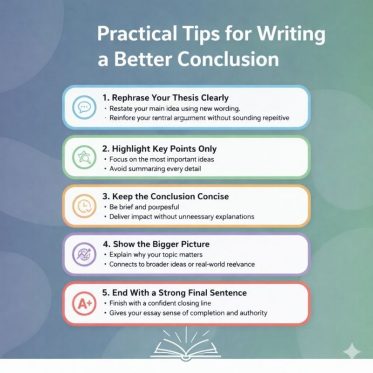
Restate your main idea using new wording to reinforce your central argument without sounding repetitive.
Focus on the most important ideas from your essay rather than summarising every detail discussed earlier.
A strong conclusion is brief and purposeful, delivering impact without unnecessary explanations.
Explain why your topic matters and how your argument connects to broader ideas or real-world relevance.
Finish with a confident closing line that gives your essay a sense of completion and authority.
Understanding what to include—and what to avoid—can make the difference between a weak ending and a powerful conclusion. Use the table below as a quick reference while writing your final paragraph.
| Do’s ✅ | Don’ts ❌ |
| Restate your main idea using fresh wording | Repeat your entire introduction or body paragraphs |
| Briefly summarise key arguments or findings | Introduce new arguments, evidence, or examples |
| Highlight why your topic or argument matters | Drift away from your original thesis |
| Keep the tone aligned with your audience and essay purpose | Use generic phrases or overused expressions |
| End with a clear, confident final sentence | End suddenly without a sense of closure |
| Maintain clarity and conciseness | Add unnecessary explanations or filler sentences |
Pro Tip: A strong conclusion should feel intentional, not rushed. If your reader can clearly recall your main idea and understand its importance after reading the final paragraph, your conclusion has done its job well.
Use this template for informative or explanatory essays where the goal is to summarise key points without taking a strong position.
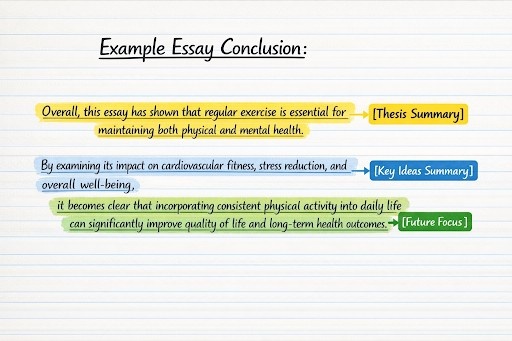
Template: Overall, this essay has shown that [restate thesis]. By examining [key ideas], it becomes clear that [final insight or takeaway].
When to use:
Example: The Benefits of Regular Exercise
Overall, this essay has shown that regular exercise is essential for maintaining both physical and mental health. By examining its impact on cardiovascular fitness, stress reduction, and overall well-being, it becomes clear that incorporating consistent physical activity into daily life can significantly improve quality of life and long-term health outcomes.
This template is ideal for argumentative or persuasive essays where you must clearly support a position.
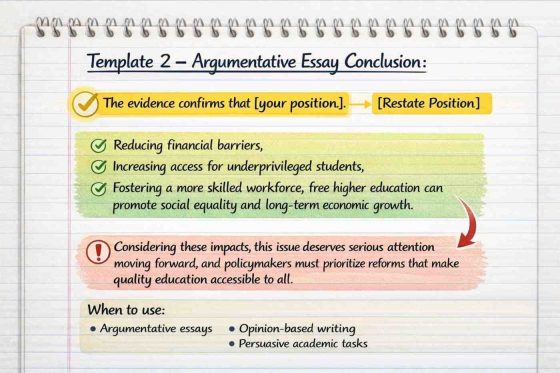
Template: The evidence confirms that [your position]. Considering its impact, this issue deserves serious attention moving forward.
When to use:
Example: Should college education be free for everyone?
The evidence confirms that college education should be free for everyone. By reducing financial barriers, increasing access for underprivileged students, and fostering a more skilled workforce, free higher education can promote social equality and long-term economic growth. Considering these impacts, this issue deserves serious attention moving forward, and policymakers must prioritize reforms that make quality education accessible to all.
When you buy a persuasive essay paper, it helps to keep your conclusion concise, avoid introducing new arguments, and ensure it clearly reflects the purpose of your essay.
Effective endings can include:
Tip: Match the ending style with the essay’s purpose.
If you want expert guidance to ensure clarity, structure, and academic tone, professional essay support can help refine your conclusion and overall paper quality. After writing your conclusion, reviewing it for clarity and flow through essay editing and proofreading can significantly improve the quality.
Expert assistance helps you refine arguments, improve flow, and create a conclusion that stands out.
Writing a strong conclusion is about more than ending an essay—it’s about reinforcing your message and giving your reader a clear sense of closure. By restating your main idea, highlighting key points, and finishing with purpose, you can turn your conclusion into one of the most impactful parts of your writing.
Ans: An essay conclusion should restate the main idea, briefly summarise key arguments, and end with a clear, meaningful final sentence. It should reinforce your message without adding new information.
Ans: In most cases, a conclusion is 3–5 sentences long. Longer essays may require slightly more detail, but clarity and conciseness are always more important than length.
Ans: You can start a conclusion by rephrasing your thesis, using a summarising phrase, or smoothly transitioning from your final body paragraph without repeating the introduction.
Ans: No. A conclusion should not introduce new arguments, evidence, or examples. Its purpose is to wrap up and reinforce what has already been discussed.
Ans: A good conclusion is clear, focused, and purposeful. It connects back to the main argument, shows why the topic matters, and leaves the reader with a strong final impression.










 WhatsApp

